Castillo Daniel, Raya-González Javier, Sarmento Hugo, Clemente Filipe Manuel, Yanci Javier
Faculty of Health Sciences, Universidad Isabel I, Burgos, Spain.
University of Coimbra, Research Unit for Sport and Physical Activity. Faculty of Sport Sciences and Physical Education, Coimbra, Portugal.
Biol Sport. 2021 Jun;38(2):291-299. doi: 10.5114/biolsport.2021.99325. Epub 2020 Oct 22.
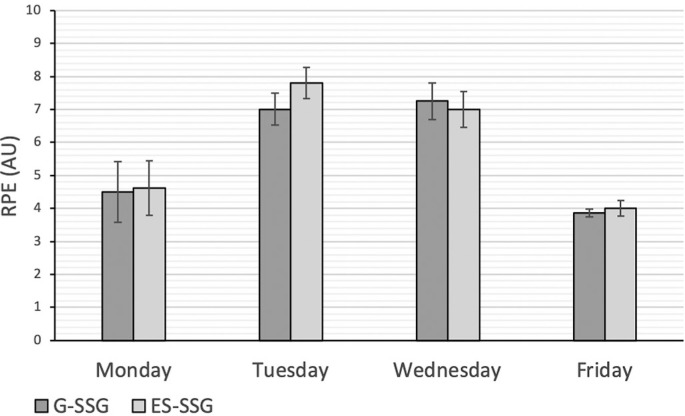
The main aim of this study was to analyse the effects of including additional speed and endurance sessions during small-sided games (SSG) training periodization on physical fitness in professional soccer players. Sixteen outfield players (age = 25.6 ± 7.6 years) who competed in the First Division of a European League participated in this study. Players were randomly assigned to perform only the SSG periodization (G-SSG group) or to add endurance and speed training contents to the SSG (ES-SSG group). Before and after the 6-week experimental period, a Yo-Yo Intermittent Recovery Test level 1 (YYIR1) and a 40 m sprinting test were performed. Rating of perceived exertion (RPE) was also measured after each training session. The G-SSG group showed a large improvement in the YYIR1 performance (p = 0.018-0.028; ES = 0.521-0.576) after the training programme, whereas no significant changes were observed for the ES-SSG group (p = 0.763-1.000; ES = 0.000-0.014). In addition, no significant differences (p > 0.05, ES = 0.005-361, trivial to small) in sprint performance at 5 and 10 m intervals up to 40 m were observed at post-training in comparison to pre-training evaluation in G-SSG and ES-SSG groups. No significant differences (p > 0.05) between groups were observed at baseline in the YYIR1 test. The 6-week SSG training supported with only six endurance and speed training sessions was no more effective than well-organized SSG alone for improving running endurance in professional soccer players.
本研究的主要目的是分析在小场地比赛(SSG)训练周期中增加额外的速度和耐力训练课对职业足球运动员体能的影响。16名参加欧洲联赛甲级联赛的非守门员球员(年龄 = 25.6 ± 7.6岁)参与了本研究。球员被随机分配为仅进行SSG训练周期(G - SSG组)或在SSG训练中增加耐力和速度训练内容(ES - SSG组)。在为期6周的实验期前后,进行了Yo - Yo间歇恢复测试1级(YYIR1)和40米短跑测试。每次训练课后还测量了主观用力感觉(RPE)。训练计划结束后,G - SSG组的YYIR1成绩有显著提高(p = 0.018 - 0.028;ES = 0.521 - 0.576),而ES - SSG组未观察到显著变化(p = 0.763 - 1.000;ES = 0.000 - 0.014)。此外,与训练前评估相比,G - SSG组和ES - SSG组在训练后40米内5米和10米间隔的短跑成绩上未观察到显著差异(p > 0.05,ES = 0.005 - 361,微小至小)。在YYIR1测试的基线时,两组之间未观察到显著差异(p > 0.05)。仅辅以六次耐力和速度训练课的6周SSG训练,对于提高职业足球运动员的跑步耐力并不比精心组织的单独SSG训练更有效。