Partners Connected Health Innovation, Partners HealthCare, 25 New Chardon St., Suite 300, Boston, MA, 02114, USA.
Research and Development Group, Hitachi, Ltd, Tokyo, Japan.
BMC Med Inform Decis Mak. 2018 Jun 22;18(1):44. doi: 10.1186/s12911-018-0620-z.
Heart failure is one of the leading causes of hospitalization in the United States. Advances in big data solutions allow for storage, management, and mining of large volumes of structured and semi-structured data, such as complex healthcare data. Applying these advances to complex healthcare data has led to the development of risk prediction models to help identify patients who would benefit most from disease management programs in an effort to reduce readmissions and healthcare cost, but the results of these efforts have been varied. The primary aim of this study was to develop a 30-day readmission risk prediction model for heart failure patients discharged from a hospital admission.
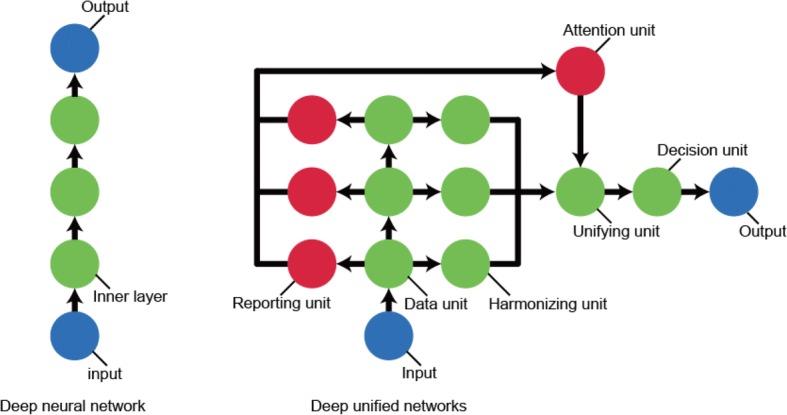
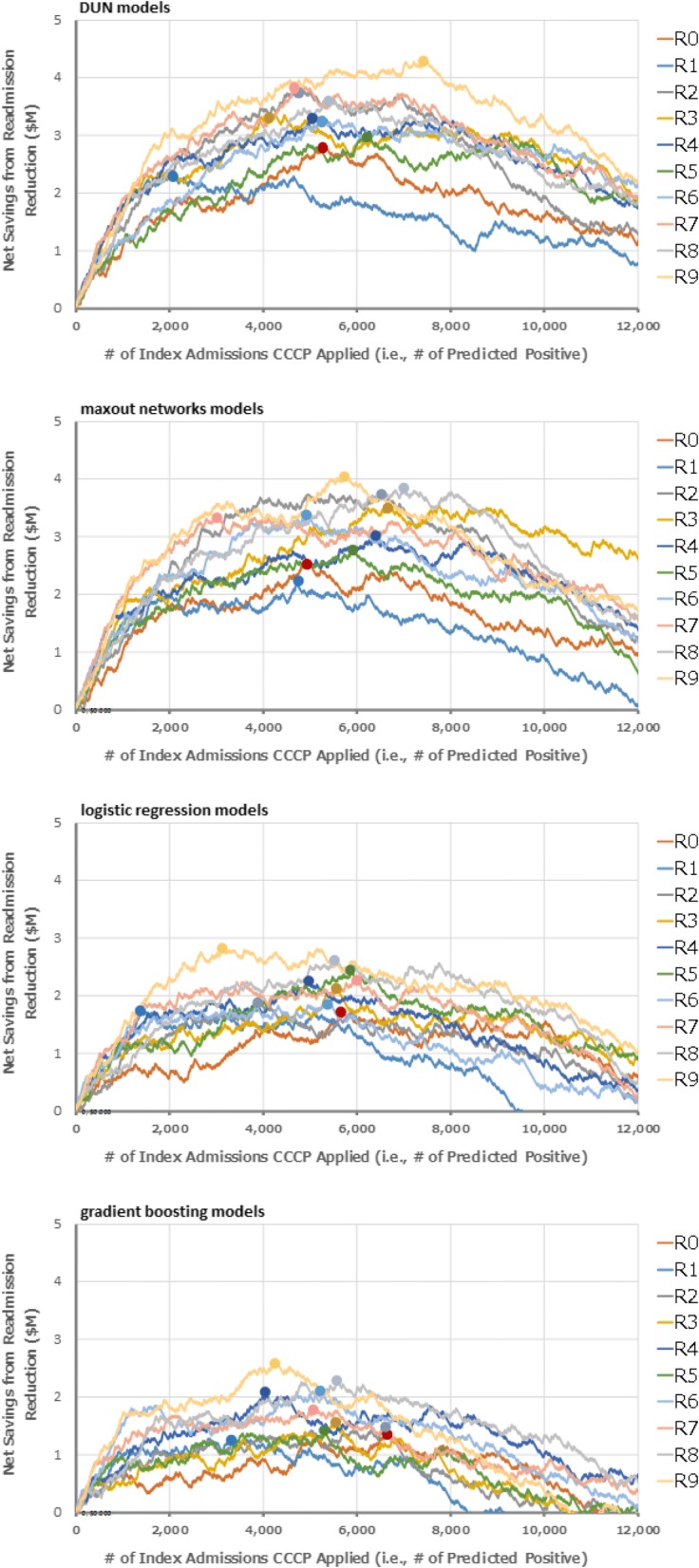
We used longitudinal electronic medical record data of heart failure patients admitted within a large healthcare system. Feature vectors included structured demographic, utilization, and clinical data, as well as selected extracts of un-structured data from clinician-authored notes. The risk prediction model was developed using deep unified networks (DUNs), a new mesh-like network structure of deep learning designed to avoid over-fitting. The model was validated with 10-fold cross-validation and results compared to models based on logistic regression, gradient boosting, and maxout networks. Overall model performance was assessed using concordance statistic. We also selected a discrimination threshold based on maximum projected cost saving to the Partners Healthcare system.
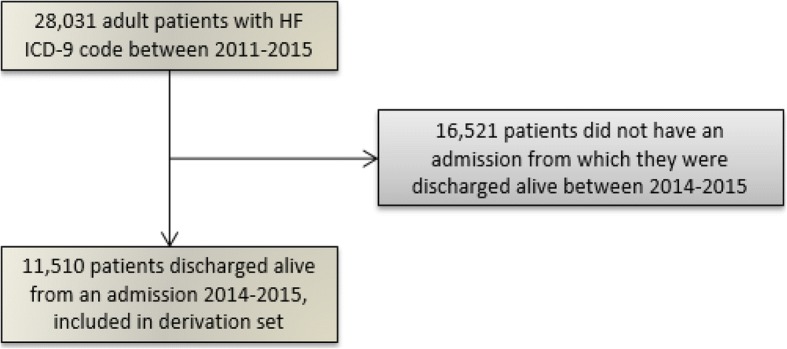
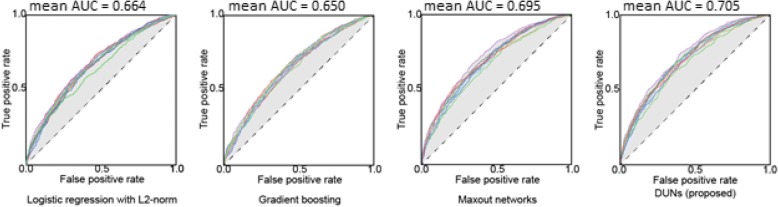
Data from 11,510 patients with 27,334 admissions and 6369 30-day readmissions were used to train the model. After data processing, the final model included 3512 variables. The DUNs model had the best performance after 10-fold cross-validation. AUCs for prediction models were 0.664 ± 0.015, 0.650 ± 0.011, 0.695 ± 0.016 and 0.705 ± 0.015 for logistic regression, gradient boosting, maxout networks, and DUNs respectively. The DUNs model had an accuracy of 76.4% at the classification threshold that corresponded with maximum cost saving to the hospital.
Deep learning techniques performed better than other traditional techniques in developing this EMR-based prediction model for 30-day readmissions in heart failure patients. Such models can be used to identify heart failure patients with impending hospitalization, enabling care teams to target interventions at their most high-risk patients and improving overall clinical outcomes.
心力衰竭是美国住院的主要原因之一。大数据解决方案的进步使得对大量结构化和半结构化数据(如复杂的医疗保健数据)的存储、管理和挖掘成为可能。将这些进展应用于复杂的医疗保健数据,已经开发出风险预测模型,以帮助识别最受益于疾病管理计划的患者,从而降低再入院率和医疗保健成本,但这些努力的结果各不相同。本研究的主要目的是为从医院出院的心力衰竭患者开发 30 天再入院风险预测模型。
我们使用大型医疗保健系统内心力衰竭患者的纵向电子病历数据。特征向量包括结构化的人口统计学、利用和临床数据,以及从临床医生撰写的笔记中选择的非结构化数据的摘录。使用深度统一网络(DUN)开发风险预测模型,DUN 是一种新的网格状深度学习网络结构,旨在避免过度拟合。该模型使用 10 折交叉验证进行验证,并与基于逻辑回归、梯度提升和 maxout 网络的模型进行比较。使用一致性统计量评估整体模型性能。我们还根据对 Partners Healthcare 系统的最大预期成本节约选择了一个判别阈值。
使用 11510 名患者的 27334 次入院和 6369 次 30 天再入院的数据来训练模型。经过数据处理,最终模型包括 3512 个变量。DUNs 模型在 10 折交叉验证后表现最佳。预测模型的 AUC 分别为 0.664±0.015、0.650±0.011、0.695±0.016 和 0.705±0.015,逻辑回归、梯度提升、maxout 网络和 DUNs 分别为 0.664±0.015、0.650±0.011、0.695±0.016 和 0.705±0.015。DUNs 模型在对应于医院最大成本节约的分类阈值下的准确率为 76.4%。
与其他传统技术相比,深度学习技术在开发基于 EMR 的心力衰竭患者 30 天再入院预测模型方面表现更好。此类模型可用于识别即将住院的心力衰竭患者,使护理团队能够将干预措施针对高危患者,从而改善整体临床结果。