Cavendish Laboratory, University of Cambridge, JJ Thomson Avenue, Cambridge, CB3 0HE, UK.
Center for Biophysics and Quantitative Biology, University of Illinois at Urbana-Champaign, 1110 West Green Street, Urbana, IL, 61801, USA.
Nat Commun. 2018 Jun 21;9(1):2426. doi: 10.1038/s41467-018-04821-5.
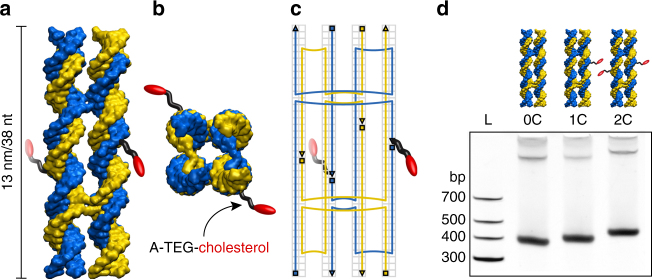
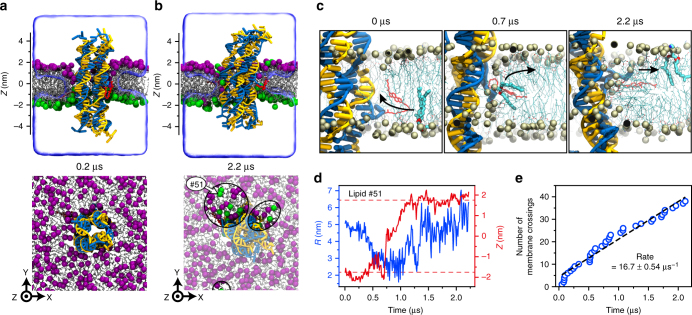
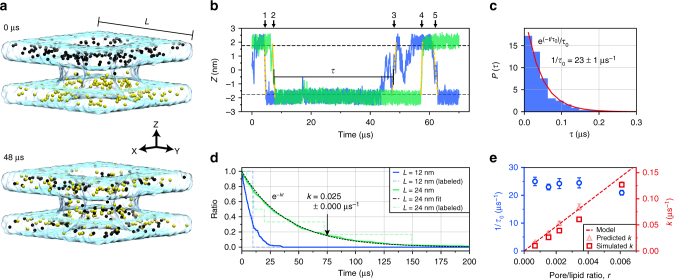
Mimicking enzyme function and increasing performance of naturally evolved proteins is one of the most challenging and intriguing aims of nanoscience. Here, we employ DNA nanotechnology to design a synthetic enzyme that substantially outperforms its biological archetypes. Consisting of only eight strands, our DNA nanostructure spontaneously inserts into biological membranes by forming a toroidal pore that connects the membrane's inner and outer leaflets. The membrane insertion catalyzes spontaneous transport of lipid molecules between the bilayer leaflets, rapidly equilibrating the lipid composition. Through a combination of microscopic simulations and fluorescence microscopy we find the lipid transport rate catalyzed by the DNA nanostructure exceeds 10 molecules per second, which is three orders of magnitude higher than the rate of lipid transport catalyzed by biological enzymes. Furthermore, we show that our DNA-based enzyme can control the composition of human cell membranes, which opens new avenues for applications of membrane-interacting DNA systems in medicine.
模拟酶的功能并提高天然进化蛋白质的性能是纳米科学中最具挑战性和趣味性的目标之一。在这里,我们利用 DNA 纳米技术设计了一种合成酶,其性能远远超过其生物原型。我们的 DNA 纳米结构由仅 8 条链组成,通过形成连接膜内叶和外叶的环形孔,自发插入生物膜中。这种膜插入催化脂质分子在双层叶之间的自发运输,迅速平衡脂质组成。通过微观模拟和荧光显微镜的组合,我们发现 DNA 纳米结构催化的脂质运输速率超过每秒 10 个分子,比生物酶催化的脂质运输速率高三个数量级。此外,我们还表明,我们的基于 DNA 的酶可以控制人细胞膜的组成,这为膜相互作用的 DNA 系统在医学中的应用开辟了新的途径。