Espejo Romilio T, Plaza Nicolás
Institute of Nutrition and Food Technology, Universidad de Chile, Santiago, Chile.
Centro de Investigación Biomédica, Facultad de Ciencias de la Salud, Instituto de Ciencias Biomédicas, Universidad Autónoma de Chile, Santiago, Chile.
Front Microbiol. 2018 Jun 8;9:1232. doi: 10.3389/fmicb.2018.01232. eCollection 2018.
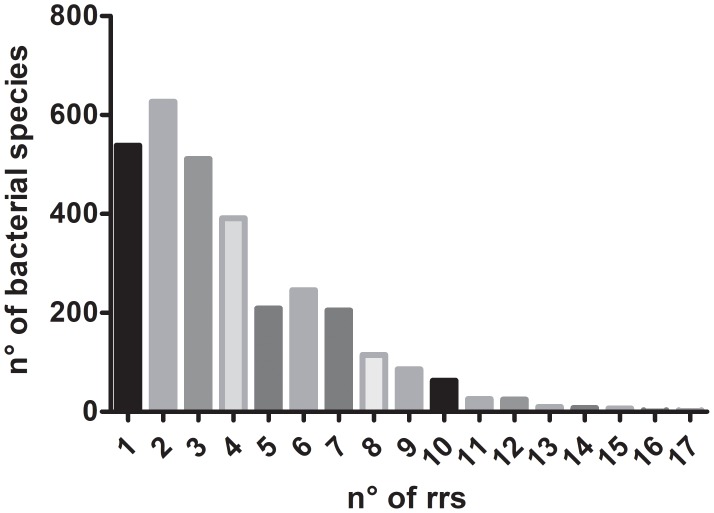
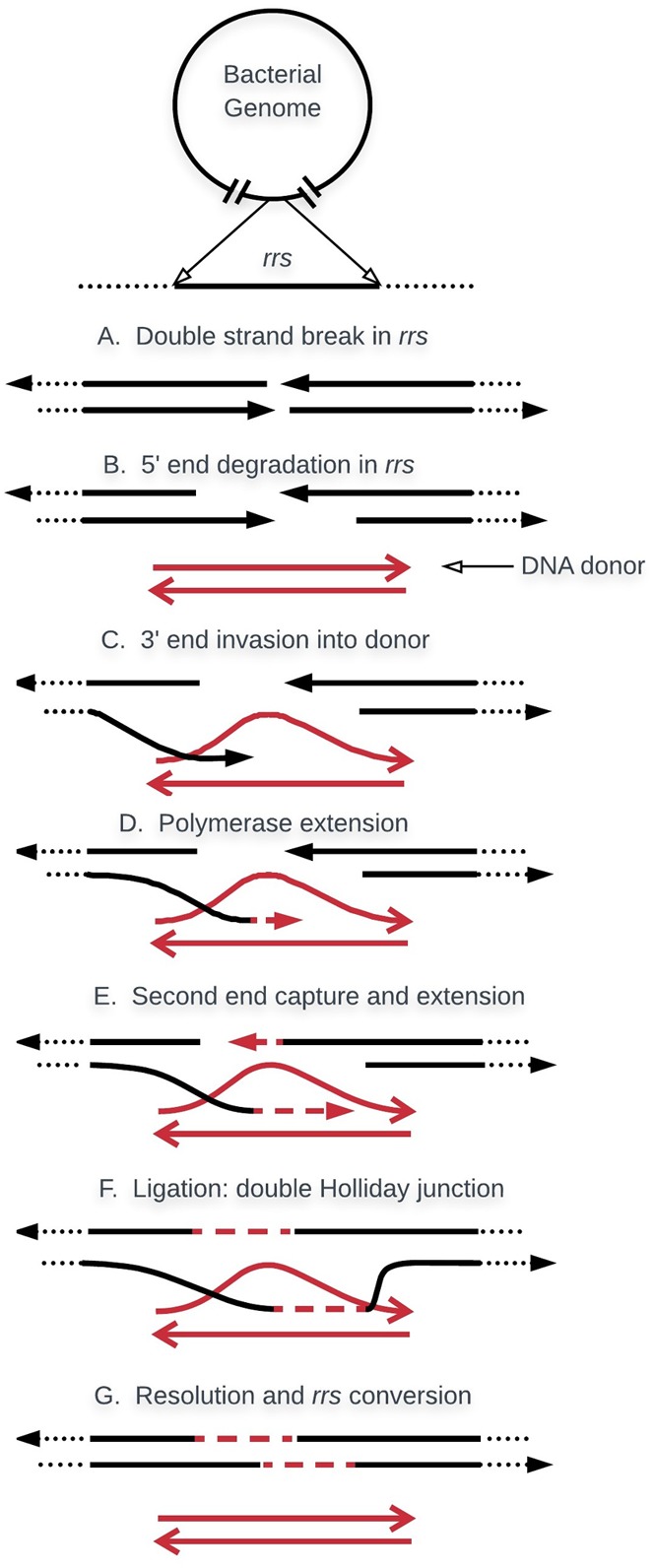
Bacterial species differ greatly in the number and location of the rRNA operons which may be present in the bacterial chromosomes and plasmids. Most bacterial species contain more than one ribosomal RNA operon copy in their genomes, with some species containing up to 15 such copies. We review the number and location of the rRNA operons and discuss evolution of 16S rRNA () genes -which are considered as ultimate chronometers for phylogenetic classification- in bacteria with multiple copies of these genes. In these bacterial species, the genes must evolve in concert and sequence changes generated by mutation or horizontal gene transfer must be either erased or spread to every gene copy to avoid divergence, as it occurs when they are present in different species. Analysis of polymorphic sites in intra-genomic copies identifies putative conversion events and demonstrates that sequence conversion is patchy and occurs in small conversion tracts. Sequence conversion probably arises by a non-reciprocal transfer between two or more copies where one copy contributes only a small contiguous segment of DNA, whereas the other copy contributes the rest of the genome in a fairly well understood molecular process. Because concerted evolution implies that a mutation in any of the copies is either eliminated or transferred to every gene in the genome, this process should slow their evolution rate relative to that of single copy genes. However, available data on the genes in bacterial genomes do not show a clear relationship between their evolution rates and the number of their copies in the genome.
不同细菌物种的核糖体RNA操纵子在数量和位置上差异很大,这些操纵子可能存在于细菌染色体和质粒中。大多数细菌物种在其基因组中含有不止一个核糖体RNA操纵子拷贝,有些物种含有多达15个这样的拷贝。我们综述了核糖体RNA操纵子的数量和位置,并讨论了具有多个这些基因拷贝的细菌中16S rRNA()基因的进化,这些基因被认为是系统发育分类的终极计时仪。在这些细菌物种中,这些基因必须协同进化,由突变或水平基因转移产生的序列变化必须被消除或传播到每个基因拷贝,以避免分化,就像它们存在于不同物种中时发生的那样。对基因组内拷贝中的多态性位点进行分析,可以识别假定的转换事件,并表明序列转换是不连续的,发生在小的转换片段中。序列转换可能是由两个或多个拷贝之间的非互惠转移引起的,其中一个拷贝只贡献一小段连续的DNA片段,而另一个拷贝则在一个相当清楚的分子过程中贡献基因组的其余部分。由于协同进化意味着任何一个拷贝中的突变要么被消除,要么转移到基因组中的每个基因,这个过程应该会相对于单拷贝基因减缓它们的进化速度。然而,关于细菌基因组中基因的现有数据并没有显示出它们的进化速度与其在基因组中的拷贝数之间存在明确的关系。