Wang Dongdong, Wu Huihui, Zhou Jiajia, Xu Pengping, Wang Changlai, Shi Ruohong, Wang Haibao, Wang Hui, Guo Zhen, Chen Qianwang
Hefei National Laboratory for Physical Sciences at Microscale Department of Materials Science and Engineering University of Science and Technology of China Hefei AH 230026 P. R. China.
School of Life Sciences University of Science and Technology of China Hefei AH 230026 P. R. China.
Adv Sci (Weinh). 2018 Apr 14;5(6):1800287. doi: 10.1002/advs.201800287. eCollection 2018 Jun.
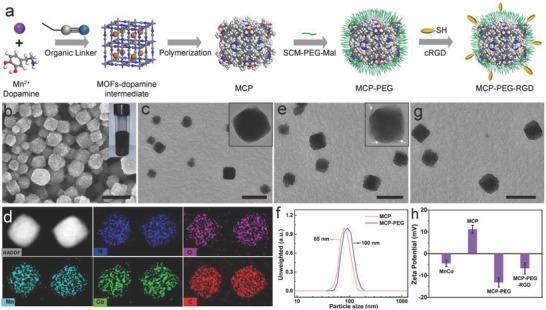
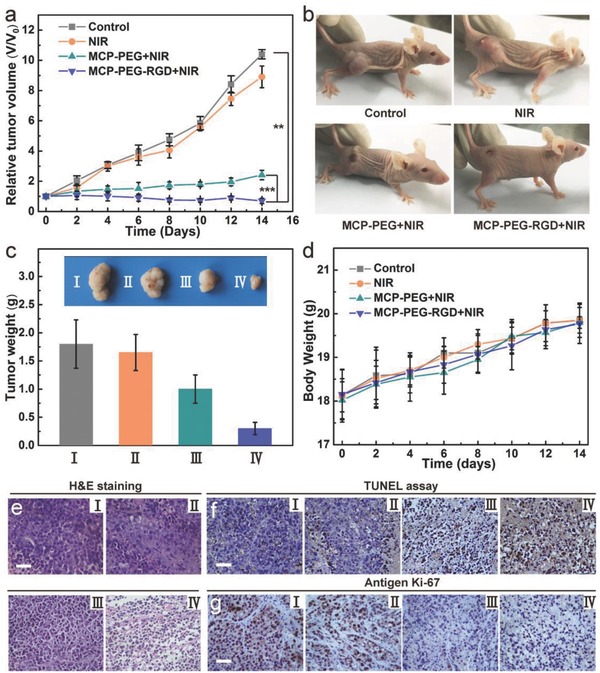
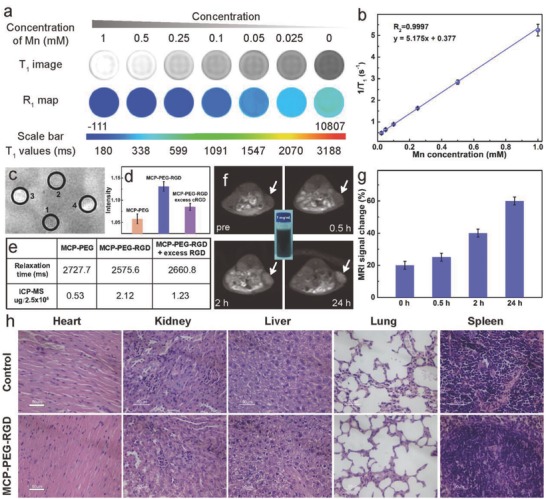
Herein, a simple one-pot way is designed to prepare a type of multifunctional metal-organic framework (MOF)-based hybrid nanogels by in situ hybridization of dopamine monomer in the skeleton of MnCo. The resultant hybrid nanoparticles (named as MCP) show enhanced photothermal conversion efficiency in comparison with pure polydopamine or MnCo nanoparticles (NPs) synthesized under a similar method and, therefore, show great potential for photothermal therapy (PTT) in vivo. The MCP NPs are expected to possess positive magnetic resonance imaging ability due to the high-spin Mn-N6 ( = 5/2) in the skeleton of MnCo. To improve the therapy efficiency as a PTT agent, the MCP NPs are further modified with functional polyethylene glycol (PEG) and thiol terminal cyclic arginine-glycine-aspartic acid peptide, respectively: the first one is to increase the stability, biocompatibility, and blood circulation time of MCP NPs in vivo; the second one is to increase the tumor accumulation of MCP-PEG NPs and improve their therapeutic efficiency as photothermal agent.
在此,设计了一种简单的一锅法,通过在MnCo骨架中原位杂交多巴胺单体来制备一种基于多功能金属有机框架(MOF)的杂化纳米凝胶。与通过类似方法合成的纯聚多巴胺或MnCo纳米颗粒(NPs)相比,所得的杂化纳米颗粒(命名为MCP)表现出更高的光热转换效率,因此在体内光热治疗(PTT)方面具有巨大潜力。由于MnCo骨架中的高自旋Mn-N6(I = 5/2),预计MCP NPs具有正磁共振成像能力。为了提高作为PTT剂的治疗效率,分别用功能性聚乙二醇(PEG)和硫醇末端环精氨酸-甘氨酸-天冬氨酸肽对MCP NPs进行进一步修饰:第一个是为了提高MCP NPs在体内的稳定性、生物相容性和血液循环时间;第二个是为了增加MCP-PEG NPs在肿瘤中的积累并提高其作为光热剂的治疗效率。