Institute of Animal Reproduction and Food Research of Polish Academy of Sciences, Department of Immunology and Food Microbiology, Olsztyn, Poland.
Non-Public Health Care Clinic of Allergy "ALLERGICA", Olsztyn, Poland.
PLoS One. 2018 Jun 26;13(6):e0198607. doi: 10.1371/journal.pone.0198607. eCollection 2018.
The study evaluates the impact of biopsychosocial factors involved in food allergy (FA) on the prevalence of eating disorders (ED). For the 5-year follow-up studies, 75 participants (aged 1-14 years) with early-onset FA and 81 healthy peers were included.
Participants were diagnosed with FA using antibody/cytokine content immunoassay tests. Medical history, including BMI z-scores, was completed using data obtained in response to a validated allergic questionnaire that incorporated the SCOFF and EAT-8 screening questionnaires for ED. FA was confirmed if total IgE was elevated, specific sIgE to food allergens exceeded 0.7 kUA/L and if manifestations were observed. Screening for ED was considered positive if two or more SCOFF and EAT-8 items were confirmed.
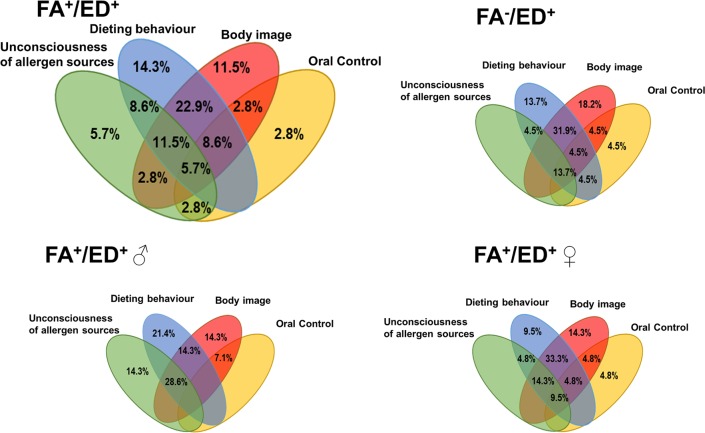
In the FA+ group, 50% of female participants and 6.7% of their healthy female peers reported ED. An ED+ result was more frequent in FA+ individuals than in their healthy peers (p = 0.046) although the association is weak. In the FA+/ED+ group, 25.3% of the participants were underweight, and 14.7% were overweight compared to their peers where this reached respectively 4.2% and 2.8% (p<0.005). 74% of the FA+/ED+ individuals reported elimination diet implementation and only 15% declared it was medically consulted. The prevalence of ED in the FA+ male group was consistently correlated with lack of confidence in FA issues (r = 0.5424) and in the FA+ female group with applied medical procedures (r = 0.7069; p<0.005).
These findings suggest that participants with FA especially struggling with lack of confidence in FA issues and those following an uncontrolled, restrictive elimination diet are more prone to food aversion and ED than their healthy peers. Applied procedures are necessary, and their neglect is associated with FA deterioration; however, the possibility of ED and biopsychosocial implications development should not be underestimated.
本研究评估了与食物过敏(FA)相关的生物心理社会因素对饮食失调(ED)患病率的影响。在为期 5 年的随访研究中,纳入了 75 名(年龄 1-14 岁)早发性 FA 患者和 81 名健康同龄人的数据。
采用抗体/细胞因子含量免疫测定试验对 FA 患者进行诊断。采用基于验证性过敏问卷的数据完成病史,包括 BMI z 评分,该问卷包含 SCOFF 和 EAT-8 筛查问卷用于 ED。如果总 IgE 升高、食物过敏原特异性 sIgE 超过 0.7 kUA/L 且有临床表现,则确认 FA。如果 SCOFF 和 EAT-8 中有两个或更多项目呈阳性,则认为 ED 筛查阳性。
在 FA+组中,50%的女性参与者和其健康女性同龄人的 6.7%报告存在 ED。FA+个体的 ED+结果比其健康同龄人更常见(p=0.046),尽管关联较弱。在 FA+/ED+组中,25.3%的参与者体重不足,14.7%超重,而其健康同龄人中分别为 4.2%和 2.8%(p<0.005)。74%的 FA+/ED+个体报告实施了消除饮食,只有 15%的个体表示这是经过医学咨询的。FA+男性组中 ED 的患病率与对 FA 问题缺乏信心(r=0.5424)呈正相关,而在 FA+女性组中与应用医学程序呈正相关(r=0.7069;p<0.005)。
这些发现表明,FA 患者,尤其是那些对 FA 问题缺乏信心且遵循不受控制的限制消除饮食的患者,比他们的健康同龄人更容易出现食物厌恶和 ED。需要应用程序,忽视这些程序与 FA 恶化有关;然而,不应低估 ED 和生物心理社会影响发展的可能性。