Department of Environmental Health Sciences, Mailman School of Public Health, Columbia University, New York, NY, 10032, USA.
Nicholas School of the Environment, Duke University, Durham, NC, USA.
J Expo Sci Environ Epidemiol. 2019 Jan;29(1):33-48. doi: 10.1038/s41370-018-0049-6. Epub 2018 Jun 28.
Polybrominated diphenyl ethers (PBDEs) have been largely replaced by organophosphate flame retardants (OPFRs) and alternative brominated flame retardants (Alt-BFRs) to meet flammability requirements. Humans are ubiquitously exposed to some variety of flame retardants through contact with consumer products directly or through household dust.
To evaluate the effectiveness of house cleaning and hand washing practices to reduce exposure to flame retardants, we measured concentrations in dermal hand wipes and urinary metabolites before and after assignment to two consecutive interventions.
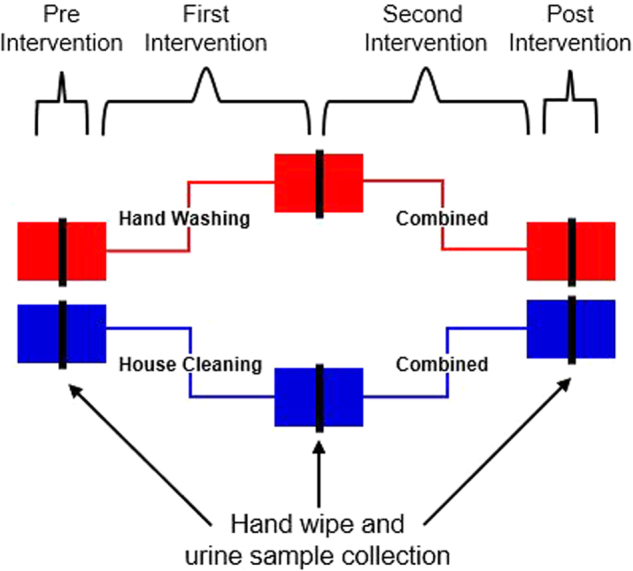
We selected 32 mother and child dyads from an existing cohort. This analysis focuses on mothers. Participants provided baseline measurements (urine, hand wipes, and questionnaires) and were then assigned for 1 week to either a house cleaning (including instruction on proper technique and cleaning supplies) or hand washing (including instruction on proper technique and soaps) intervention arm. For the second week, participants were assigned to the second intervention in addition to their initial assignment, thus all subjects both washed their hands and cleaned according to the intervention guidelines during week 2. We collected measurements at the end of weeks 1 and 2.
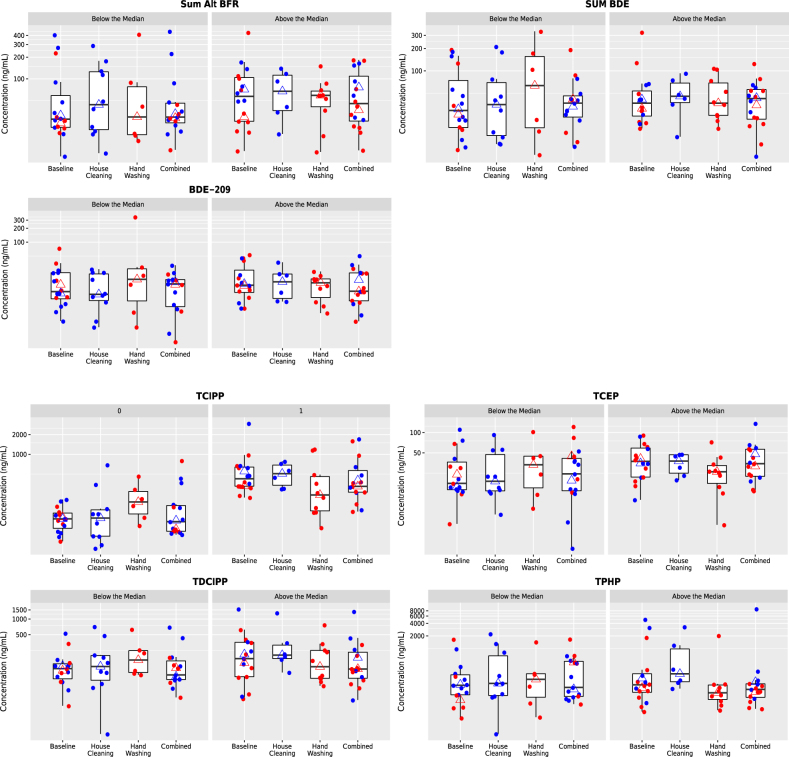
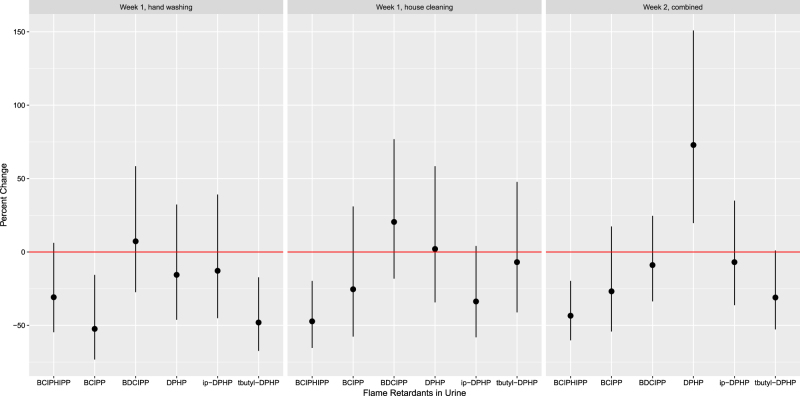
We found reductions in urinary analytes after week 1 of house cleaning (BCIPHIPP and ip-DPHP), week 1 of hand washing (BCIPP, BCIPHIPP, and tbutyl-DPHP), and week 2 of combined interventions (BCIPHIPP and tbutyl-DPHP), compare to baseline. We found no significant decline in hand wipes in the entire sample but did find reductions after week 1 of house cleaning (BDE 209), week 1 of hand washing (TCEP), and week 2 of combined interventions (TDCIPP and BDE 209) in women with exposure above the median at baseline (verified through simulations).
Exposure to individual flame retardants was reduced by about half, in some cases, by 1 week of increased hand washing, house cleaning to reduce dust, or combined activities.
为满足易燃性要求,多溴二苯醚(PBDEs)已在很大程度上被有机磷系阻燃剂(OPFRs)和替代溴化阻燃剂(Alt-BFRs)取代。人类通过直接接触消费品或通过家庭灰尘,普遍接触到各种阻燃剂。
为了评估房屋清洁和洗手习惯对减少阻燃剂暴露的有效性,我们在分配给连续两项干预措施前后,测量了皮肤擦拭物和尿液代谢物中的浓度。
我们从现有的队列中选择了 32 对母子。本分析重点关注母亲。参与者提供基线测量值(尿液、手部擦拭物和问卷),然后被分配进行为期一周的房屋清洁(包括正确技术和清洁用品的指导)或洗手(包括正确技术和肥皂的指导)干预组。在第二周,所有参与者都要进行第二项干预,除了最初的分配,因此在第二周,所有参与者都要按照干预指南同时洗手和清洁。我们在第 1 周和第 2 周结束时收集测量值。
我们发现,在第 1 周的房屋清洁(BCIPHIPP 和 ip-DPHP)、第 1 周的洗手(BCIPP、BCIPHIPP 和 tbutyl-DPHP)和第 2 周的联合干预(BCIPHIPP 和 tbutyl-DPHP)后,尿分析物减少。我们发现整个样本中的手部擦拭物没有显著下降,但在第 1 周的房屋清洁(BDE 209)、第 1 周的洗手(TCEP)和第 2 周的联合干预(TDCIPP 和 BDE 209)后,基线暴露中位数以上的女性手部擦拭物减少。
通过增加洗手、房屋清洁以减少灰尘或联合活动,某些情况下,在一周内,个体阻燃剂的暴露量减少了约一半。