School of Biomedical Engineering, Shanghai Jiao Tong University, Shanghai, China.
Department of Radiation Oncology, Shanghai Chest Hospital, Shanghai Jiao Tong University, Shanghai, China.
Sci Rep. 2018 Jul 2;8(1):9902. doi: 10.1038/s41598-018-28243-x.
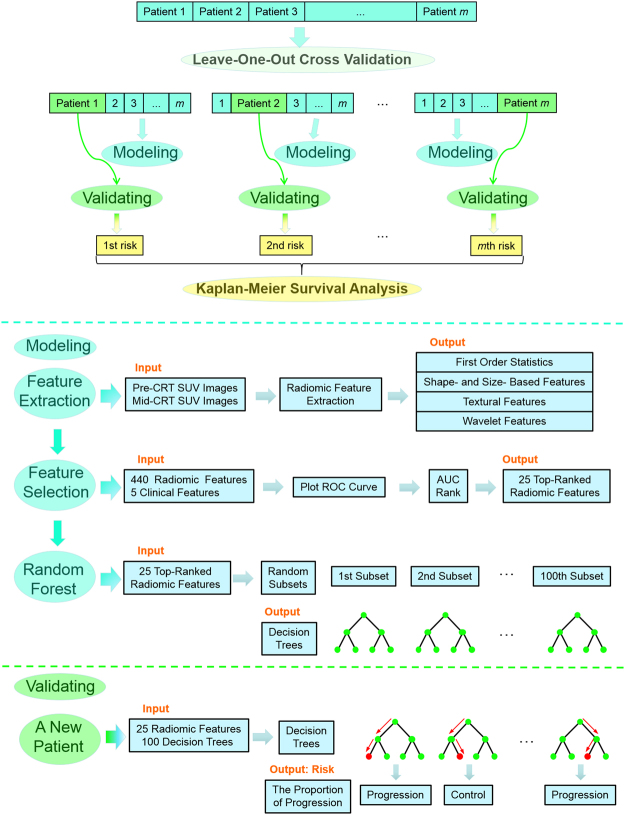
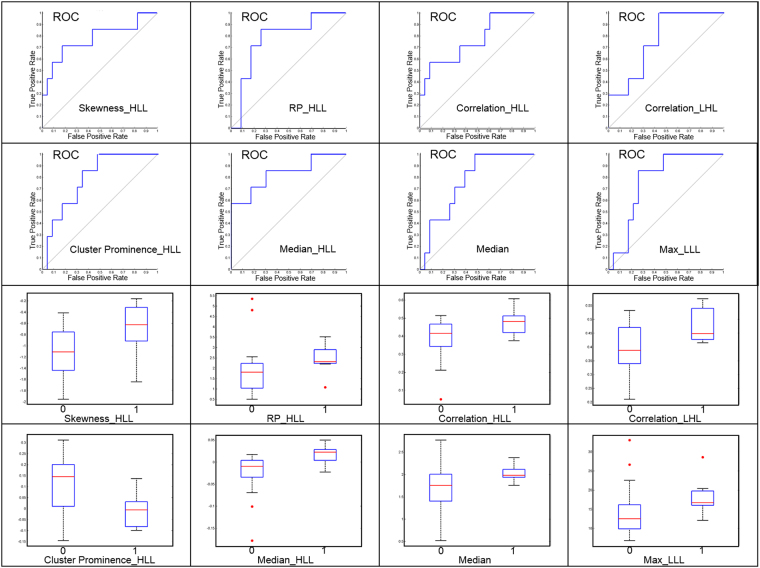
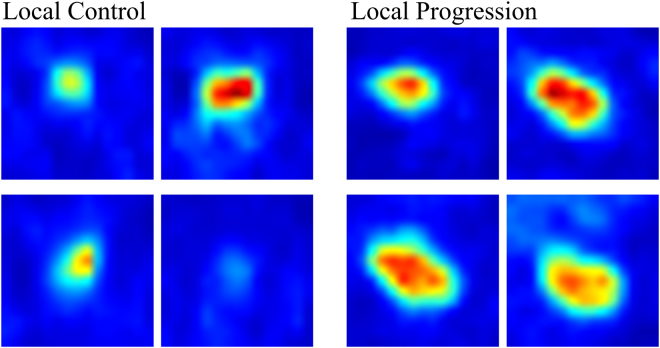
This study was designed to evaluate the predictive performance of F-fluorodeoxyglucose positron emission tomography (PET)-based radiomic features for local control of esophageal cancer treated with concurrent chemoradiotherapy (CRT). For each of the 30 patients enrolled, 440 radiomic features were extracted from both pre-CRT and mid-CRT PET images. The top 25 features with the highest areas under the receiver operating characteristic curve for identifying local control status were selected as discriminative features. Four machine-learning methods, random forest (RF), support vector machine, logistic regression, and extreme learning machine, were used to build predictive models with clinical features, radiomic features or a combination of both. An RF model incorporating both clinical and radiomic features achieved the best predictive performance, with an accuracy of 93.3%, a specificity of 95.7%, and a sensitivity of 85.7%. Based on risk scores of local failure predicted by this model, the 2-year local control rate and PFS rate were 100.0% (95% CI 100.0-100.0%) and 52.2% (31.8-72.6%) in the low-risk group and 14.3% (0.0-40.2%) and 0.0% (0.0-40.2%) in the high-risk group, respectively. This model may have the potential to stratify patients with different risks of local failure after CRT for esophageal cancer, which may facilitate the delivery of personalized treatment.
这项研究旨在评估氟-18 脱氧葡萄糖正电子发射断层扫描(PET)基于放射组学特征在同步放化疗(CRT)治疗食管癌局部控制中的预测性能。对于纳入的 30 名患者中的每一位,从治疗前和中期 CRT 的 PET 图像中提取了 440 个放射组学特征。选择前 25 个具有最高受试者工作特征曲线下面积的特征作为判别特征。使用随机森林(RF)、支持向量机、逻辑回归和极限学习机这四种机器学习方法,构建包含临床特征、放射组学特征或两者结合的预测模型。纳入临床和放射组学特征的 RF 模型取得了最佳的预测性能,准确率为 93.3%,特异性为 95.7%,敏感性为 85.7%。基于该模型预测的局部失败风险评分,低危组 2 年局部控制率和 PFS 率分别为 100.0%(95%CI 100.0-100.0%)和 52.2%(31.8-72.6%),高危组分别为 14.3%(0.0-40.2%)和 0.0%(0.0-40.2%)。该模型可能有潜力对接受 CRT 治疗的食管癌患者进行局部失败风险分层,从而有助于提供个体化治疗。