Department of Veterinary Integrative Biosciences, College of Veterinary Medicine and Biomedical Sciences, Texas A&M University, College Station, Texas, USA.
Office of Policy (1809T), U.S. Environmental Protection Agency, Washington, District of Columbia, USA.
Environ Health Perspect. 2018 Jun 28;126(6):067009. doi: 10.1289/EHP3368. eCollection 2018 Jun.
The National Academies recommended risk assessments redefine the traditional noncancer Reference Dose (RfD) as a probabilistically derived risk-specific dose, a framework for which was recently developed by the World Health Organization (WHO).
Our aim was to assess the feasibility and implications of replacing traditional RfDs with probabilistic estimates of the human dose associated with an effect magnitude M and population incidence I (HDI).
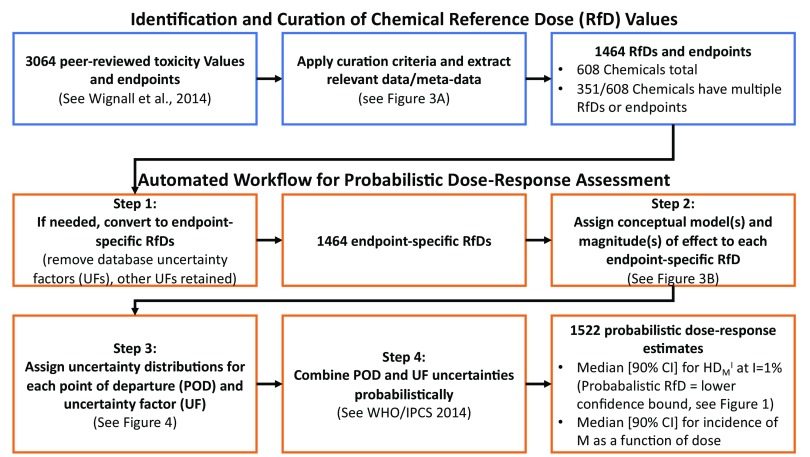
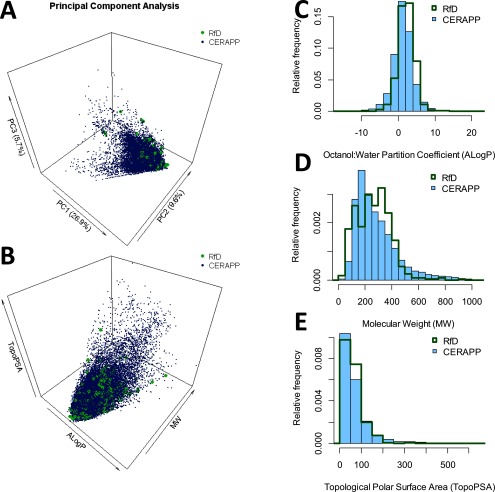
We created a comprehensive, curated database of RfDs derived from animal data and developed a standardized, automated, web-accessible probabilistic dose-response workflow implementing the WHO framework.
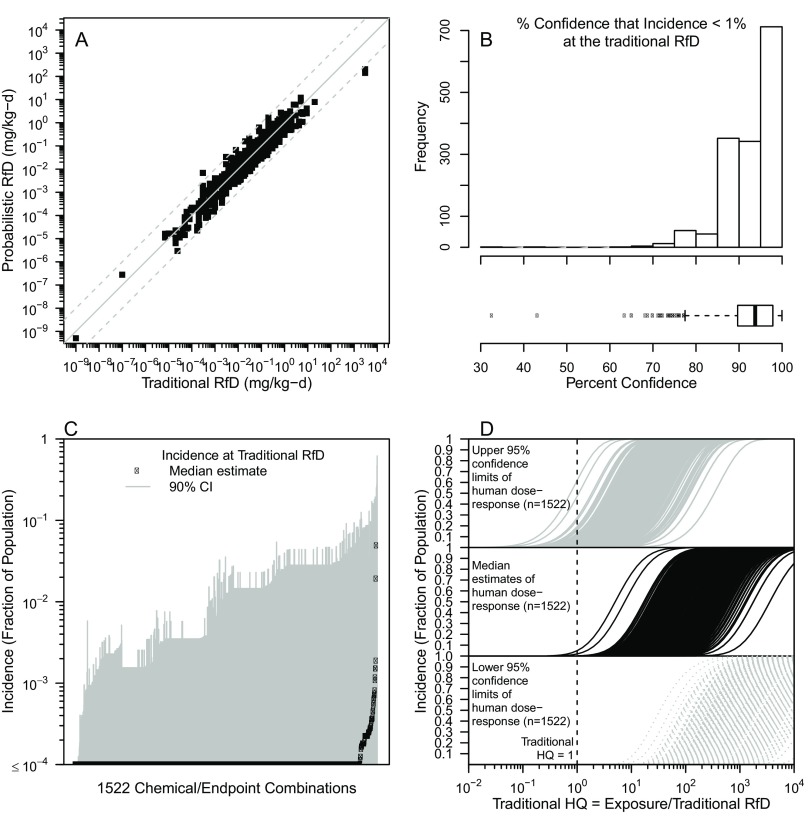
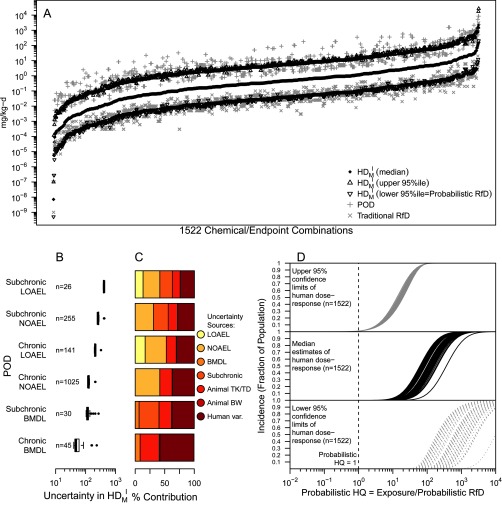
We identified 1,464 RfDs and associated endpoints, representing 608 chemicals across many types of effects. Applying our standardized workflow resulted in 1,522 HDI values. Traditional RfDs are generally within an order of magnitude of the HDI lower confidence bound for I=1% and M values commonly used for benchmark doses. The greatest contributor to uncertainty was lack of benchmark dose estimates, followed by uncertainty in the extent of human variability. Exposure at the traditional RfD frequently implies an upper 95% confidence bound of several percent of the population affected. Whether such incidences are considered acceptable is likely to vary by chemical and risk context, especially given the wide range of severity of the associated effects, from clinical chemistry to mortality.
Overall, replacing RfDs with HDI estimates can provide a more consistent, scientifically rigorous, and transparent basis for risk management decisions, as well as support additional decision contexts such as economic benefit-cost analysis, risk-risk tradeoffs, life-cycle impact analysis, and emergency response. https://doi.org/10.1289/EHP3368.
美国国家科学院建议风险评估将传统的非癌症参考剂量 (RfD) 重新定义为概率衍生的风险特异性剂量,世界卫生组织 (WHO) 最近为此制定了一个框架。
我们旨在评估用与效应幅度 M 和人群发生率 I(HDI)相关的人类剂量的概率估计值替代传统 RfD 的可行性和影响。
我们创建了一个全面的、经过精心整理的动物数据衍生的 RfD 数据库,并开发了一个标准化的、自动化的、网络可访问的概率剂量反应工作流程,该流程实施了 WHO 框架。
我们确定了 1464 个 RfD 和相关终点,代表了 608 种化学物质的多种效应。应用我们的标准化工作流程得出了 1522 个 HDI 值。传统 RfD 通常与人群发生率 I=1%和常用的基准剂量的 HDI 下限置信区间相差一个数量级。不确定性的最大贡献因素是缺乏基准剂量估计,其次是人类变异性的程度不确定。在传统 RfD 下的暴露通常意味着受影响人群的 95%置信上限的几个百分点。是否认为这种发生率是可以接受的,可能因化学物质和风险背景而异,尤其是考虑到相关效应的严重程度范围很广,从临床化学到死亡率。
总体而言,用 HDI 估计值替代 RfD 可以为风险管理决策提供更一致、科学严谨和透明的基础,并支持其他决策环境,如经济收益成本分析、风险风险权衡、生命周期影响分析和应急响应。https://doi.org/10.1289/EHP3368.