Nutrition and Dietetics, Monash Health, Monash Medical Centre, Clayton, VIC, Australia.
Department of Nutrition, Dietetics and Food, Monash University, Clayton, VIC, Australia.
BMC Cancer. 2018 Jul 3;18(1):707. doi: 10.1186/s12885-018-4595-z.
A major challenge for those living with cancers of the upper gastrointestinal tract (oesophagus, stomach and pancreas), is the impact of the disease and treatment on nutritional status and quality of life. People with cancer and malnutrition have a greater risk of morbidity and mortality. Nutrition intervention is recommended to commence immediately in those who are malnourished or at risk of malnutrition. Novel cost-effective approaches that can deliver early, pre-hospital nutrition intervention before usual hospital dietetic service is commenced are needed. Linking clinicians and patients via mobile health (mHealth) and wireless technologies is a contemporary solution not yet tested for delivery of nutrition therapy to people with cancer. The aim of this study is to commence nutrition intervention earlier than usual care and evaluate the effects of using the telephone or mHealth for intervention delivery. It is hypothesised that participants allocated to receive the early and intensive pre-hospital dietetic service will have more quality-adjusted life years lived compared with control participants. This study will also demonstrate the feasibility and effectiveness of mHealth for the nutrition management of patients at home undergoing cancer treatment.
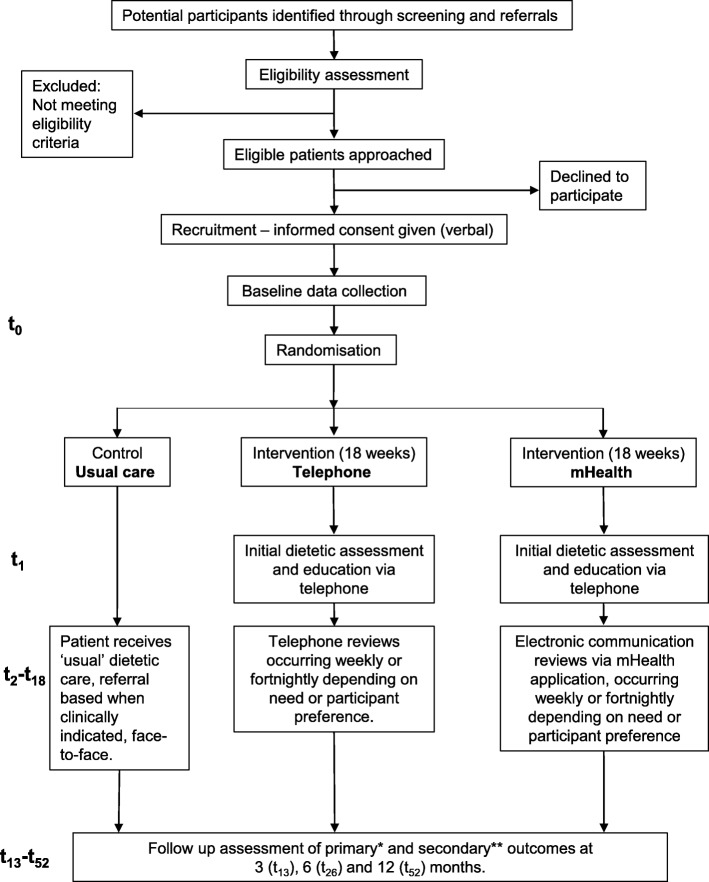
This study is a prospective three-group randomised controlled trial, with a concurrent economic evaluation. The 18 week intervention is provided in addition to usual care and is delivered by two different modes, via telephone (group 1) or via mHealth (group 2), The control group receives usual care alone (group 3). The intervention is an individually tailored, symptom-directed nutritional behavioural management program led by a dietitian. Participants will have at least fortnightly reviews. The primary outcome is quality adjusted life years lived and secondary outcomes include markers of nutritional status. Outcomes will be measured at three, six and 12 months follow up.
The findings will provide evidence of a strategy to implement early and intensive nutrition intervention outside the hospital setting that can favourably impact on quality of life and nutritional status. This patient-centred approach is relevant to current health service provision and challenges the current reactive delivery model of care.
27th January 2017 Australian and New Zealand Clinical Trial Registry ( ACTRN12617000152325 ).
对于上消化道(食管、胃和胰腺)癌症患者来说,一个主要的挑战是疾病和治疗对营养状况和生活质量的影响。患有癌症和营养不良的人发病和死亡的风险更大。建议对营养不良或有营养不良风险的人立即进行营养干预。需要寻找新颖且具有成本效益的方法,以便在常规医院饮食服务开始之前,尽早在医院外提供营养干预。通过移动健康(mHealth)和无线技术将临床医生和患者联系起来是一种尚未经过测试的当代解决方案,无法为癌症患者提供营养治疗。本研究的目的是比常规护理更早地进行营养干预,并评估使用电话或 mHealth 进行干预的效果。研究假设与对照组相比,接受早期和强化的院外饮食服务的参与者将拥有更多的质量调整生命年。本研究还将展示 mHealth 在家中接受癌症治疗的患者营养管理中的可行性和有效性。
这是一项前瞻性三组随机对照试验,同时进行经济评估。该 18 周的干预措施是在常规护理之外提供的,通过两种不同的模式进行,即通过电话(组 1)或通过 mHealth(组 2)。对照组仅接受常规护理(组 3)。干预措施是由营养师主导的个性化、症状导向的营养行为管理计划。参与者将至少每两周进行一次复查。主要结果是生存质量调整生命年,次要结果包括营养状况标志物。结果将在 3、6 和 12 个月的随访时进行测量。
研究结果将提供一种在医院环境之外实施早期和强化营养干预的策略的证据,这可以有利地影响生活质量和营养状况。这种以患者为中心的方法与当前的医疗服务提供相关,挑战了当前的被动护理模式。
2017 年 1 月 27 日澳大利亚和新西兰临床试验注册中心(ACTRN12617000152325)。