Center for a Livable Future, Johns Hopkins Bloomberg School of Public Health, Baltimore, MD, USA.
Graduate Group in Nutritional Biology, University of California Davis, Davis, CA, USA.
BMC Public Health. 2018 Jul 3;18(1):817. doi: 10.1186/s12889-018-5563-x.
Food system function is vulnerable to disruption from a variety of sources. Disruption of the processes required for food provision may result in decreases in food security in affected communities. Currently, there are few tools that quantitatively predict or analyze food system vulnerabilities to contribute to food system resilience analysis. This work presents a prototype version of one such tool, a fault tree, which can be used conceptually and for future modeling work. Fault tree analysis is an engineering tool used to illustrate basic and intermediate factors that can cause overall system failures.
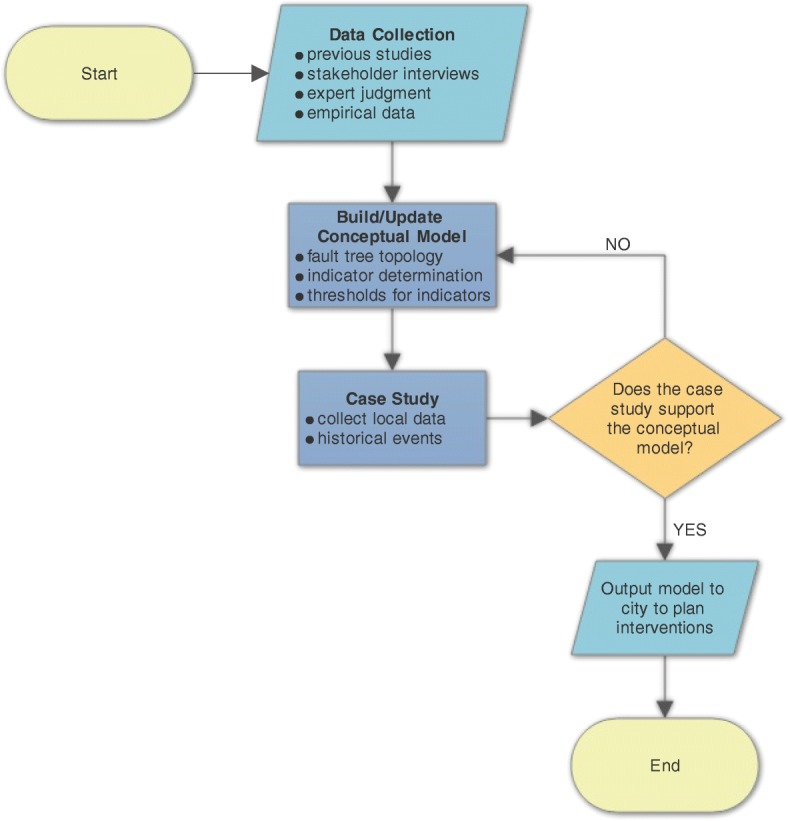
The fault tree defines food system functioning as food security at the community level and maps the components of the food system onto three main tenets of food security - accessibility, availability, and acceptability. Subtrees were populated using a top down approach guided by expertise, extant literature, and 36 stakeholder interviews.
The food system is complex, requiring 12 subtrees to elaborate potential failures. Subtrees comprising accessibility include physical accessibility of the vending point and economic accessibility among community members. Food availability depends on the functioning of the food supply chain, or, in the case of individuals who rely on donated food, the food donation system. The food supply chain includes processing, wholesale operations, distribution systems, and retail center subtrees. Elements of acceptability include the medical appropriateness, nutritional adequacy, and cultural acceptability of food. Case studies of the effects of Winter Storm Jonas of 2016 and the 2013-2017 California drought in Baltimore City illustrate the utility of the fault tree model.
FTA of potential routes to food system failure provides a tool that allows for consideration of the entirety of the food system; has potential to provide a quantitative assessment of food system failure and recovery; and is able to capture short-term and long-term hazards in a single framework. This systems modeling approach highlights an extensive list of vulnerability points throughout the food system, and underscores the message that reducing food system vulnerabilities requires action at all levels to protect communities from the risks of short-term and long-term threats to food security.
食物系统功能容易受到各种来源的干扰。食物供应过程的中断可能导致受影响社区的粮食不安全状况恶化。目前,很少有工具可以定量预测或分析食物系统的脆弱性,以促进食物系统弹性分析。本工作提出了这样一种工具的原型,即故障树,可以从概念上和未来的建模工作中使用。故障树分析是一种用于说明可能导致整个系统故障的基本和中间因素的工程工具。
故障树将社区层面的粮食安全定义为食物系统的功能,并将食物系统的组成部分映射到粮食安全的三个主要原则上,即可及性、可得性和可接受性。子树是使用自上而下的方法根据专业知识、现有文献和 36 次利益相关者访谈来填充的。
食物系统很复杂,需要 12 个子树来详细说明潜在的故障。可及性子树包括销售点的物理可及性和社区成员之间的经济可及性。食物可得性取决于食物供应链的运作,或者在依赖捐赠食物的个人的情况下,取决于食物捐赠系统。食物供应链包括加工、批发业务、配送系统和零售中心子树。可接受性的要素包括食物的医学适宜性、营养充足性和文化可接受性。2016 年冬季风暴乔纳斯和 2013-2017 年加利福尼亚干旱对巴尔的摩市的影响案例研究说明了故障树模型的实用性。
潜在食物系统故障途径的故障树分析提供了一种工具,可以考虑整个食物系统;有可能对食物系统故障和恢复进行定量评估;并且能够在单个框架中捕获短期和长期的危害。这种系统建模方法突出了食物系统中广泛的脆弱性点,并强调了一个信息,即减少食物系统的脆弱性需要在所有层面采取行动,以保护社区免受短期和长期粮食安全威胁的风险。