Department of Food and Nutrition, University of Helsinki, P.O. Box 66, FI-00014, Helsinki, Finland.
Health Sciences/Faculty of Social Sciences, University of Tampere, Medisiinarinkatu 3, FI-33014, Tampere, Finland.
Int J Behav Nutr Phys Act. 2018 Jul 3;15(1):62. doi: 10.1186/s12966-018-0693-1.
Studies investigating dietary resemblance between parents and their children have gained mixed results, and the resemblance seems to vary across nutrients, foods, dietary-assessment tools used, and parent-child pairs. We investigated parent-child dietary resemblance using a novel approach in applying statistical analysis, which allowed the comparison of 'whole-diet' between parents and their children. Additionally, we sought to establish whether sociodemographic factors or family meals were associated with dietary resemblance and whether parent-child dietary resemblance was dependent on the parent providing food consumption data on behalf of the child (father or mother, "the respondent").
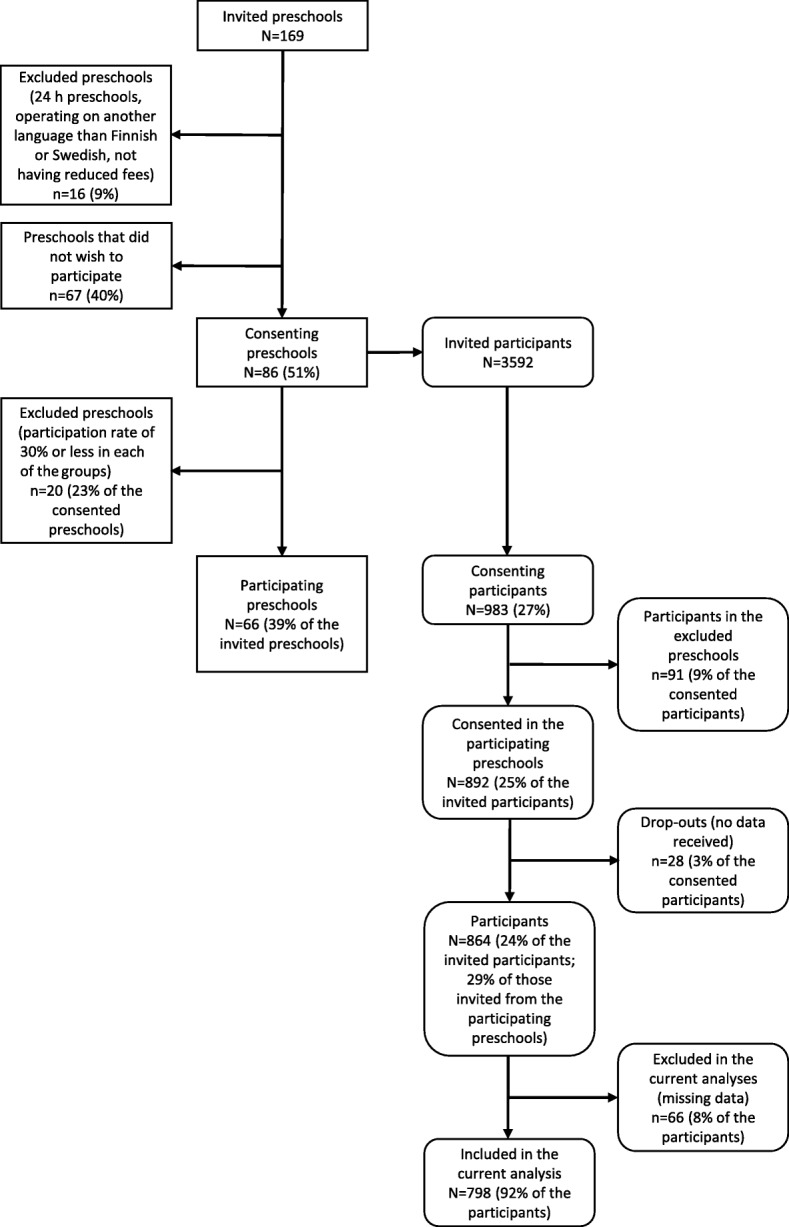
The DAGIS study investigated health behaviors among Finnish preschoolers using a cross-sectional design. One parent filled in a food frequency questionnaire (FFQ) measuring the child's food consumption outside preschool hours during the last week. In addition, we instructed both parents or legal guardians, should the child have two, to fill in a similar FFQ regarding their own food use. Parents also reported their educational level, the number of children living in the same household, and the number of family meals. As a measure of dietary resemblance between a parent and a child, we computed Spearman correlations ranging mostly from no resemblance (0) to complete resemblance (+ 1) between parent-child pairs over the 'whole-diet' (excluding preschool hours). These resemblance measures were further investigated using linear mixed models.
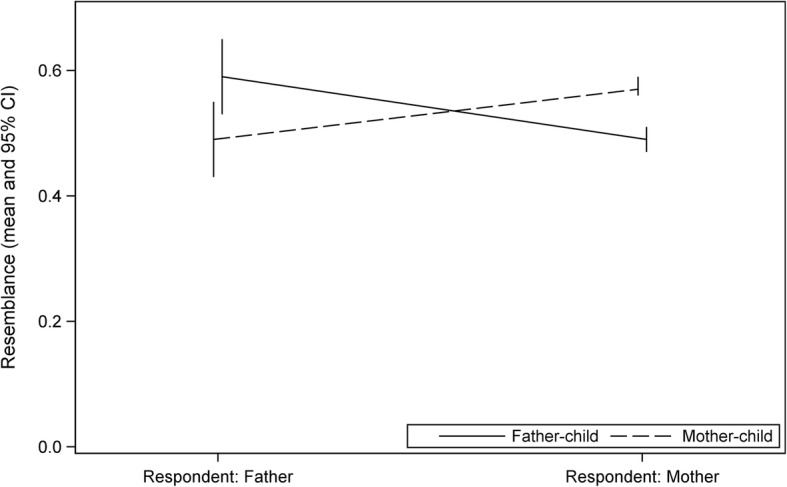
We obtained 665 father-child and 798 mother-child resemblance measures. Mother-child resemblance was on average 0.57 and stronger than father-child resemblance (0.50, p < 0.0001), which was explained by a parent-respondent interaction: the diet of the child resembled more the diet of the parent who provided food consumption data for the child. In univariate models, father- and mother-reported number of family meals were positively associated with father-child and mother-child resemblances. Mother-reported number of family meals was positively associated with mother-child resemblance in a full model.
The diet of the child seems to resemble more the diet of the parent responsible for the reporting of food consumption. Studies should report who provided the food consumption data for the child and take this into account in analyses, since reporter-bias can influence the results.
研究父母与子女饮食相似性的结果喜忧参半,这种相似性似乎因营养素、食物、所用饮食评估工具以及父母-子女对的不同而有所差异。我们采用一种新的方法,即应用统计分析来比较父母和子女的“整体饮食”,以此研究父母-子女饮食相似性。此外,我们还试图确定社会人口因素或家庭餐是否与饮食相似性相关,以及父母-子女饮食相似性是否取决于提供儿童饮食消费数据的父母(父亲或母亲,“报告人”)。
DAGIS 研究采用横断面设计调查芬兰学龄前儿童的健康行为。一位家长填写一份食物频率问卷(FFQ),以测量儿童在学前校外时间内过去一周的食物消费情况。此外,我们还指示所有家长或法定监护人(如果儿童有两个家长或监护人)填写一份类似的 FFQ,以报告他们自己的食物使用情况。家长还报告了他们的教育水平、同住儿童的数量以及家庭餐的数量。我们计算了父母和子女之间“整体饮食”(不包括学前时间)的 Spearman 相关系数,该系数从无相似性(0)到完全相似性(+1)不等,作为父母与子女之间饮食相似性的衡量指标。我们进一步使用线性混合模型来研究这些相似性度量。
我们获得了 665 对父女相似性和 798 对母子相似性的度量。母子相似性平均为 0.57,高于父女相似性(0.50,p<0.0001),这可以用父母-报告人相互作用来解释:儿童的饮食更类似于为儿童提供饮食消费数据的父母的饮食。在单变量模型中,父亲和母亲报告的家庭餐次数与父女和母子相似性呈正相关。在全模型中,母亲报告的家庭餐次数与母子相似性呈正相关。
儿童的饮食似乎更类似于负责报告食物消费的父母的饮食。研究应报告谁为儿童提供了食物消费数据,并在分析中考虑到这一点,因为报告人的偏差可能会影响结果。