Sannö Axel, Rosendal Thomas, Aspán Anna, Backhans Annette, Jacobson Magdalena
Department of Clinical Sciences, Swedish University of Agricultural Sciences (SLU), Box 7054, 750 07, Uppsala, Sweden.
Department of Disease Control and Epidemiology, National Veterinary Institute, Uppsala, Sweden.
Acta Vet Scand. 2018 Jul 3;60(1):40. doi: 10.1186/s13028-018-0395-3.
Pure Eurasian wild boars and/or hybrids with domestic pigs are present in the wild on most continents. These wild pigs have been demonstrated to carry a large number of zoonotic and epizootic pathogens such as Salmonella spp., Yersinia enterocolitica and Y. pseudotuberculosis. Wild boar populations throughout Europe are growing and more and more wild boar meat is being consumed, the majority within the homes of hunters without having passed a veterinary inspection. The aim of this study was to investigate if factors such as population density, level of artificial feeding, time since establishment of a given population, and the handling of animal by-products from slaughtered animals could influence the presence of these pathogens in the wild boar.
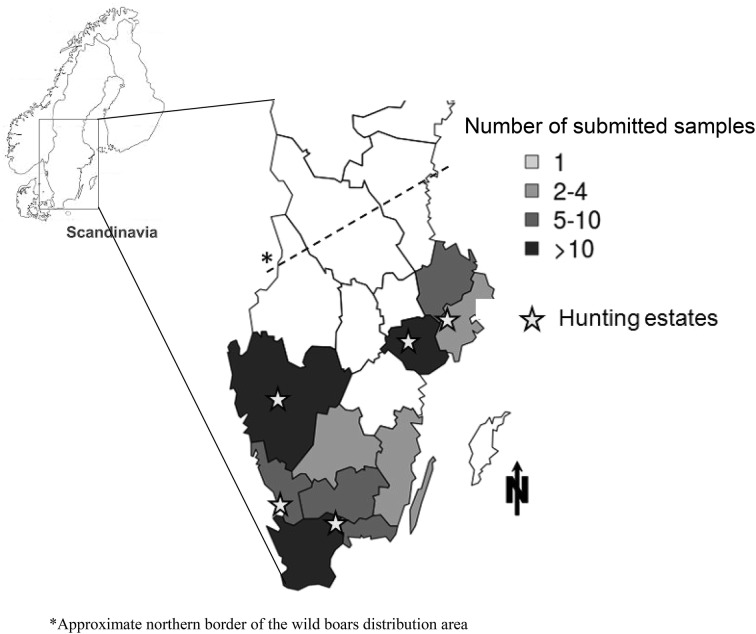
In total, 90 wild boars from 30 different populations in Sweden were sampled and analysed using a protocol combining pre-cultivation and PCR-detection. The results showed that 27% of the sampled wild boars were positive for Salmonella spp., 31% were positive for Y. enterocolitica and 22% were positive for Y. pseudotuberculosis. In 80% of the sampled populations, at least one wild boar was positive for one of these enteropathogens and in total, 60% of the animals carried at least one of the investigated enteropathogens. The presumptive risk factors were analysed using a case-control approach, however, no significant associations were found.
Human enteropathogens are commonly carried by wild boars, mainly in the tonsils, and can thus constitute a risk for contamination of the carcass and meat during slaughter. Based on the present results, the effect of reducing population densities and number of artificial feeding places might be limited.
大多数大陆的野外都存在纯种欧亚野猪和/或与家猪的杂交种。这些野猪已被证明携带大量人畜共患病和动物流行病病原体,如沙门氏菌属、小肠结肠炎耶尔森菌和假结核耶尔森菌。欧洲各地的野猪种群正在增长,越来越多的野猪肉被食用,其中大部分是在猎人家里食用,未经兽医检查。本研究的目的是调查种群密度、人工喂养水平、特定种群建立后的时间以及屠宰动物副产品的处理等因素是否会影响野猪体内这些病原体的存在。
总共对瑞典30个不同种群的90头野猪进行了采样,并使用结合预培养和PCR检测的方案进行分析。结果表明,27%的采样野猪沙门氏菌属呈阳性,31%的小肠结肠炎耶尔森菌呈阳性,22%的假结核耶尔森菌呈阳性。在80%的采样种群中,至少有一头野猪对这些肠道病原体之一呈阳性,总体而言,60%的动物携带至少一种被调查的肠道病原体。使用病例对照方法分析了推定的风险因素,然而,未发现显著关联。
野猪通常携带人类肠道病原体,主要存在于扁桃体中,因此在屠宰过程中可能会对胴体和肉造成污染风险。基于目前的结果,降低种群密度和人工喂养地点数量的效果可能有限。