Cui Pengwei, Li Jingxin, Liu Na, Duan Zhao-Jun
Suzhou Center for Disease Control and Prevention, Jiangsu Province, Suzhou, China.
Department of Viral Diarrhea, National Institute for Viral Disease Control and Prevention, Chinese Centers for Disease Control and Prevention, 155 Changbai Road, Changping District, Beijng, 102206, China.
BMC Gastroenterol. 2018 Jul 13;18(1):114. doi: 10.1186/s12876-018-0839-2.
Acute diarrheal illness (ADI) is an important public health problem worldwide. We estimated the morbidity, distribution, and burden of self-reported ADI in China over the last three decades.
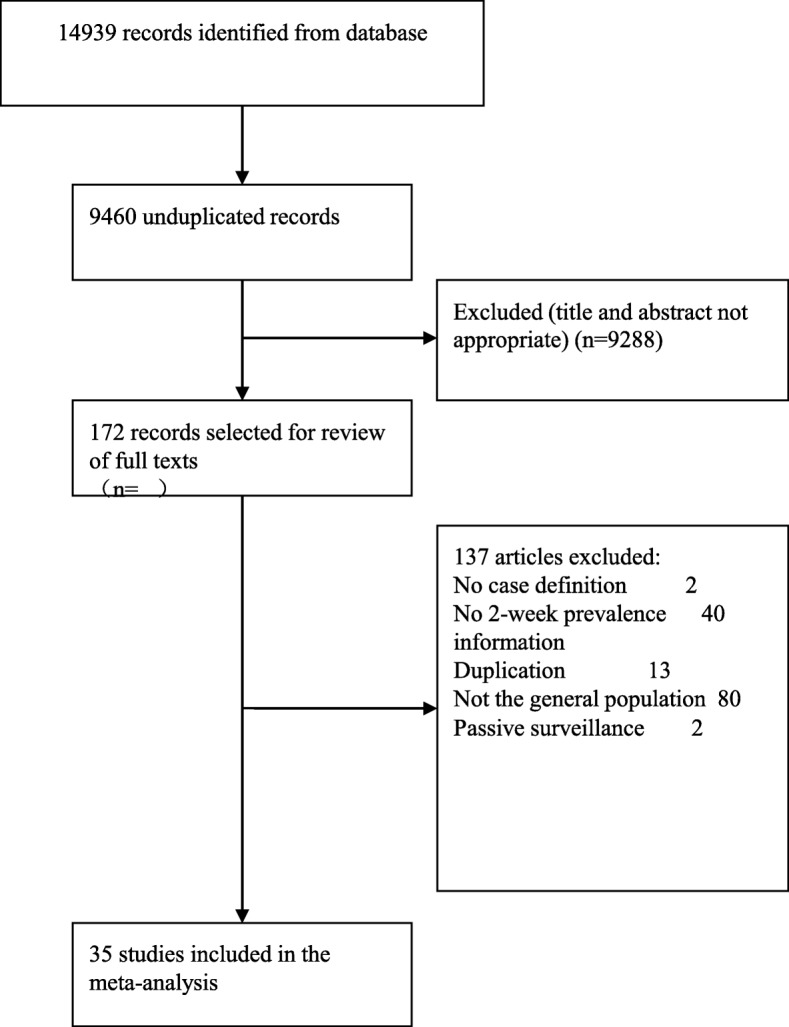
We used the keywords "diarrhea and morbidity" to identify studies published in Chinese by searching CNKI, WANFANG, Chongqing VIP, and SinoMed. Studies published in English were identified using the keywords "diarrhea, morbidity, and China" to search Pubmed/Medline, Embase, and Cochrane Library Data. All articles published before Dec 31, 2014 were included in the search. Data were extracted and the pooled 2-week incidence rate of ADI was calculated using the fixed-effects or random-effects model according to statistical testing for homogeneity. The incidences of each subgroup (organized by age, location, study period) were also calculated. Publication bias was examined using Begg's test. Data manipulation and statistical analyses were undertaken using R-2.15.1 software.
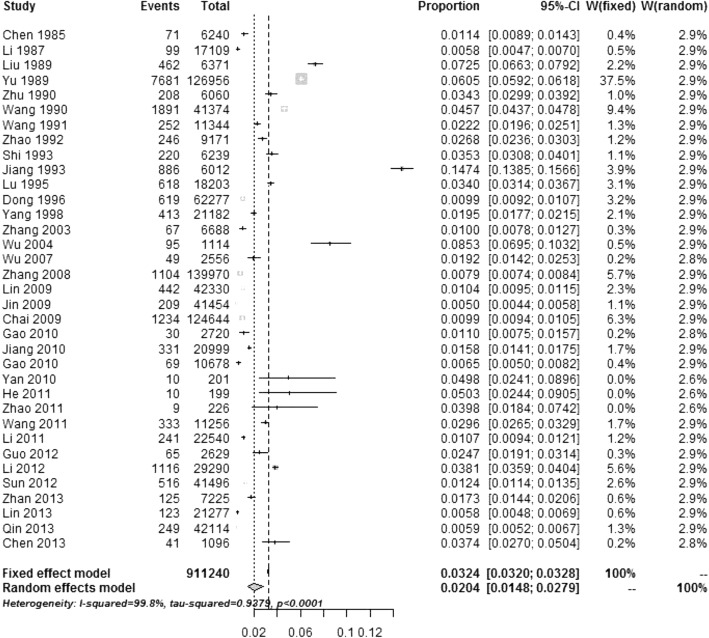
We estimated that the pooled 2-week prevalence of ADI in China was 2.04% (95% CI: 1.48-2.79) and that the corresponding incidence rate was 0.53 (95% CI: 0.38-0.73) episodes per person-year. The ADI rate was highest among children aged < 5 years (1.43 episodes per person-year), and it was slightly higher in males than in females (0.58 vs 0.52 episodes per person-year). From 1980 to 2012, there was a significant decrease in the incidence of ADI, from 0.82 to 0.48 episodes per person-year, but the ADI incidence was consistent over the last two decades. Additionally, the incidence of ADI was higher in rural areas and in west China and peaked in the summer months.
The current study indicates that ADI caused a substantial disease burden in China in the last 30 years, especially in rural areas and west China, where sanitation conditions were relatively poor. These findings highlight the importance of further investigation of the specific causes of and effective preventive measures for ADI.
急性腹泻病(ADI)是全球重要的公共卫生问题。我们估算了过去三十年中国自我报告的急性腹泻病的发病率、分布情况及疾病负担。
我们使用关键词“腹泻与发病率”在中国知网、万方、维普和中国生物医学文献数据库中检索已发表的中文研究。使用关键词“腹泻、发病率和中国”在PubMed/Medline、Embase和Cochrane图书馆数据库中检索已发表的英文研究。检索纳入2014年12月31日前发表的所有文章。提取数据,并根据同质性统计检验使用固定效应模型或随机效应模型计算急性腹泻病的合并两周发病率。还计算了各亚组(按年龄、地点、研究时期划分)的发病率。使用Begg检验检测发表偏倚。使用R-2.15.1软件进行数据处理和统计分析。
我们估算中国急性腹泻病的合并两周患病率为2.04%(95%置信区间:1.48 - 2.79),相应的发病率为每人每年0.53次(95%置信区间:0.38 - 0.73)。五岁以下儿童的急性腹泻病发病率最高(每人每年1.43次),男性发病率略高于女性(每人每年0.58次对0.52次)。1980年至2012年,急性腹泻病发病率显著下降,从每人每年0.82次降至0.48次,但过去二十年急性腹泻病发病率保持稳定。此外,农村地区和中国西部的急性腹泻病发病率较高,且在夏季达到峰值。
当前研究表明,过去三十年急性腹泻病在中国造成了巨大的疾病负担,尤其是在卫生条件相对较差的农村地区和中国西部。这些发现凸显了进一步调查急性腹泻病具体病因及有效预防措施的重要性。