Mardiansyah Dedi, Badloe Trevon, Triyana Kuwat, Mehmood Muhammad Q, Raeis-Hosseini Niloufar, Lee Yoonkyung, Sabarman Harsojo, Kim Kyunghoon, Rho Junsuk
Department of Physics, Universitas Gadjah Mada, Yogyakarta, 55281, Indonesia.
Department of Physics Education, Universitas Pasir Pengaraian, Riau, 28558, Indonesia.
Sci Rep. 2018 Jul 13;8(1):10639. doi: 10.1038/s41598-018-28744-9.
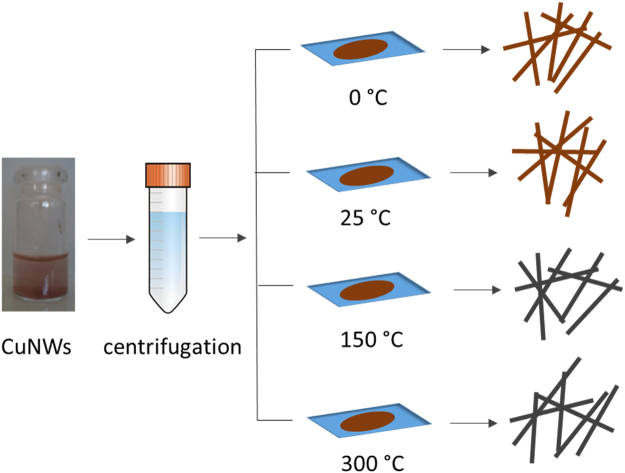
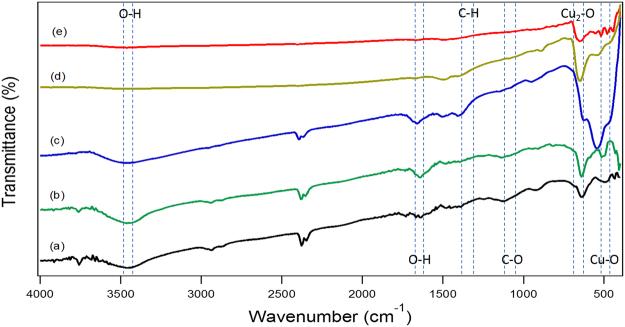
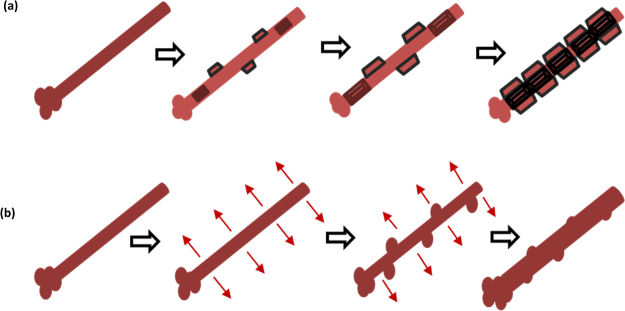
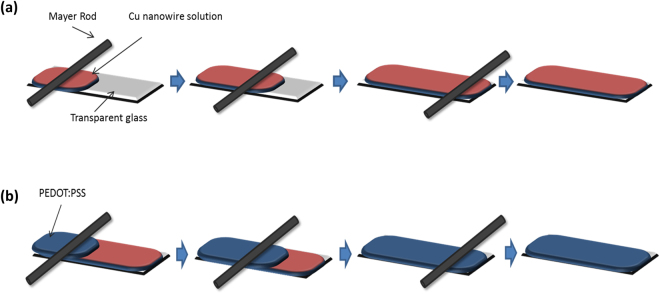
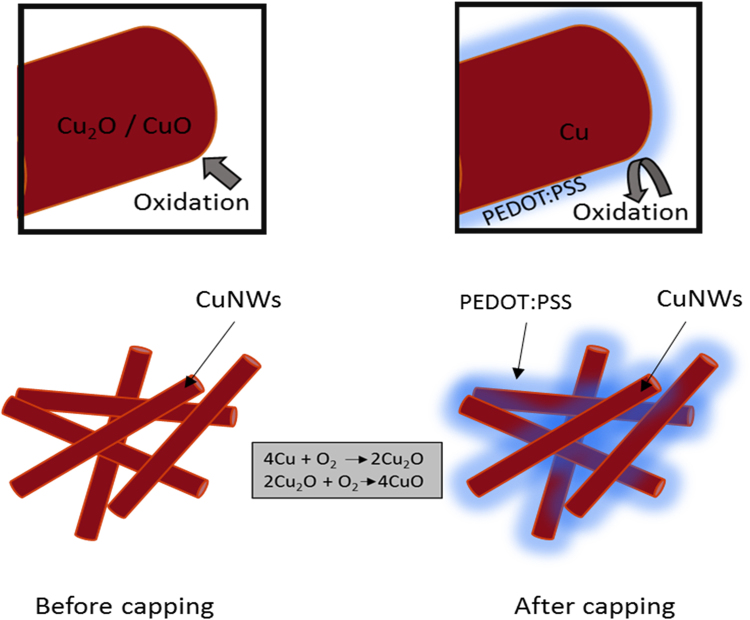
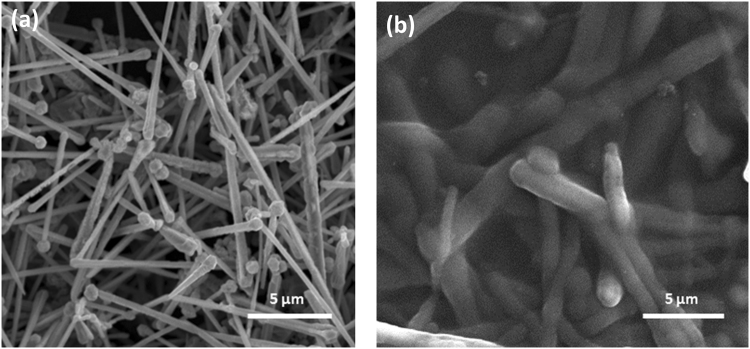
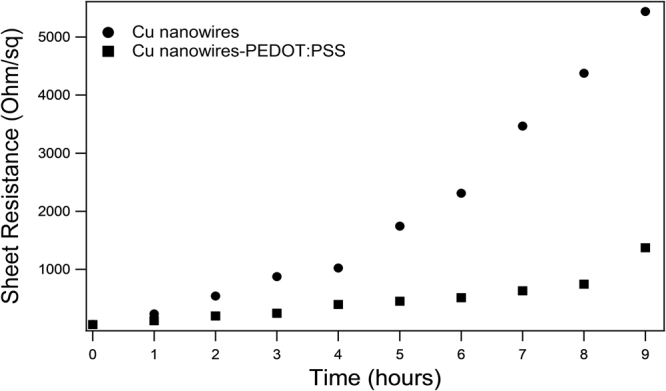
Oxidation can strongly influence the performance of Cu nanowires (CuNWs) by decreasing their conductivity. Here, we identify and investigate a way to prevent the oxidation process of CuNWs to maintain the high conducting performance of CuNWs as transparent electrodes. CuNWs were synthesised using an aqueous method. We prepared several temperature treatments (from 0-300 °C) to represent oxidation of CuNWs in different environments, to study the oxidation process and changes in morphology in detail. Depending on the temperature, smooth and uniform CuNWs exposed to oxidation produced rough CuO and CuO nanowires. We then suggest a method of protecting nanowires from oxidation, using the Mayer rod coating method to apply a layer of PEDOT:PSS to a transparent conducting film of CuNWs. The result indicates that this method of protection can protect the film, and maintain a stable, and constant resistance over of time, without effecting the excellent conductivity properties of pure CuNWs.
氧化会通过降低铜纳米线(CuNWs)的导电性而强烈影响其性能。在此,我们确定并研究了一种防止CuNWs氧化过程的方法,以保持CuNWs作为透明电极的高导电性能。采用水相法合成了CuNWs。我们进行了几种温度处理(从0至300°C),以代表CuNWs在不同环境中的氧化情况,从而详细研究氧化过程和形态变化。根据温度不同,暴露于氧化环境中的光滑均匀的CuNWs会生成粗糙的CuO和CuO纳米线。然后,我们提出了一种保护纳米线不被氧化的方法,即使用迈耶棒涂布法在CuNWs透明导电膜上涂覆一层PEDOT:PSS。结果表明,这种保护方法可以保护该薄膜,并随着时间的推移保持稳定且恒定的电阻,同时不会影响纯CuNWs优异的导电性能。