• 文献检索
  • 文档翻译
  • 深度研究
  • 学术资讯
  • Suppr Zotero 插件Zotero 插件
  • 邀请有礼
  • 套餐&价格
  • 历史记录
应用&插件
Suppr Zotero 插件Zotero 插件浏览器插件Mac 客户端Windows 客户端微信小程序
定价
高级版会员购买积分包购买API积分包
服务
文献检索文档翻译深度研究API 文档MCP 服务
关于我们
关于 Suppr公司介绍联系我们用户协议隐私条款
关注我们

Suppr 超能文献

核心技术专利:CN118964589B侵权必究
粤ICP备2023148730 号-1Suppr @ 2026

文献检索

告别复杂PubMed语法,用中文像聊天一样搜索,搜遍4000万医学文献。AI智能推荐,让科研检索更轻松。

立即免费搜索

文件翻译

保留排版,准确专业,支持PDF/Word/PPT等文件格式,支持 12+语言互译。

免费翻译文档

深度研究

AI帮你快速写综述,25分钟生成高质量综述,智能提取关键信息,辅助科研写作。

立即免费体验

Pragmatic Tools for Sharing Genomic Research Results with the Relatives of Living and Deceased Research Participants.

作者信息

Wolf Susan M, Scholtes Emily, Koenig Barbara A, Petersen Gloria M, Berry Susan A, Beskow Laura M, Daly Mary B, Fernandez Conrad V, Green Robert C, LeRoy Bonnie S, Lindor Noralane M, O'Rourke P Pearl, Breitkopf Carmen Radecki, Rothstein Mark A, Van Ness Brian, Wilfond Benjamin S

机构信息

Susan M. Wolf, J.D., is McKnight Presidential Professor of Law, Medicine & Public Policy; Faegre Baker Daniels Professor of Law; Professor of Medicine; and Chair of the Consortium on Law and Values in Health, Environment & the Life Sciences, University of Minnesota. She was one of three Principal Investigators on NIH/NCI/NHGRI grant 1R01CA154517 on return of genomic results to family members, including after the death of the proband. Emily Scholtes, J.D., is a graduate of the University of Minnesota Law School, where she served as a Research Assistant on the project on return of genomic results to family members. She then clerked for the U.S. Court of Appeals for the Eighth Circuit before going into private practice. The views expressed in this article are exclusively those of the authors. This article has been prepared for informational purposes only and does not constitute legal advice. Barbara A. Koenig, Ph.D., is Director of Bioethics and Professor of Bioethics and Medical Anthropology based at the Institute for Health & Aging, University of California, San Francisco. She was one of three Principal Investigators on NIH/NCI/NHGRI grant 1R01CA154517 on return of genomic results to family members, including after the death of the proband. Gloria M. Petersen, Ph.D., is Professor of Epidemiology, Department of Health Sciences Research, Mayo Clinic College of Medicine. She is a Founding Fellow of the American College of Medical Genetics and Genomics. She was one of three Principal Investigators on NIH/NCI/NHGRI grant 1R01CA154517 on return of genomic results to family members, including after the death of the proband. Susan A. Berry, M.D., is Professor of Pediatrics & Genetics and Division Director for Genetics and Metabolism in the Department of Pediatrics, University of Minnesota. She is a Fellow of the American Academy of Pediatrics and the American College of Medical Genetics. Laura M. Beskow, M.P.H., Ph.D., is Professor of Health Policy and Director of Research Ethics, Center for Biomedical Ethics & Society, Vanderbilt University. She received her M.P.H. with a concentration in health law from Boston University and her Ph.D. in Health Policy and Administration, with a minor in Epidemiology, at the University of North Carolina at Chapel Hill. Mary B. Daly, M.D., Ph.D., is a medical oncologist and epidemiologist who chairs the Department of Clinical Genetics at Fox Chase Cancer Center. Her research focuses on defining the best methods of communicating hereditary cancer risk information and on providing risk management strategies and coping skills to family members dealing with an increased risk for cancer. Conrad V. Fernandez, B.Sc., M.D., is Professor and Head of the Division of Pediatric Hematology/Oncology in the Department of Pediatrics, IWK Health Centre, Dalhousie University and is cross-appointed in Bioethics, Medicine, and Postgraduate Studies. He obtained his medical degree at McMaster University, specialist certification in Pediatrics as a Fellow of the Royal College of Physicians and Surgeons of Canada at Dalhousie University, and completed specialty training in Pediatric Hematology/Oncology at the University of British Columbia. Robert C. Green, M.D., M.P.H., is a medical geneticist and physician-scientist who directs the G2P Research Program in translational genomics and health outcomes in the Division of Genetics, Brigham and Women's Hospital and Harvard Medical School. He is also Associate Director for Research at Partners Personalized Medicine. Dr. Green leads and co-leads the MedSeq Project and the BabySeq Project respectively, two NIH-funded randomized trials designed to explore the medical, behavioral, and economic implications of integrating genome sequencing into the medical care of adults and newborns. Bonnie S. LeRoy, M.S., C.G.C., is Professor and Director of the Graduate Program in Genetic Counseling, University of Minnesota. Her work focuses on preparing graduate students to enter the profession of genetic counseling. Her research examines the ethical and social challenges associated with the genetic counseling profession. She served as the President of the American Board of Genetic Counseling from 2001-03. Noralane M. Lindor, M.D., is Professor of Medical Genetics in the Department of Health Sciences Research at Mayo Clinic in Scottsdale, Arizona. She received her medical degree from Mayo Medical School, and did her residencies at Bowman Gray School of Medicine in Winston-Salem, North Carolina, and at Mayo Clinic in Rochester. P. Pearl O'Rourke, M.D., is Director of Human Research Affairs at Partners HealthCare in Boston, and Associate Professor of Pediatrics at Harvard Medical School. She completed medical school at Dartmouth Medical School and the University of Minnesota Medical School. Carmen Radecki Breitkopf, Ph.D., is Professor of Health Services Research in the Department of Health Sciences Research at Mayo Clinic College of Medicine and Science in Rochester, Minnesota. She earned her Master's and Doctoral degrees in Psychology from the State University of New York at Albany. Mark A. Rothstein, J.D., is Herbert F. Boehl Chair of Law & Medicine and Director of the Institute for Bioethics, Health Policy & Law at the University of Louisville School of Medicine. He is past-President of the American Society of Law, Medicine & Ethics and serves as Public Health Ethics editor for the American Journal of Public Health. Brian Van Ness, Ph.D., is Professor of Genetics, Cell Biology and Development at the University of Minnesota. He earned his doctorate in Biochemistry from the University of Minnesota, completed a postdoctoral fellowship at Fox Chase Cancer Center, and has served as the Department Head and Director of the Institute of Human Genetics at the University of Minnesota. Benjamin S. Wilfond, M.D., is Director of the Treuman Katz Center for Pediatric Bioethics, Seattle Children's Hospital; Professor and Chief of the Division of Bioethics; Professor, Pulmonary and Sleep Medicine, Department of Pediatrics; and Adjunct Professor, Department of Bioethics and Humanities, University of Washington School of Medicine. He is past-President of the Association of Bioethics Program Directors, Chair for the Clinical Research Ethics Consultation Working Group for the Clinical and Translational Science Awards program, and a member of the Bioethics and Legal Working Group of the Newborn Screening Translational Research Network.

出版信息

J Law Med Ethics. 2018 Mar;46(1):87-109. doi: 10.1177/1073110518766024. Epub 2018 Mar 27.
DOI:10.1177/1073110518766024
PMID:30008546
原文链接:https://pmc.ncbi.nlm.nih.gov/articles/PMC6040667/
Abstract
摘要
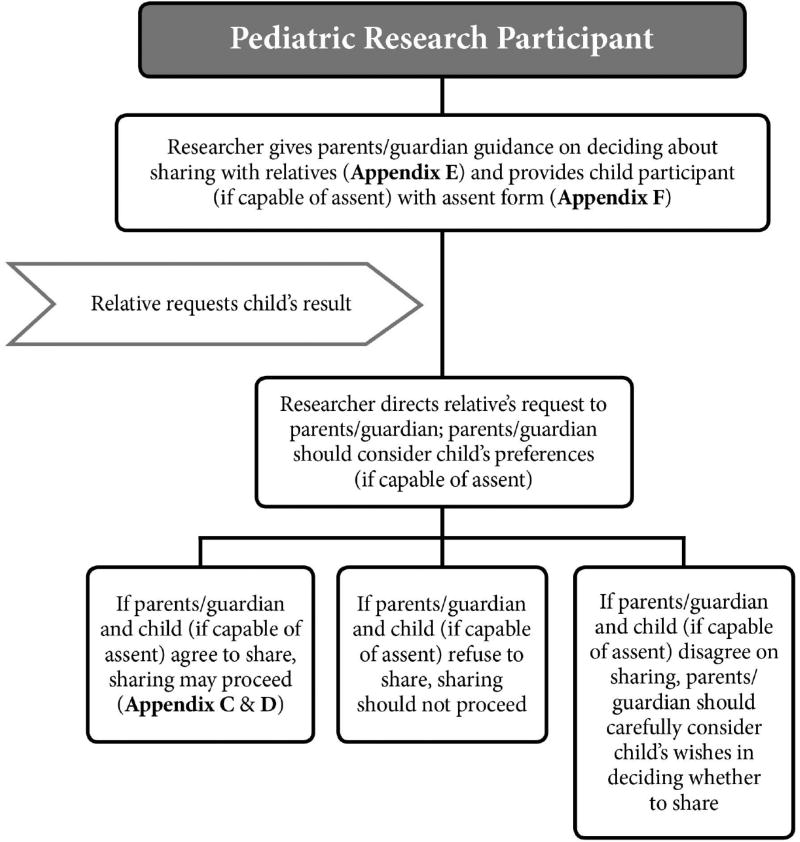
https://cdn.ncbi.nlm.nih.gov/pmc/blobs/f327/6040667/d3b6cd57834d/nihms973435f3.jpg
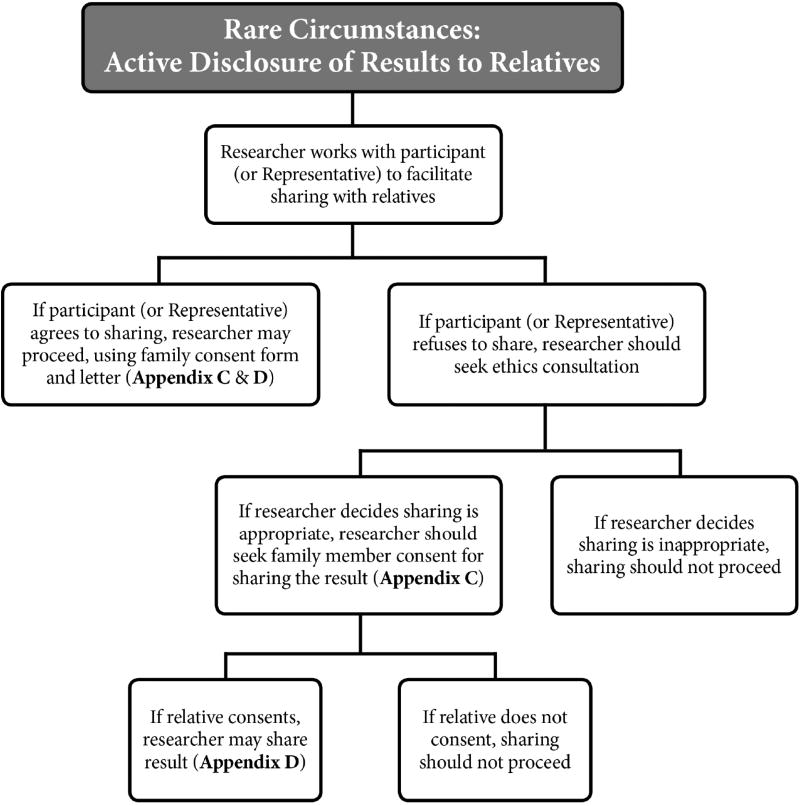
https://cdn.ncbi.nlm.nih.gov/pmc/blobs/f327/6040667/f9e7978e321b/nihms973435f1.jpg
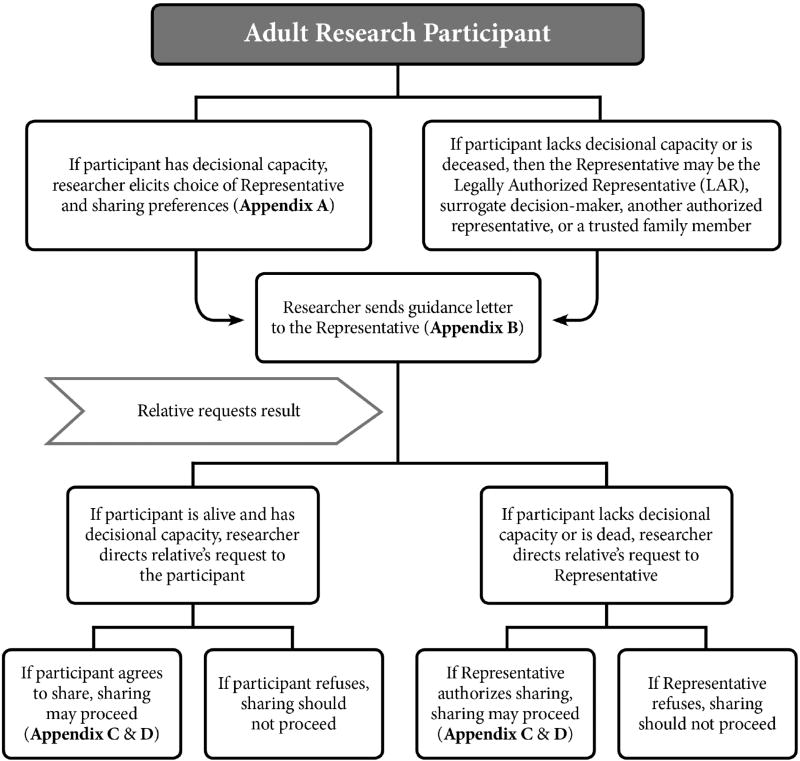
https://cdn.ncbi.nlm.nih.gov/pmc/blobs/f327/6040667/8fd9931c39a0/nihms973435f2.jpg
https://cdn.ncbi.nlm.nih.gov/pmc/blobs/f327/6040667/d3b6cd57834d/nihms973435f3.jpg
https://cdn.ncbi.nlm.nih.gov/pmc/blobs/f327/6040667/f9e7978e321b/nihms973435f1.jpg
https://cdn.ncbi.nlm.nih.gov/pmc/blobs/f327/6040667/8fd9931c39a0/nihms973435f2.jpg
https://cdn.ncbi.nlm.nih.gov/pmc/blobs/f327/6040667/d3b6cd57834d/nihms973435f3.jpg

相似文献

1
Pragmatic Tools for Sharing Genomic Research Results with the Relatives of Living and Deceased Research Participants.与在世和已故研究参与者的亲属分享基因组研究结果的实用工具。
J Law Med Ethics. 2018 Mar;46(1):87-109. doi: 10.1177/1073110518766024. Epub 2018 Mar 27.
2
Relationships matter: ethical considerations for returning results to family members of deceased subjects.关系很重要:向已故受试者家属反馈结果的伦理考量
Am J Bioeth. 2013;13(10):66-7. doi: 10.1080/15265161.2013.828533.
3
What does the duty to warn require?警告义务要求什么?
Am J Bioeth. 2013;13(10):62-3. doi: 10.1080/15265161.2013.828528.
4
Should researchers disclose results to descendants?研究人员应该向后代披露研究结果吗?
Am J Bioeth. 2013;13(10):64-5. doi: 10.1080/15265161.2013.828531.
5
The ethics of contacting family members of a subject in a genetic research study to return results for an autosomal dominant syndrome.遗传研究中联系受试者家属并向其反馈常染色体显性遗传综合征检测结果的伦理问题。
Am J Bioeth. 2013;13(10):61. doi: 10.1080/15265161.2013.828523.
6
Ethical and legal implications of whole genome and whole exome sequencing in African populations.全基因组和全外显子组测序在非裔人群中的伦理和法律影响。
BMC Med Ethics. 2013 May 28;14:21. doi: 10.1186/1472-6939-14-21.
7
The Double Helix: Applying an Ethic of Care to the Duty to Warn Genetic Relatives of Genetic Information.《双螺旋:将关怀伦理应用于向基因亲属告知基因信息的义务》
Bioethics. 2016 Mar;30(3):181-7. doi: 10.1111/bioe.12176. Epub 2015 Jul 21.
8
Ethics. Identifiability in genomic research.伦理学。基因组研究中的可识别性。
Science. 2007 Aug 3;317(5838):600-2. doi: 10.1126/science.1147699.
9
Balancing the risks and benefits of genomic data sharing: genome research participants' perspectives.权衡基因组数据共享的风险与益处:基因组研究参与者的观点
Public Health Genomics. 2012;15(2):106-14. doi: 10.1159/000334718. Epub 2011 Dec 30.
10
Disclosure to genetic relatives without consent - Australian genetic professionals' awareness of the health privacy law.未经同意向遗传亲属披露信息-澳大利亚遗传专业人员对健康隐私法的认识。
BMC Med Ethics. 2020 Feb 4;21(1):13. doi: 10.1186/s12910-020-0451-1.

引用本文的文献

1
Return of Results in Genomic Research Using Large-Scale or Whole Genome Sequencing: Toward a New Normal.使用大规模或全基因组测序进行基因组研究的结果回报:迈向新常态。
Annu Rev Genomics Hum Genet. 2023 Aug 25;24:393-414. doi: 10.1146/annurev-genom-101122-103209. Epub 2023 Mar 13.
2
Perspectives regarding family disclosure of genetic research results in three racial and ethnic minority populations.关于向三个种族和少数民族群体的家庭披露基因研究结果的观点。
J Community Genet. 2020 Oct;11(4):433-443. doi: 10.1007/s12687-020-00472-6. Epub 2020 Jun 19.
3
Challenges in returning results in a genomic medicine implementation study: the Return of Actionable Variants Empirical (RAVE) study.

本文引用的文献

1
Attitudes Toward Return of Genetic Research Results to Relatives, Including After Death: Comparison of Cancer Probands, Blood Relatives, and Spouse/Partners.对将基因研究结果返还给亲属(包括在亲属去世后)的态度:癌症先证者、血亲及配偶/伴侣的比较
J Empir Res Hum Res Ethics. 2018 Jul;13(3):295-304. doi: 10.1177/1556264618769165. Epub 2018 Apr 27.
2
A feasibility study of returning clinically actionable somatic genomic alterations identified in a research laboratory.一项关于反馈在研究实验室中鉴定出的具有临床可操作性的体细胞基因组改变的可行性研究。
Oncotarget. 2017 Jun 27;8(26):41806-41814. doi: 10.18632/oncotarget.16018.
3
基因组医学实施研究中的结果反馈挑战:可操作变异实证反馈(RAVE)研究
NPJ Genom Med. 2020 May 4;5:19. doi: 10.1038/s41525-020-0127-2. eCollection 2020.
4
Stakeholders' perspectives on the post-mortem use of genetic and health-related data for research: a systematic review.利益相关者对死后使用遗传和健康相关数据进行研究的看法:系统评价。
Eur J Hum Genet. 2020 Apr;28(4):403-416. doi: 10.1038/s41431-019-0503-5. Epub 2019 Sep 16.
5
A Tale of Two Capacities: Including Children and Decisionally Vulnerable Adults in Biomedical Research.两种能力的故事:将儿童和决策能力脆弱的成年人纳入生物医学研究
Front Genet. 2019 Apr 5;10:289. doi: 10.3389/fgene.2019.00289. eCollection 2019.
6
Informed Consent in Biomedical Research.生物医学研究中的知情同意
Comput Struct Biotechnol J. 2019 Mar 25;17:463-474. doi: 10.1016/j.csbj.2019.03.010. eCollection 2019.
7
The Responsibility to Recontact Research Participants after Reinterpretation of Genetic and Genomic Research Results.遗传和基因组研究结果重新解释后联系研究参与者的责任。
Am J Hum Genet. 2019 Apr 4;104(4):578-595. doi: 10.1016/j.ajhg.2019.02.025.
Discordance in selected designee for return of genomic findings in the event of participant death and estate executor.
在参与者死亡及涉及遗产执行人的情况下,基因组研究结果返还的指定人选不一致。
Mol Genet Genomic Med. 2017 Jan 16;5(2):172-176. doi: 10.1002/mgg3.274. eCollection 2017 Mar.
4
Raising Genomic Citizens: Adolescents and the Return of Secondary Genomic Findings.培养基因组公民:青少年与二级基因组发现的回归
J Law Med Ethics. 2016 Jun;44(2):292-308. doi: 10.1177/1073110516654123.
5
Clinical Sequencing Exploratory Research Consortium: Accelerating Evidence-Based Practice of Genomic Medicine.临床测序探索性研究联盟:加速基于证据的基因组医学实践。
Am J Hum Genet. 2016 Jun 2;98(6):1051-1066. doi: 10.1016/j.ajhg.2016.04.011. Epub 2016 May 12.
6
Adolescents' preferences regarding disclosure of incidental findings in genomic sequencing that are not medically actionable in childhood.青少年对于童年期基因组测序中不可进行医学干预的偶然发现的披露偏好。
Am J Med Genet A. 2016 Aug;170(8):2083-8. doi: 10.1002/ajmg.a.37730. Epub 2016 May 5.
7
The IGNITE network: a model for genomic medicine implementation and research.IGNITE网络:基因组医学实施与研究的一个模型。
BMC Med Genomics. 2016 Jan 5;9:1. doi: 10.1186/s12920-015-0162-5.
8
Disclosing Secondary Findings from Pediatric Sequencing to Families: Considering the "Benefit to Families".向家庭披露儿科测序的次要发现:考量“对家庭的益处”
J Law Med Ethics. 2015 Fall;43(3):552-8. doi: 10.1111/jlme.12298.
9
Pediatric Cancer Genetics Research and an Evolving Preventive Ethics Approach for Return of Results after Death of the Subject.儿科癌症遗传学研究以及针对受试者死亡后结果反馈的不断发展的预防性伦理方法。
J Law Med Ethics. 2015 Fall;43(3):529-37. doi: 10.1111/jlme.12295.
10
Patients' Choices for Return of Exome Sequencing Results to Relatives in the Event of Their Death.患者去世后将外显子组测序结果返还给亲属的患者选择。
J Law Med Ethics. 2015 Fall;43(3):476-85. doi: 10.1111/jlme.12290.