Institute of Respiratory Disease, Department of Respiratory, Respiratory Intensive Care Unit, Xinqiao Hospital, Third Military Medical University, Chongqing 400037, China.
Emergency Department, Xinqiao Hospital, Third Military Medical University, Chongqing 400037, China.
Mediators Inflamm. 2018 Jun 12;2018:1739615. doi: 10.1155/2018/1739615. eCollection 2018.
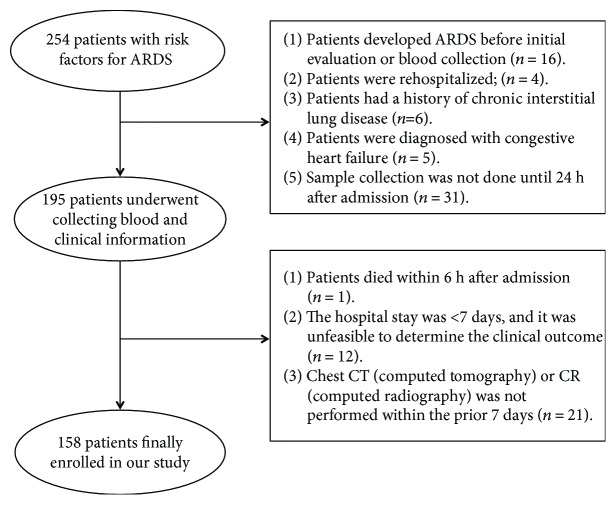
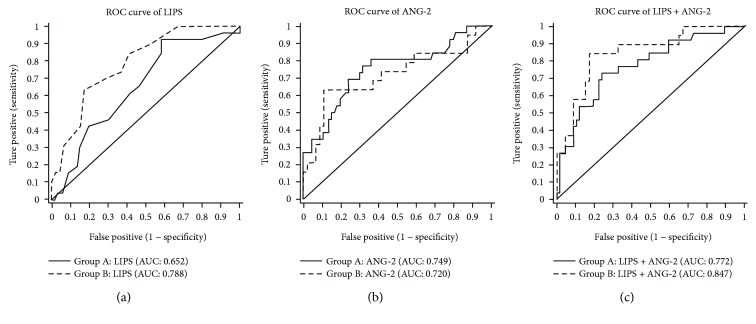
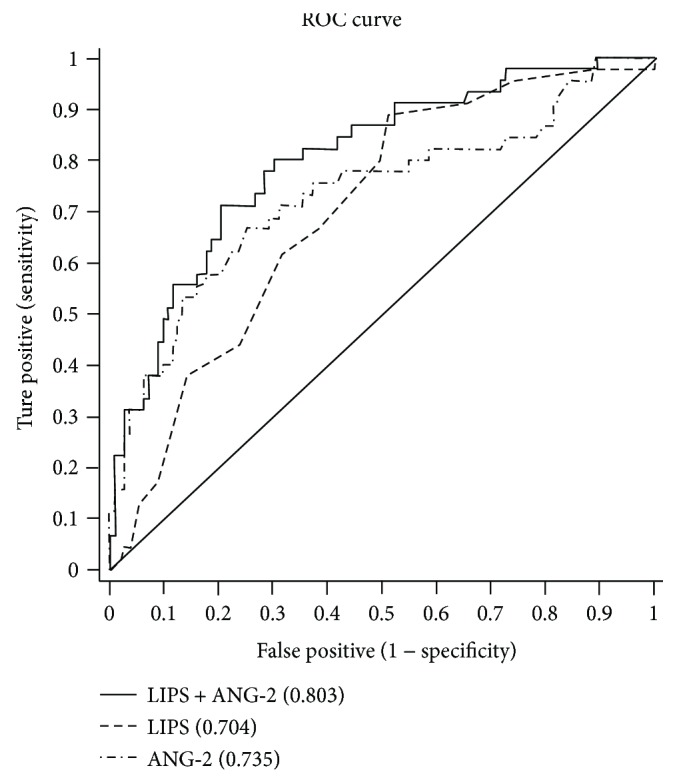
To investigate the predictive value of the acute physiology and chronic health evaluation 2 (APACHE2) score and lung injury prediction score (LIPS) for acute respiratory distress syndrome (ARDS) when combined with biomarkers for this condition in patients with ARDS risk factors. In total, 158 Han Chinese patients with ARDS risk factors were recruited from the Respiratory and Emergency Intensive Care Units. The LIPS, APACHE2 score, primary diagnosis at admission, and ARDS risk factors were determined within 6 h of admission, and PaO/FiO was determined on the day of admission. Blood was collected within 24 h of admission for the measurement of angiopoietin-2 (ANG-2), sE-selectin, interleukin-6 (IL-6), and interleukin-8 (IL-8) levels. ARDS was monitored for the next 7 days. Univariate and multivariate analyses and receiver operating characteristic (ROC) analyses were employed to construct a model for ARDS prediction. Forty-eight patients developed ARDS within 7 days of admission. Plasma ANG-2 level, sE-selectin level, LIPS, and APACHE2 score in ARDS patients were significantly higher than those in non-ARDS patients. ANG-2 level, LIPS, and APACHE2 score were correlated with ARDS ( < 0.001, < 0.006, and < 0.042, resp.). When the APACHE2 score was used in combination with the LIPS and ANG-2 level to predict ARDS, the area under the ROC curve (AUC) was not significantly increased. Compared to LIPS or ANG-2 alone, LIPS in combination with ANG-2 had significantly increased positive predictive value (PPV) and AUC for the prediction of ARDS. In conclusion, plasma ANG-2 level, LIPS, and APACHE2 score are correlated with ARDS. Combined LIPS and ANG-2 level displays favorable sensitivity, specificity, and AUC for the prediction of ARDS.
目的 探讨急性生理学与慢性健康状况评分系统Ⅱ(APACHEⅡ)评分和肺损伤预测评分(LIPS)联合生物标志物对有急性呼吸窘迫综合征(ARDS)风险患者的预测价值。
方法 共纳入 158 例有 ARDS 风险的汉族患者,分别来自呼吸与危重症医学科。在入院后 6 h 内确定 LIPS、APACHEⅡ评分、入院时的主要诊断和 ARDS 风险因素,入院当天测定 PaO/FiO。在入院后 24 h 内采集血液,用于检测血管生成素-2(ANG-2)、可溶性 E-选择素(sE-selectin)、白细胞介素-6(IL-6)和白细胞介素-8(IL-8)水平。监测 ARDS 患者在接下来的 7 天内的情况。采用单因素和多因素分析以及受试者工作特征(ROC)分析来构建 ARDS 预测模型。
结果 48 例患者在入院后 7 天内发生 ARDS。与非 ARDS 患者相比,ARDS 患者的血浆 ANG-2 水平、sE-selectin 水平、LIPS 和 APACHEⅡ评分显著更高。ANG-2 水平、LIPS 和 APACHEⅡ评分与 ARDS 相关(均 < 0.001、 < 0.006 和 < 0.042)。当 APACHEⅡ评分联合 LIPS 和 ANG-2 水平用于预测 ARDS 时,ROC 曲线下面积(AUC)并没有显著增加。与单独使用 LIPS 或 ANG-2 相比,LIPS 联合 ANG-2 对 ARDS 的预测具有更高的阳性预测值(PPV)和 AUC。
结论 血浆 ANG-2 水平、LIPS 和 APACHEⅡ评分与 ARDS 相关。LIPS 联合 ANG-2 对 ARDS 的预测具有较好的敏感性、特异性和 AUC。