University of Florida, School of Forest Resources and Conservation, Gainesville, FL, United States of America.
The F.A. Bartlett Tree Experts Company, Charlotte, NC, United States of America.
PLoS One. 2018 Jul 18;13(7):e0199738. doi: 10.1371/journal.pone.0199738. eCollection 2018.
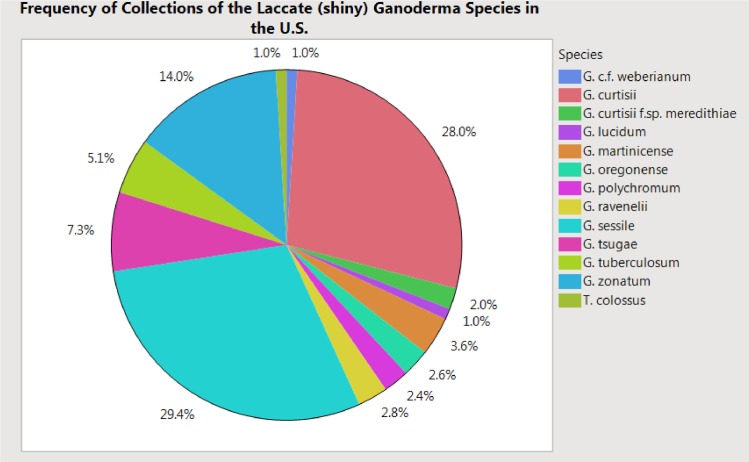
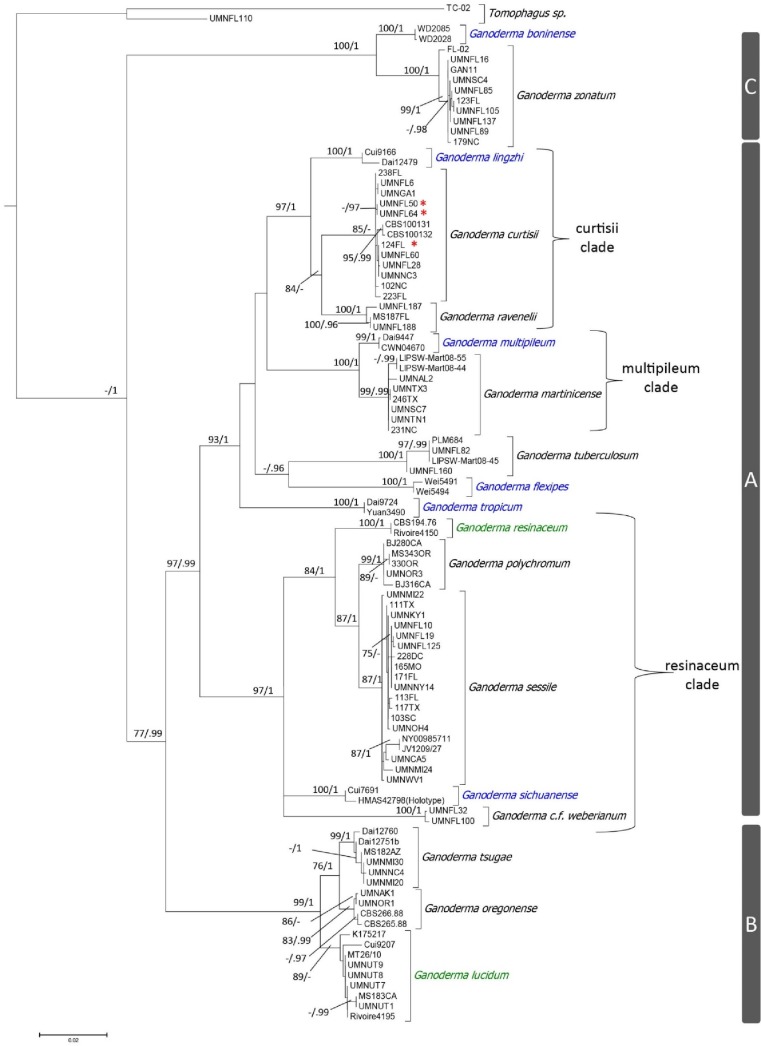
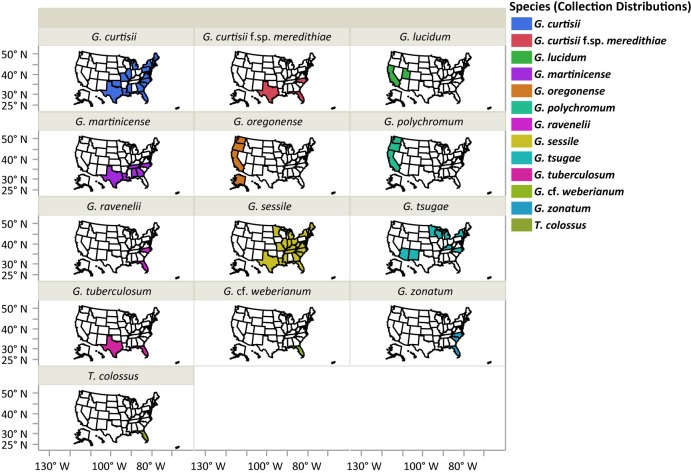
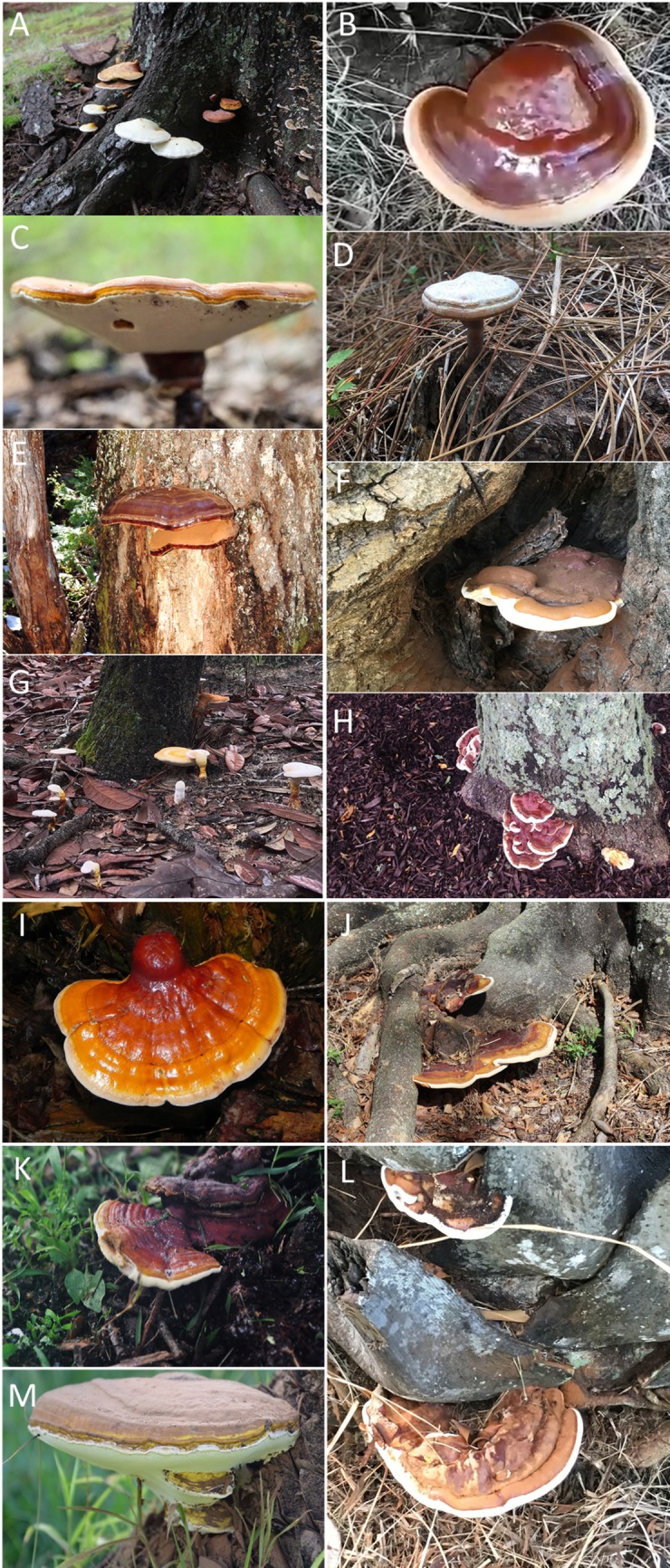
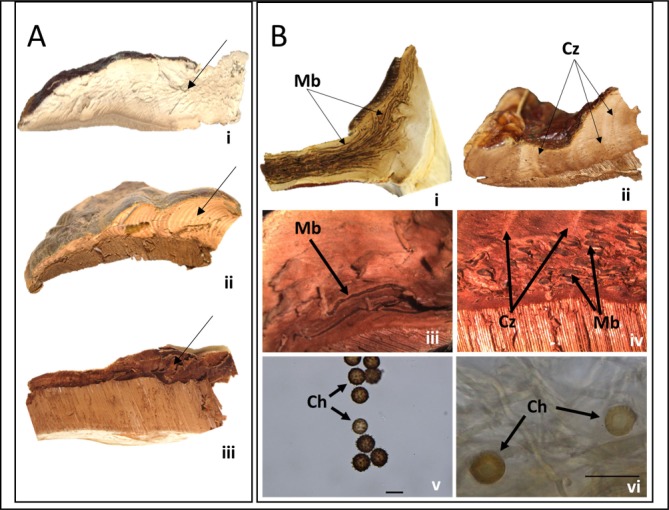
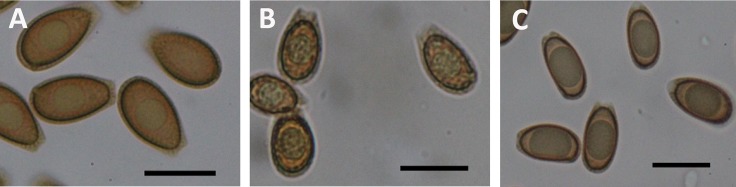
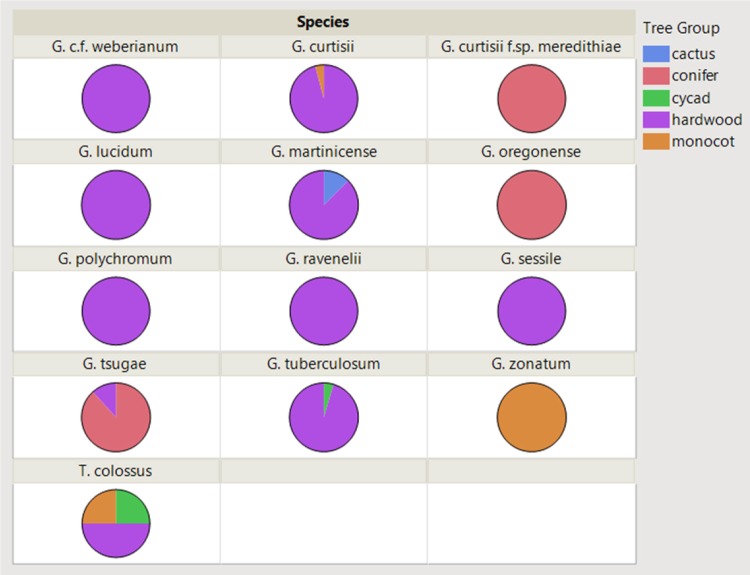
Ganoderma is a large, diverse and globally-distributed genus in the Basidiomycota that includes species causing a white rot form of wood decay on a variety of tree species. For the past century, many studies of Ganoderma in North America and other regions of the world have used the name G. lucidum sensu lato for any laccate (shiny or varnished) Ganoderma species growing on hardwood trees or substrates. Molecular studies have established that G. lucidum sensu stricto (Curtis) Karst is native to Europe and some parts of China. To determine the species of the laccate Ganoderma that are present in the United States, we studied over 500 collections from recently collected samples and herbarium specimens from hardwoods, conifers, and monocots. A multilocus phylogeny using ITS, tef1α, rpb1 and rpb2 revealed three well-supported clades, similar to previously reported findings. From the U.S. collections, thirteen taxa representing twelve species were identified, including: G. curtisii, G. lucidum sensu stricto, G. martinicense, G. oregonense, G. polychromum, G. ravenelii, G. sessile, G. tsugae, G. tuberculosum, G. cf. weberianum, G. zonatum, and Tomophagus colossus (syn. G. colossus). The species G. meredithiae is synonymized with G. curtisii, and considered a physiological variant that specializes in decay of pines. The designation G. curtisii f.sp. meredithiae forma specialis nov. is proposed. Species such as G. curtisii and G. sessile, once considered as G. lucidum sensu lato, were found to be divergent from one another, and highly divergent from G. lucidum sensu stricto. Morphological characteristics such as context tissue color and features (e.g. melanoid bands), basidiospore shape and size, geographic location, and host preference were found to aid in species identification. Surprisingly, G. lucidum sensu stricto was found in the U.S., but only in geographically restricted areas of northern Utah and California. These collections appear to have resulted from the introduction of this species into the United States possibly from mushroom growers producing G. lucidum outdoors. Overall, this study clarifies the chaotic taxonomy of the laccate Ganoderma in the United States, and will help to remove ambiguities from future studies focusing on the North American species of laccate Ganoderma.
灵芝是担子菌门中一个种类多样、分布广泛的属,包括一些能够引起多种树种木质腐朽的白腐菌。在过去的一个世纪里,许多对北美的灵芝和世界其他地区灵芝的研究都使用了广义灵芝(lucidum sensu lato)这一名称来指代生长在硬木树上或基质上的漆酶(有光泽或涂有清漆)灵芝物种。分子研究已经确定,狭义灵芝(Curtis)Karst 原产于欧洲和中国的一些地区。为了确定美国存在的漆酶灵芝的种类,我们研究了来自最近采集的样本和硬木、针叶树和单子叶植物标本的 500 多个采集物。使用 ITS、tef1α、rpb1 和 rpb2 的多基因系统发育树揭示了三个支持良好的分支,与之前的报告结果相似。从美国的采集物中,鉴定出了 13 个代表 12 个种的分类群,包括:Curtisia curtisii、狭义灵芝、灵芝马丁西斯、灵芝奥勒冈、灵芝多色、灵芝拉维内利、灵芝 sessile、灵芝 tsugae、灵芝 tuberculosum、灵芝 Weberianum、灵芝 zonatum 和 Tomophagus colossus(同义词灵芝 colossus)。Meredithia 种被归入 Curtisii 种,被认为是一种专门分解松树的生理变体。提出了新的特别形式的 Curtisii f.sp. meredithiae forma specialis nov. 名称。像 Curtisii 和 sessile 这样的物种,曾经被认为是广义灵芝 sensu lato,现在被发现与彼此以及与狭义灵芝 sensu stricto 有很大的差异。形态特征,如组织颜色和特征(如黑素带)、担孢子形状和大小、地理位置和宿主偏好,被发现有助于物种鉴定。令人惊讶的是,狭义灵芝 sensu stricto 在美国被发现,但仅在犹他州和加利福尼亚州北部的地理限制区域。这些采集物似乎是由于该物种被引入美国,可能是蘑菇种植者在户外生产灵芝 lucidum 所致。总的来说,这项研究澄清了美国漆酶灵芝混乱的分类学,并将有助于消除未来关于北美的漆酶灵芝物种研究中的歧义。