Geramita Emily M, Herbeck Belnap Bea, Abebe Kaleab Z, Rothenberger Scott D, Rotondi Armando J, Rollman Bruce L
Division of General Internal Medicine, University of Pittsburgh Medical Center, Pittsburgh, PA, United States.
Department of Psychosomatic Medicine and Psychotherapy, University of Göttingen Medical Center, Göttingen, Germany.
J Med Internet Res. 2018 Jul 17;20(7):e10402. doi: 10.2196/10402.
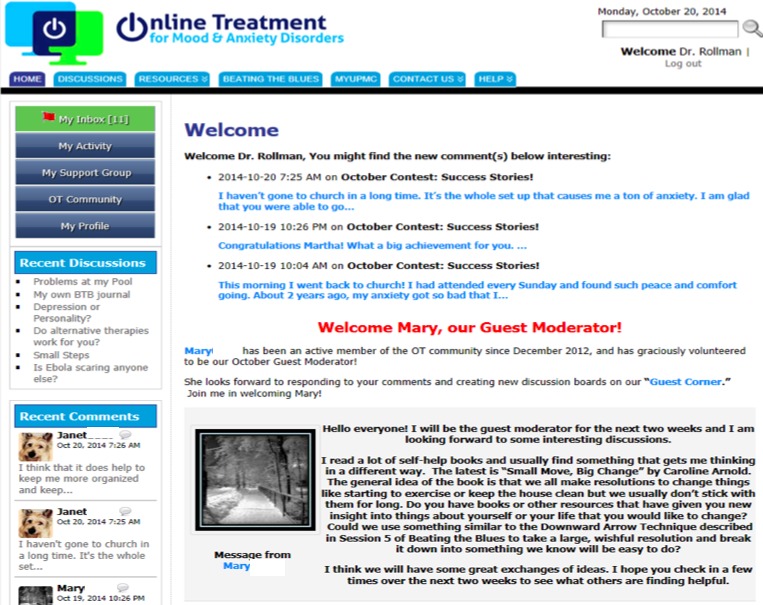
We recently reported that depressed and anxious primary care patients randomized to a moderated internet support group (ISG) plus computerized cognitive behavioral therapy (cCBT) did not experience improvements in depression and anxiety over cCBT alone at 6-month follow-up.
The 1% rule posits that 1% of participants in online communities generate approximately 90% of new user-created content. The aims of this study were to apply the 1% rule to categorize patient engagement with the ISG and identify whether any patient subgroups benefitted from ISG use.
We categorized the 302 patients randomized to the ISG as: superusers (3/302, 1.0%), top contributors (30/302, 9.9%), contributors (108/302, 35.8%), observers (87/302, 28.8%) and those who never logged in (74/302, 24.5%). We then applied linear mixed models to examine associations between engagement and 6-month changes in health-related quality of life (HRQoL; Short Form Health Survey Mental Health Component, SF-12 MCS) and depression and anxiety symptoms (Patient-Reported Outcomes Measurement Information System, PROMIS).
At baseline, participant mean age was 42.6 years, 81.1% (245/302) were female, and mean Patient Health Questionnaire (PHQ-9), Generalized Anxiety Disorder scale (GAD-7), and SF-12 MCS scores were 13.4, 12.6, and 31.7, respectively. Of the 75.5% (228/302) who logged in, 61.8 % (141/228) created ≥1 post (median 1, interquartile range, IQR 0-5); superusers created 42.3 % (630/1488) of posts (median 246, IQR 78-306), top contributors created 34.6% (515/1488; median 11, IQR 10-18), and contributors created 23.1 % (343/1488; median 3, IQR 1-5). Compared to participants who never logged in, the combined superuser + top contributor subgroup (n=33) reported 6-month improvements in anxiety (PROMIS: -11.6 vs -7.8; P=.04) and HRQoL (SF-12 MCS: 16.1 vs 10.1; P=.01) but not in depression. No other subgroup reported significant symptom improvements.
Patient engagement with the ISG was more broadly distributed than predicted by the 1% rule. The 11% of participants with the highest engagement levels reported significant improvements in anxiety and HRQoL.
ClinicalTrials.gov NCT01482806; https://clinicaltrials.gov/ct2/show/NCT01482806 (Archived by WebCite at http://www.webcitation.org/708Bjlge9).
我们最近报告称,在6个月的随访中,随机分配至适度互联网支持小组(ISG)加计算机化认知行为疗法(cCBT)的抑郁和焦虑初级保健患者,与仅接受cCBT的患者相比,抑郁和焦虑症状并未得到改善。
“1%规则”假定在线社区中1%的参与者产生了约90%的新用户创建内容。本研究的目的是应用“1%规则”对患者参与ISG的情况进行分类,并确定是否有任何患者亚组从使用ISG中受益。
我们将随机分配至ISG的302名患者分为:超级用户(3/302,1.0%)、顶级贡献者(30/302,9.9%)、贡献者(108/302,35.8%)、观察者(87/302,28.8%)和从未登录者(74/302,24.5%)。然后,我们应用线性混合模型来检验参与度与6个月健康相关生活质量(HRQoL;简短健康调查问卷心理健康分量表,SF-12 MCS)以及抑郁和焦虑症状(患者报告结局测量信息系统,PROMIS)变化之间的关联。
基线时,参与者的平均年龄为42.6岁,81.1%(245/302)为女性,患者健康问卷(PHQ-9)、广泛性焦虑障碍量表(GAD-7)和SF-12 MCS的平均得分分别为13.4、12.6和31.7。在登录的75.5%(228/302)患者中,61.8%(141/228)创建了≥1个帖子(中位数为1,四分位间距,IQR 0 - 5);超级用户创建了42.3%(630/1488)的帖子(中位数为246,IQR 78 - 306),顶级贡献者创建了34.6%(515/1488;中位数为11,IQR 10 - 18),贡献者创建了23.1%(343/1488;中位数为3,IQR 1 - 5)。与从未登录的参与者相比,超级用户 + 顶级贡献者联合亚组(n = 33)报告在6个月时焦虑(PROMIS:-11.6对-7.8;P = 0.04)和HRQoL(SF-12 MCS:16.1对10.1;P = 0.01)有所改善,但抑郁症状未改善。没有其他亚组报告症状有显著改善。
患者对ISG的参与度分布比“1%规则”预测的更广泛。参与度最高的11%参与者报告焦虑和HRQoL有显著改善。
ClinicalTrials.gov NCT01482806;https://clinicaltrials.gov/ct2/show/NCT01482806(由WebCite存档于http://www.webcitation.org/708Bjlge9)。