
用于组织工程应用的聚合物表面改性:精氨酸作为一种粘性蛋白类似物,用于容纳活细胞。
Surface Modification of Polymers for Tissue Engineering Applications: Arginine Acts as a Sticky Protein Equivalent for Viable Cell Accommodation.
作者信息
Sengupta Poulomi, Prasad Bhagavatula L V
机构信息
Physical Chemistry Division, CSIR National Chemical Laboratory Dr. Homi Bhabha Road, Pashan, Pune 411008, India.
出版信息
ACS Omega. 2018 Apr 30;3(4):4242-4251. doi: 10.1021/acsomega.8b00215. Epub 2018 Apr 16.
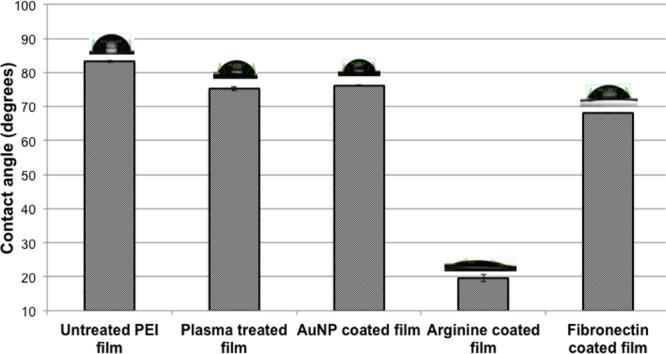
Hydrophobic polymers, for their favorable mechanical properties, are a popular choice as permanent bioimplants. These materials remain absolutely bioinert for years, but throw up challenges when it comes to fast integration with healthy tissue. Addressing this, herein, we present a surface-modification technique of converting the hydrophobic surface of a polymeric film into a hydrophilic one using a layer-by-layer assembly process involving gold nanoparticles and small molecules like amino acids. These films showed much improved animal cell (murine fibroblast) adherence properties compared to commercially available tissue culture plates. Moreover, arginine-modified films exhibited a nearly equivalent cell viability compared to the films modified with the natural extracellular matrix component fibronectin. The surface hydrophilicity and roughness of our novel film were characterized by contact angle measurement and atomic force microscopy. Cell counting, fluorescence microscopy, cell viability, and collagen estimation assay were employed to demonstrate that our film favored a much improved cell adherence, and accommodation in comparison to the commercially available tissue culture plates.
疏水性聚合物因其良好的机械性能,是作为永久性生物植入物的热门选择。这些材料多年来一直完全生物惰性,但在与健康组织快速整合方面却带来了挑战。针对这一问题,在此我们提出一种表面改性技术,通过涉及金纳米颗粒和氨基酸等小分子的层层组装过程,将聚合物薄膜的疏水表面转化为亲水表面。与市售组织培养板相比,这些薄膜显示出显著改善的动物细胞(小鼠成纤维细胞)粘附特性。此外,与用天然细胞外基质成分纤连蛋白修饰的薄膜相比,精氨酸修饰的薄膜表现出几乎相同的细胞活力。通过接触角测量和原子力显微镜对我们新型薄膜的表面亲水性和粗糙度进行了表征。采用细胞计数、荧光显微镜、细胞活力和胶原蛋白估计测定法来证明,与市售组织培养板相比,我们的薄膜有利于显著改善细胞粘附和容纳能力。




 Zotero 插件