Respiratory Group, Division of Applied Health Sciences, University of Aberdeen, Aberdeen AB25 2ZP, UK.
Respiratory Group, Division of Applied Health Sciences, University of Aberdeen, Aberdeen AB25 2ZP, UK; Liverpool School of Tropical Medicine, Department of Clinical Sciences, Pembroke Place, Liverpool L3 5QA, UK.
Environ Int. 2018 Oct;119:429-437. doi: 10.1016/j.envint.2018.07.002. Epub 2018 Jul 20.
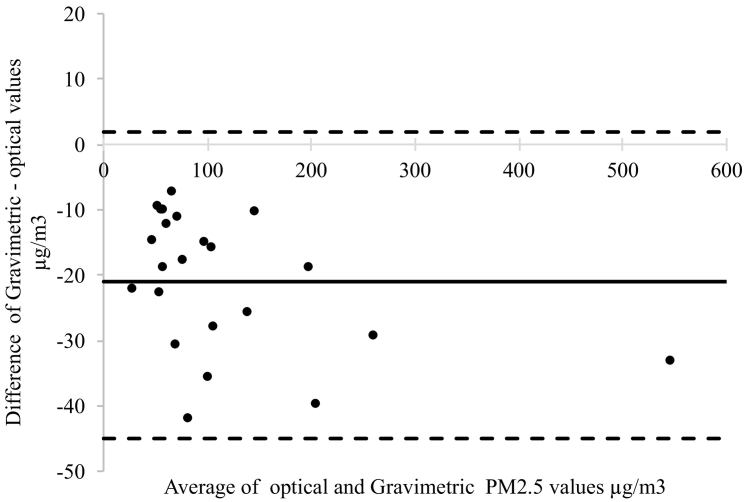
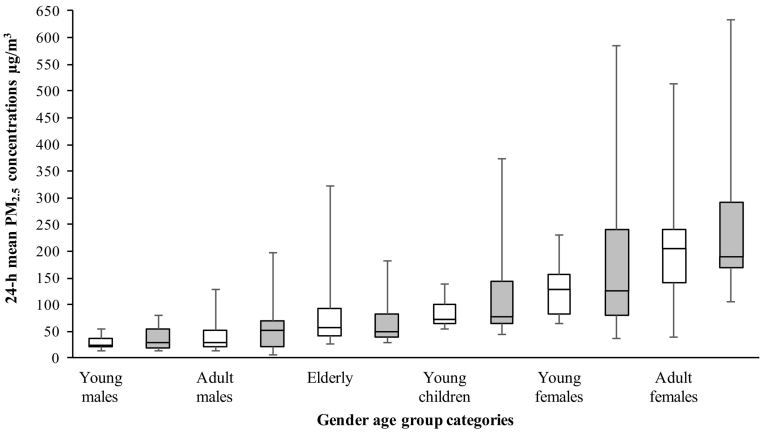
Household Air Pollution (HAP) from burning biomass fuels is a major cause of mortality and morbidity in low-income settings worldwide. Little is known about the differences in objective personal HAP exposure by age and gender. We measured personal exposure to HAP across six groups defined by age and gender (young children, young males, young females, adult males, adult females, and elderly) in rural households in two sub-Saharan African countries. Data on 24-hour personal exposure to HAP were collected from 215 participants from 85 households in Uganda and Ethiopia. HAP exposure was assessed by measuring carbon monoxide (CO) and/or fine particulate matter (PM) concentrations using five types of devices. 24 h PM personal exposure was highest among adult females with Geometric Mean (GM) and Geometric Standard Deviation (GSD) concentrations of 205 μg/m (1.67) in Ethiopia; 177 μg/m (1.61 GSD) in Uganda. The lowest PM exposures were recorded among young males GM (GSD) 30.2 μg/m (1.89) in Ethiopia; 26.3 μg/m (1.48) in Uganda. Young females had exposures about two-thirds of the adult female group. Adult males, young children and the elderly experienced lower exposures reflecting their limited involvement in cooking. There was a similar pattern of exposure by age and gender in both countries and when assessed by CO measurement. There are substantial differences in exposure to HAP depending on age and gender in sub-Saharan Africa rural households reflecting differences in household cooking activity and time spent indoors. Future work should consider these differences when implementing exposure reduction interventions. There was a strong agreement between optical and gravimetric devices measurements although optical devices tended to overestimate exposure. There is need to calibrate optical devices against a gravimetric standard prior to quantifying exposure.
家庭空气污染(HAP)源于燃烧生物质燃料,是全球低收入环境中导致死亡和发病的主要原因。关于年龄和性别对个人 HAP 暴露的影响差异知之甚少。我们在撒哈拉以南非洲的两个国家的农村家庭中,根据年龄和性别(幼儿、年轻男性、年轻女性、成年男性、成年女性和老年人)将六个组别定义为目标人群,对其 HAP 个人暴露情况进行了测量。我们从乌干达和埃塞俄比亚 85 个家庭的 215 名参与者中收集了 24 小时个人 HAP 暴露数据。通过使用五种设备来测量一氧化碳(CO)和/或细颗粒物(PM)浓度,评估 HAP 暴露情况。24 小时 PM 个人暴露量在埃塞俄比亚成年女性中最高,几何平均值(GM)和几何标准差(GSD)浓度分别为 205μg/m(1.67);在乌干达为 177μg/m(1.61 GSD)。PM 暴露量最低的是年轻男性,GM(GSD)分别为 30.2μg/m(1.89)在埃塞俄比亚;26.3μg/m(1.48)在乌干达。年轻女性的暴露量约为成年女性组的三分之二。成年男性、幼儿和老年人的暴露量较低,这反映了他们在烹饪方面的参与度有限。在这两个国家以及通过 CO 测量评估时,都呈现出与年龄和性别相似的暴露模式。在撒哈拉以南非洲农村家庭中,HAP 暴露情况因年龄和性别而异,这反映了家庭烹饪活动和室内停留时间的差异。在实施减少暴露的干预措施时,应考虑到这些差异。尽管光学设备往往会高估暴露量,但光学设备和重量设备的测量结果之间存在很强的一致性。在对暴露量进行量化之前,需要使用重量设备对光学设备进行校准。