Nephrology Department, IIS-Fundación Jiménez Díaz-Universidad Autónoma de Madrid, 28040 Madrid, Spain.
Department of Internal Medicine, Koc University School of Medicine, Istanbul 34450, Turkey.
Toxins (Basel). 2018 Jul 19;10(7):300. doi: 10.3390/toxins10070300.
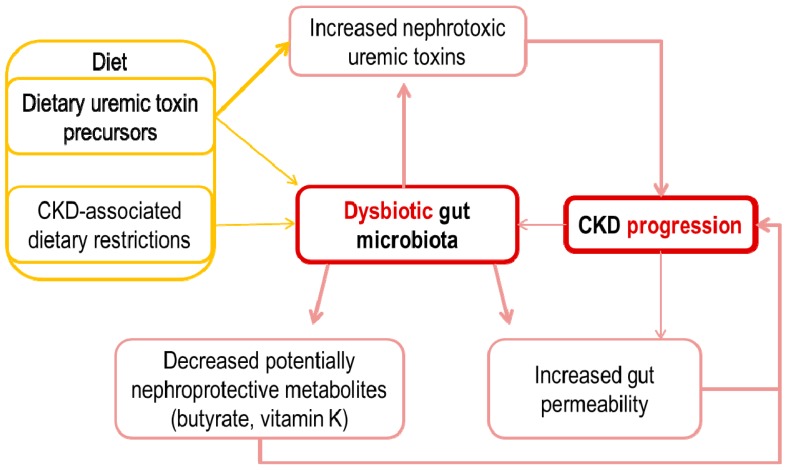
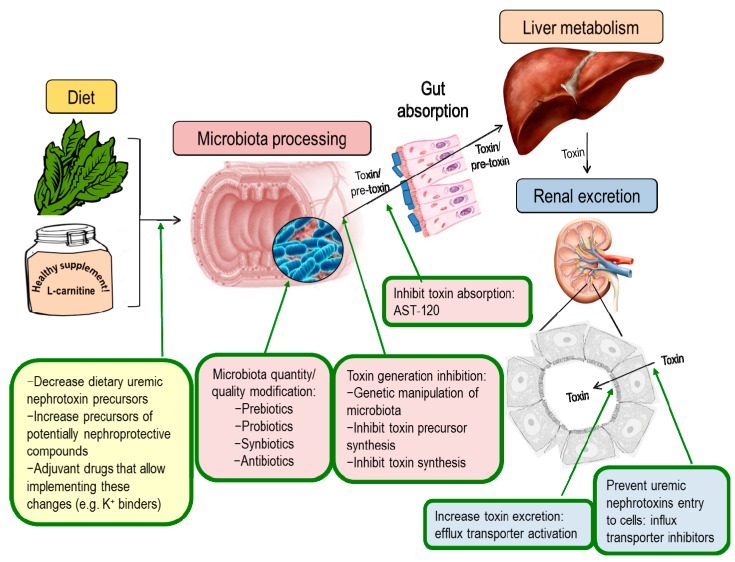
In chronic kidney disease (CKD), accumulation of uremic toxins is associated with an increased risk of CKD progression. Some uremic toxins result from nutrient processing by gut microbiota, yielding precursors of uremic toxins or uremic toxins themselves, such as trimethylamine N-Oxide (TMAO), p-cresyl sulphate, indoxyl sulphate and indole-3 acetic acid. Increased intake of some nutrients may modify the gut microbiota, increasing the number of bacteria that process them to yield uremic toxins. Circulating levels of nutrient-derived uremic toxins are associated to increased risk of CKD progression. This offers the opportunity for therapeutic intervention by either modifying the diet, modifying the microbiota, decreasing uremic toxin production by microbiota, increasing toxin excretion or targeting specific uremic toxins. We now review the link between nutrients, microbiota and uremic toxin with CKD progression. Specific focus will be placed on the generation specific uremic toxins with nephrotoxic potential, the decreased availability of bacteria-derived metabolites with nephroprotective potential, such as vitamin K and butyrate and the cellular and molecular mechanisms linking these toxins and protective factors to kidney diseases. This information provides a conceptual framework that allows the development of novel therapeutic approaches.
在慢性肾脏病(CKD)中,尿毒症毒素的积累与 CKD 进展的风险增加有关。一些尿毒症毒素是肠道微生物群对营养物质加工的结果,产生尿毒症毒素的前体或尿毒症毒素本身,如三甲胺 N-氧化物(TMAO)、对甲酚硫酸盐、吲哚硫酸和吲哚-3-乙酸。一些营养素摄入的增加可能会改变肠道微生物群,增加处理它们产生尿毒症毒素的细菌数量。来源于营养素的尿毒症毒素的循环水平与 CKD 进展的风险增加有关。这为通过改变饮食、改变微生物群、减少微生物群产生的尿毒症毒素、增加毒素排泄或针对特定尿毒症毒素来进行治疗干预提供了机会。我们现在回顾了营养素、微生物群和尿毒症毒素与 CKD 进展之间的联系。特别关注具有肾毒性的特定尿毒症毒素的产生、具有肾保护潜力的细菌衍生代谢物的可用性降低,如维生素 K 和丁酸盐,以及将这些毒素和保护因素与肾脏疾病联系起来的细胞和分子机制。这些信息提供了一个概念框架,允许开发新的治疗方法。