Department of Internal Medicine, University of Michigan Medical School, Ann Arbor, Michigan, USA.
Center for Clinical Management Research, Veterans Affairs Ann Arbor Healthcare System, Ann Arbor, Michigan, USA.
BMJ Qual Saf. 2019 Jan;28(1):74-84. doi: 10.1136/bmjqs-2017-007573. Epub 2018 Jul 25.
Identifying characteristics associated with struggling healthcare organisations may help inform improvement. Thus, we systematically reviewed the literature to: (1) Identify organisational factors associated with struggling healthcare organisations and (2) Summarise these factors into actionable domains.
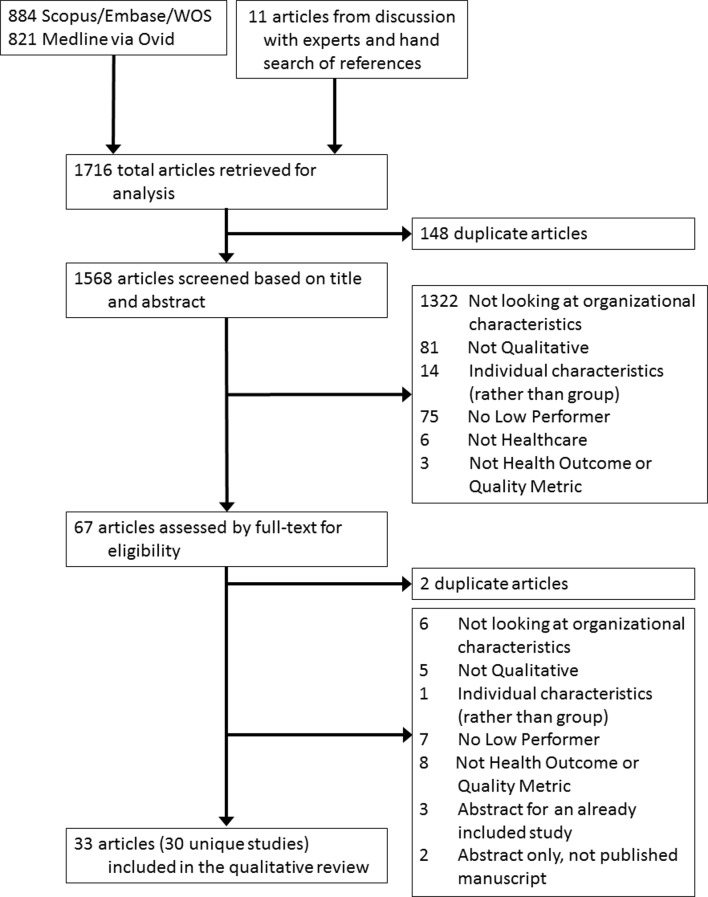
Systematic review of qualitative studies that evaluated organisational characteristics of healthcare organisations that were struggling as defined by below-average patient outcomes (eg, mortality) or quality of care metrics (eg, Patient Safety Indicators). Searches were conducted in MEDLINE (via Ovid), EMBASE, Cochrane Library, CINAHL, and Web of Science from database inception through February 8 2018. Qualitative data were analysed using framework-based synthesis and summarised into key domains. Study quality was evaluated using the Critical Appraisal Skills Program tool.
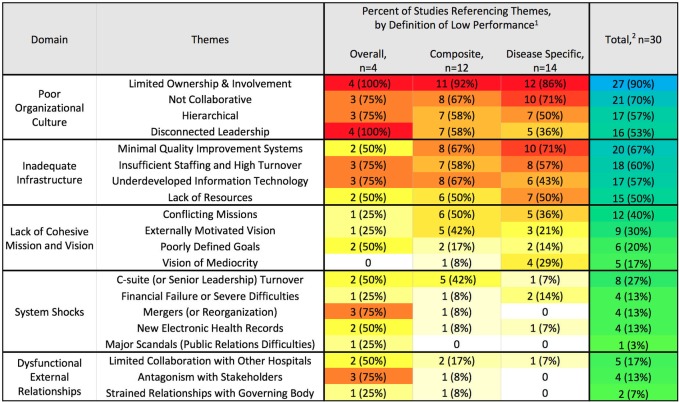
Thirty studies (33 articles) from multiple countries and settings (eg, acute care, outpatient) with a diverse range of interviewees (eg, nurses, leadership, staff) were included in the final analysis. Five domains characterised struggling healthcare organisations: poor organisational culture (limited ownership, not collaborative, hierarchical, with disconnected leadership), inadequate infrastructure (limited quality improvement, staffing, information technology or resources), lack of a cohesive mission (mission conflicts with other missions, is externally motivated, poorly defined or promotes mediocrity), system shocks (ie, events such as leadership turnover, new electronic health record system or organisational scandals that detract from daily operations), and dysfunctional external relations with other hospitals, stakeholders, or governing bodies.
Struggling healthcare organisations share characteristics that may affect their ability to provide optimal care. Understanding and identifying these characteristics may provide a first step to helping low performers address organisational challenges to improvement.
PROSPERO: CRD42017067367.
确定与陷入困境的医疗机构相关的特征可能有助于提供改进信息。因此,我们系统地回顾了文献,以:(1)确定与表现不佳的医疗机构相关的组织因素;(2)将这些因素总结为可操作的领域。
系统地回顾了评估表现不佳的医疗机构(定义为患者预后(如死亡率)或护理质量指标(如患者安全指标)低于平均水平的医疗机构)的组织特征的定性研究。检索了 MEDLINE(通过 Ovid)、EMBASE、Cochrane 图书馆、CINAHL 和 Web of Science 从数据库创建到 2018 年 2 月 8 日的文献。使用基于框架的综合方法对定性数据进行分析,并将其总结为关键领域。使用批判性评价技能计划工具评估研究质量。
来自多个国家和环境(如急性护理、门诊)的 30 项研究(33 篇文章)和具有不同访谈对象(如护士、领导层、工作人员)的研究被纳入最终分析。有五个领域可以描述陷入困境的医疗机构:较差的组织文化(有限的所有权、不协作、层级制、领导脱节)、基础设施不足(质量改进、人员配备、信息技术或资源有限)、缺乏凝聚力的使命(使命与其他使命冲突、受外部动机驱动、定义不明确或促进平庸)、系统冲击(即领导更替、新的电子健康记录系统或组织丑闻等事件,这些事件会影响日常运营)以及与其他医院、利益相关者或管理机构的关系失调。
陷入困境的医疗机构具有可能影响其提供最佳护理能力的特征。了解和识别这些特征可能是帮助表现不佳的医疗机构解决组织挑战以实现改进的第一步。
PROSPERO:CRD42017067367。