Department of Community Medicine and Behavioural Sciences, Faculty of Medicine, Kuwait University, Kuwait, Kuwait.
Department of Food Science and Nutrition, College of Life Sciences, Kuwait University, Kuwait, Kuwait.
BMJ Open. 2018 Aug 1;8(7):e021401. doi: 10.1136/bmjopen-2017-021401.
In Kuwait, as in many Arab states in the Gulf region, there are limited data on the prevalence of vitamin D deficiency among healthy adolescents. This study aimed to estimate the prevalence of vitamin D deficiency in a nationally representative sample of adolescents and investigate factors associated with vitamin D status.
A cross-sectional study was conducted on 1416 adolescents aged 11-16 years, who were randomly selected from middle schools in all governorates of Kuwait. Data were collected from parents through self-administered questionnaire and from adolescents through face-to-face interview. Vitamin D was measured using liquid chromatography-tandem mass spectrometry. Logistic regression was used to investigate the independent factors associated with vitamin D status.
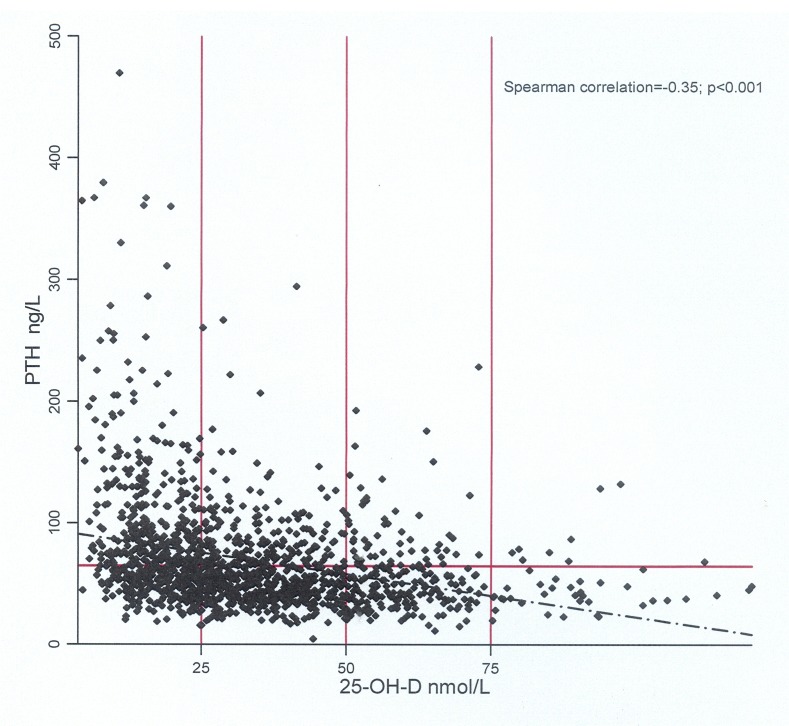
The prevalence of vitamin D deficiency was 81.21% (95% CI 71.61% to 90.81%), while severe deficiency was 39.48%. Only 3.60% of adolescents were vitamin D-sufficient. The prevalence of vitamin D deficiency was significantly higher among girls compared with boys (91.69% vs 70.32%; p<0.001). There was a significant inverse correlation between vitamin D and parathyroid hormone (Spearman correlation=-0.35; p<0.001). In the final model, gender, age, governorate, parental education, body mass index, vitamin D supplement and the number of times adolescents walk to schools per week were all significantly related to vitamin D deficiency.
High prevalence of vitamin D deficiency was noted among adolescents in Kuwait despite the abundant sunshine, which may reflect strong sun avoidance behaviour. Adequate outdoor daytime activities should be encouraged especially for girls. We call for locally tailored guidelines for vitamin D supplement in which girls should have a higher dose compared with boys.
在科威特,与海湾地区的许多阿拉伯国家一样,关于健康青少年维生素 D 缺乏症的流行率数据有限。本研究旨在评估科威特全国代表性青少年样本中维生素 D 缺乏症的流行率,并探讨与维生素 D 状况相关的因素。
对来自科威特各省中学的 1416 名 11-16 岁青少年进行了一项横断面研究。通过父母的自我管理问卷和青少年的面对面访谈收集数据。使用液相色谱-串联质谱法测量维生素 D。使用逻辑回归来调查与维生素 D 状况相关的独立因素。
维生素 D 缺乏症的患病率为 81.21%(95%CI 71.61%至 90.81%),而严重缺乏症的患病率为 39.48%。只有 3.60%的青少年维生素 D 充足。与男孩相比,女孩的维生素 D 缺乏症患病率明显更高(91.69%比 70.32%;p<0.001)。维生素 D 与甲状旁腺激素呈显著负相关(Spearman 相关系数=-0.35;p<0.001)。在最终模型中,性别、年龄、省份、父母教育程度、体重指数、维生素 D 补充剂以及青少年每周步行上学的次数均与维生素 D 缺乏症显著相关。
尽管科威特阳光充足,但青少年中维生素 D 缺乏症的患病率很高,这可能反映了强烈的避免阳光行为。应鼓励青少年进行充足的日间户外活动,特别是女孩。我们呼吁制定适合当地情况的维生素 D 补充指南,其中女孩的剂量应高于男孩。