Department of Cardiovascular Medicine, Juntendo University Graduate School of Medicine, Bunkyo-ku, Tokyo, Japan.
Research Laboratories for Health Science & Food Technologies, Kirin Co., Ltd., Yokohama, Kanagawa, Japan.
J Int Soc Sports Nutr. 2018 Aug 2;15(1):39. doi: 10.1186/s12970-018-0244-9.
Lactococcus lactis JCM 5805 (LC-Plasma) is a unique lactic acid bacteria (LAB) which activates plasmacytoid dendritic cells (pDC). We aimed to evaluate the effect of LC-Plasma on dendritic cell (DC) activity and subjective indices of upper respiratory tract infections (URTI) and fatigue in athletes under high intensity exercise.
We conducted a randomized, placebo-controlled, double-blinded trial. Fifty-one male subjects belonging to a university sports club were randomized into placebo (n = 25) and LC-Plasma (n = 26) groups. Individuals ingested placebo capsules containing cornstarch or LC-Plasma capsules containing 100 billion cells of heat-killed LC-Plasma per day for 13 days. During the intervention period, subjects performed high intensity exercise according to their sports club training regime. Blood and saliva sampling were obtained at days 1 and 14, and physical conditions were recorded in a diary. We investigated expression of maturation markers on DCs, muscle damage and stress markers and used student's t test adjusted by Bonferoni's method for multiple comparison between groups. These data were presented as mean ± SD. We also investigated cumulative days of symptoms regarding infections and fatigue and used Chi-square test for comparison between groups. These data were presented as cumulative number.
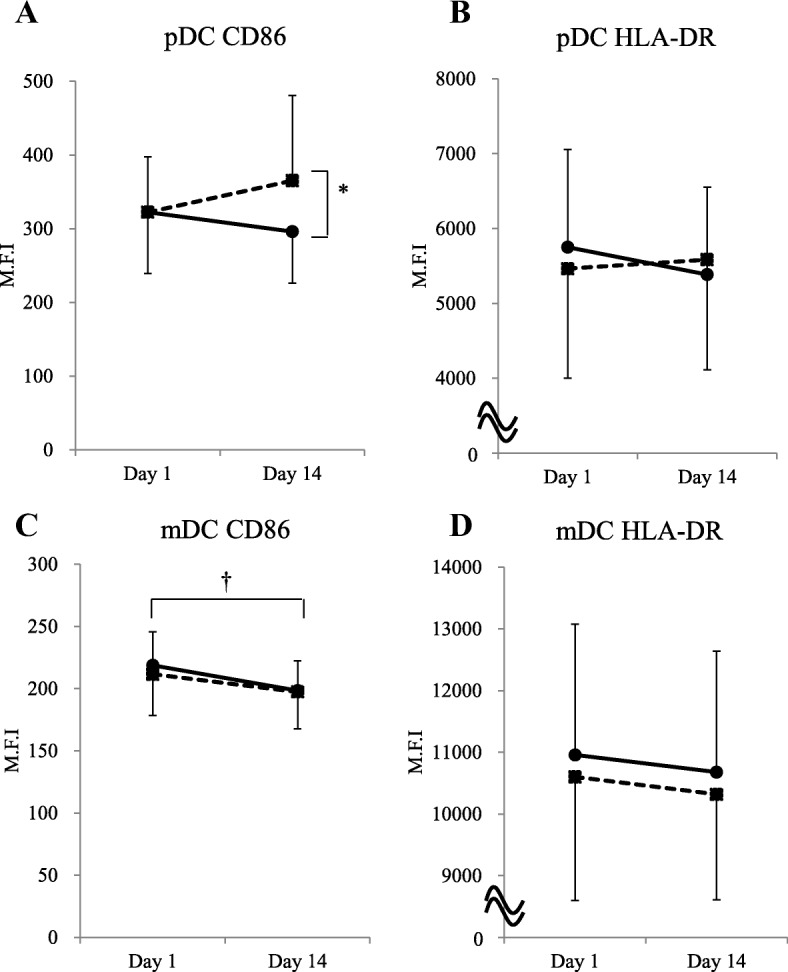
CD86 as maturation marker on pDC was significantly increased in the LC-Plasma group at day 14 (Placebo: 296 ± 70 vs. LC-Plasma: 365 ± 115; Mean Fluorescent Intensity; p = 0.013). Cumulative days of URTI were significantly lower in the LC-Plasma group (Placebo: URTI positive 56, URTI negative 256 vs. LC-Plasma: URTI positive 39, URTI negative 299; days; p = 0.028) and symptoms like sneeze or running nose were significantly lower in the LC-Plasma group (Placebo: Symptom positive 52, Symptom negative 258, vs. LC-Plasma: Symptom positive 36, Symptom negative 301; days; p = 0.032). Moreover, the cumulative days of fatigue were significantly fewer in the LC-Plasma group (Placebo: Symptom positive 128, Symptom negative 182, vs. LC-Plasma: Symptom positive 110, Symptom negative 225; days; p = 0.032). Markers of muscle damage and stress markers were not significantly different between groups.
We consider that heat-killed LC-Plasma supplementation relieves morbidity and symptoms of URTI via activation of pDC and decreases fatigue accumulation during consecutive high intensity exercise in athletes. However, LC-Plasma ingestion did not affect markers of muscle damage and stress.
UMIN-CTR, UMIN000020372 . Registered 28 December 2015.
乳球菌乳亚种 JCM 5805(LC-Plasma)是一种独特的乳酸菌(LAB),可激活浆细胞样树突状细胞(pDC)。我们旨在评估 LC-Plasma 对树突状细胞(DC)活性以及高强度运动下运动员上呼吸道感染(URTI)和疲劳的主观指标的影响。
我们进行了一项随机、安慰剂对照、双盲试验。51 名属于大学体育俱乐部的男性受试者被随机分为安慰剂(n=25)和 LC-Plasma(n=26)组。个体每天摄入安慰剂胶囊(含玉米淀粉)或 LC-Plasma 胶囊(含 1000 亿个热灭活 LC-Plasma 细胞),持续 13 天。在干预期间,根据体育俱乐部的训练方案,受试者进行高强度运动。在第 1 天和第 14 天采集血液和唾液样本,并在日记中记录身体状况。我们研究了 DC 上成熟标志物的表达、肌肉损伤和应激标志物,并使用学生 t 检验调整 Bonferoni 法进行组间多重比较。这些数据以平均值±标准差表示。我们还研究了与感染和疲劳相关的症状的累积天数,并使用卡方检验进行组间比较。这些数据以累积数表示。
第 14 天,pDC 上的 CD86 作为成熟标志物在 LC-Plasma 组中显著增加(安慰剂:296±70 vs. LC-Plasma:365±115;平均荧光强度;p=0.013)。LC-Plasma 组 URTI 的累积天数明显较低(安慰剂:URTI 阳性 56,URTI 阴性 256 vs. LC-Plasma:URTI 阳性 39,URTI 阴性 299;天数;p=0.028),打喷嚏或流鼻涕等症状明显较少(安慰剂:症状阳性 52,症状阴性 258,vs. LC-Plasma:症状阳性 36,症状阴性 301;天数;p=0.032)。此外,LC-Plasma 组的疲劳累积天数明显减少(安慰剂:症状阳性 128,症状阴性 182,vs. LC-Plasma:症状阳性 110,症状阴性 225;天数;p=0.032)。肌肉损伤和应激标志物的标志物在两组之间没有显著差异。
我们认为,热灭活 LC-Plasma 补充剂通过激活 pDC 减轻了运动员连续高强度运动期间 URTI 的发病和症状,并减少了疲劳的积累。然而,LC-Plasma 的摄入并不影响肌肉损伤和应激标志物。
UMIN-CTR,UMIN000020372。2015 年 12 月 28 日注册。