Noriler Sandriele A, Savi Daiani C, Aluizio Rodrigo, Palácio-Cortes Angela M, Possiede Yvelise M, Glienke Chirlei
Department of Basic Pathology, Federal University of Paraná, Curitiba, Brazil.
Department of Genetics, Federal University of Paraná, Curitiba, Brazil.
Front Microbiol. 2018 Jul 24;9:1526. doi: 10.3389/fmicb.2018.01526. eCollection 2018.
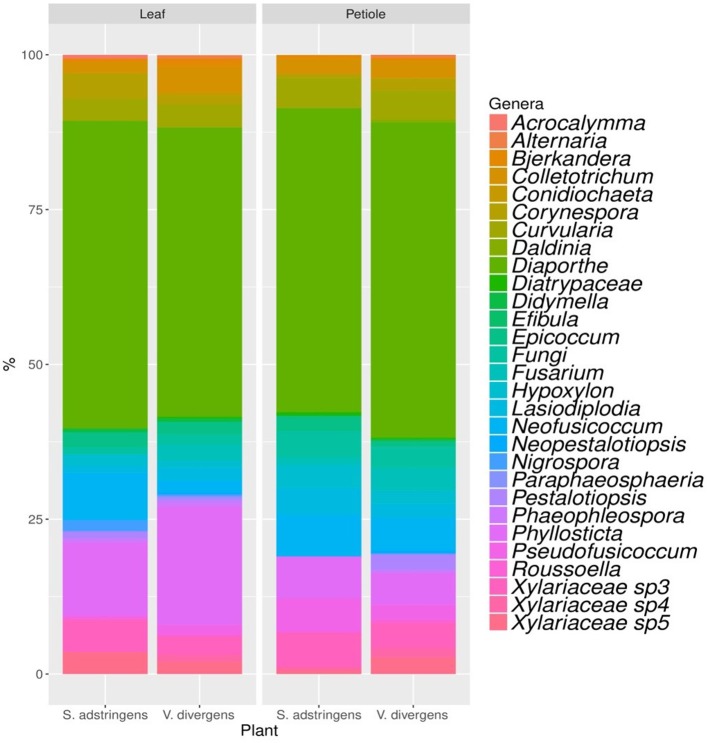
Medicinal plants have been recognized as hosts of high diverse endophytic microorganisms, including fungi that produce secondary metabolites with biological activity. Two biomes in Brazil, Pantanal (wetland), and Cerrado (savannah), are known as biodiversity hotspots, and despite their importance as a reservoir for several species, knowledge about the fungal biodiversity in these biomes is very limited. Fungal endophytic communities associated with leaves and petioles of the medicinal plants (from Pantanal) and (from Cerrado) were analyzed and studied for their antimicrobial activity against human and plant pathogens. A total of 1,146 isolates of endophytic fungi were obtained from plants collected in January and June of 2016 and grouped into 124 morphotypes. One isolate of each morphotype was identified by sequencing of internal transcribed spacer (ITS) region of the rDNA gene, which revealed the presence of 24 genera, including 3 possible new genera, and 48 taxa. Differences in the endophytic community according to the biomes were observed concerning the analyzed morphotypes. However, when we analyzed the diversity of genera and richness, they were similar for both plants, with , and as dominant genera. In addition, the community composition of differs according to the analyzed plant tissues (petiole and leaf). These data suggested that both, the plant species and plant tissues play a role in the composition of endophytic community. As regards the biotechnological potential, 5 isolates showed activity against the phytopathogens , and , and 8 isolates showed high activity against clinical pathogens and were selected for the production of crude extract in different culture media. Extract from cultivation of sp. LGMF1548 and LGMF1583 and LGMF1535 showed activity against methicillin-resistant , and . In addition, extracts of cf. LGMF1631 inhibited 90% of the mycelial growth of the and 70% of and may represent an alternative to be used in the biological control of these phytopathogens. Future research will focus on the chemical characterization and structural elucidation of these bioactive compounds.
药用植物被认为是多种内生微生物的宿主,包括能产生具有生物活性的次生代谢产物的真菌。巴西的两个生物群落,潘塔纳尔湿地(湿地)和塞拉多(稀树草原),被称为生物多样性热点地区,尽管它们作为多种物种的储存库很重要,但关于这些生物群落中真菌生物多样性的知识却非常有限。对与(来自潘塔纳尔湿地的)和(来自塞拉多的)药用植物的叶片和叶柄相关的真菌内生群落进行了分析,并研究了它们对人类和植物病原体的抗菌活性。2016年1月和6月从采集的植物中总共获得了1146株内生真菌分离株,并将其分为124个形态型。通过对rDNA基因的内部转录间隔区(ITS)进行测序,鉴定了每个形态型的一个分离株,结果显示存在24个属,包括3个可能的新属和48个分类单元。在所分析的形态型方面,观察到内生群落因生物群落不同而存在差异。然而,当我们分析属的多样性和丰富度时,两种植物的情况相似,以、和为优势属。此外,根据所分析的植物组织(叶柄和叶片),的群落组成也有所不同。这些数据表明,植物物种和植物组织在真菌内生群落的组成中都发挥了作用。至于生物技术潜力,5株分离株对植物病原体、和表现出活性,8株分离株对临床病原体表现出高活性,并被选择在不同培养基中生产粗提物。菌株LGMF1548、LGMF1583和LGMF1535培养物的提取物对耐甲氧西林的、和表现出活性。此外,菌株cf. LGMF1631的提取物抑制了90%的菌丝生长和70%的菌丝生长,可能是用于这些植物病原体生物防治的一种替代方法。未来的研究将集中在这些生物活性化合物的化学表征和结构解析上。