Ethiopian Institute of Water Resources, Addis Ababa University, Addis Ababa, Ethiopia.
Department of Epidemiology and Biostatistics, Institute of Public Health, University of Gondar, Gondar, Ethiopia.
Malar J. 2018 Aug 10;17(1):290. doi: 10.1186/s12936-018-2434-y.
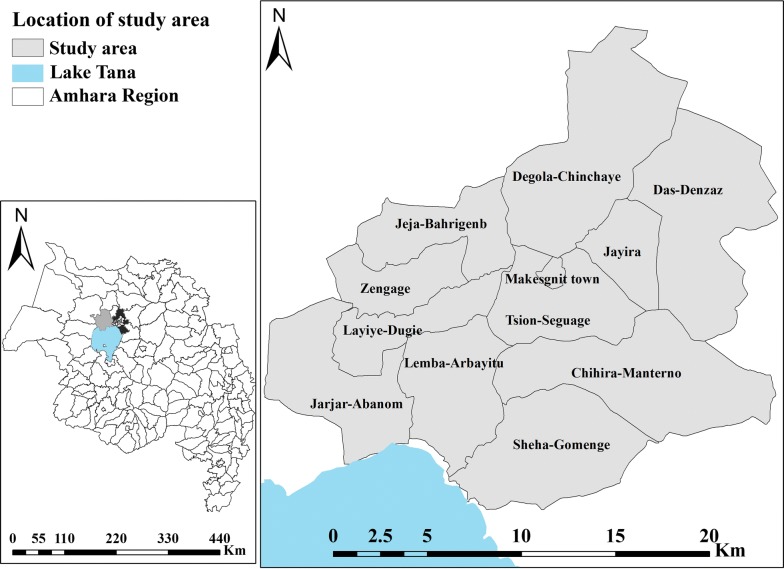
In Ethiopia, malaria has declined in the last decade; only a small number of cases have been reported, primarily from hotspots. The contribution of house proximity to water bodies and the role of migration in malaria transmission has not yet been examined in detail in northwest Ethiopia. Individual and household-level environmental and socio-demographic drivers of malaria heterogeneity were explored contextually in meso-endemic villages around Lake Tana, northwest Ethiopia.
A health facility-based paired age-sex matched case-control study involving 303 matched pairs was undertaken from 10 October 2016, to 30 June 2017. Geo-referencing of case households, control households, proximate water bodies, and health centres was carried out. A pretested and structured questionnaire was used to collect data on socio-demography, household assets, housing, travel history, and malaria intervention measures. Medians (interquartile range) were computed for continuous variables. Pearson's Chi square/Fisher's exact test was used to detect significant differences in proportions. Principal component analysis was performed to estimate household wealth. Stratified analysis was used to confirm confounding and interaction. A multivariable conditional logistic regression model was used to detect risk factors for malaria.
Of 303 malaria cases, 59 (19.5% [15.4-24.3]) were imported malaria cases whereas 244 (80.5% [75.7-84.6]) were locally acquired malaria cases. In bivariate analysis, marital status, educational status, and bed net ownership were significantly associated with malaria cases. In multivariable adjustment, travel to malarious lowlands in the preceding month (adjusted mOR = 7.32; 95% CI 2.40-22.34), household member's travel to malarious lowlands (adjusted mOR = 2.75; 95% CI 1.02-7.44), and inadequate health information on malaria (adjusted mOR = 1.57; 95% CI 1.03-2.41) were predictors of malaria. Stratified analysis confirmed that elevation of households and travel to malarious lowlands were not effect modifiers. Travel to malarious lowlands had a confounding effect on malaria but elevation of households did not.
In this study, travel to farms in the lowlands and inadequate health information on malaria were risk factors for malaria in villages around Lake Tana. This evidence is critical for the design of improved strategic interventions that consider imported malaria cases and approaches for accessing health information on malaria control in northwest Ethiopia.
在过去十年中,埃塞俄比亚的疟疾发病率有所下降;主要来自热点地区的报告病例数量很少。在埃塞俄比亚西北部,房屋靠近水体以及移民在疟疾传播中的作用尚未得到详细研究。在埃塞俄比亚西北部塔纳湖周围的中-高度流行村庄中,从上下文角度探讨了个体和家庭层面的环境和社会人口驱动因素对疟疾异质性的影响。
2016 年 10 月 10 日至 2017 年 6 月 30 日,开展了一项基于卫生机构的 303 对年龄和性别匹配的病例对照研究。对病例家庭、对照家庭、附近水体和卫生中心进行了地理定位。使用经过预测试和结构化的问卷收集了社会人口统计学、家庭资产、住房、旅行史和疟疾干预措施的数据。连续变量的中位数(四分位距)。使用 Pearson's Chi 平方/Fisher's 精确检验检测比例的显著差异。进行主成分分析以估计家庭财富。分层分析用于确认混杂和相互作用。使用多变量条件逻辑回归模型检测疟疾的危险因素。
在 303 例疟疾病例中,59 例(19.5%[15.4-24.3])为输入性疟疾病例,244 例(80.5%[75.7-84.6])为本地获得性疟疾病例。在单变量分析中,婚姻状况、教育程度和蚊帐拥有情况与疟疾病例显著相关。在多变量调整中,在前一个月前往疟疾低地旅行(调整后的优势比[OR] = 7.32;95%置信区间 [CI] 2.40-22.34)、家庭成员前往疟疾低地旅行(调整后的 OR = 2.75;95% CI 1.02-7.44)和缺乏疟疾健康信息(调整后的 OR = 1.57;95% CI 1.03-2.41)是疟疾的预测因素。分层分析证实,家庭的升高和前往疟疾低地旅行不是效应修饰物。前往疟疾低地旅行对疟疾有混杂影响,但家庭的升高没有。
在这项研究中,前往低地农场旅行和缺乏疟疾健康信息是塔纳湖周围村庄疟疾的危险因素。这一证据对于设计改进的战略干预措施至关重要,这些措施考虑到输入性疟疾病例,并考虑到在埃塞俄比亚西北部获取疟疾控制健康信息的方法。