School of Medical and Health Sciences, Edith Cowan University, Joondalup, WA 6027, Australia.
Medical School, Royal Perth Hospital Unit, The University of Western Australia, Perth, WA 6000, Australia.
Nutrients. 2018 Aug 13;10(8):1081. doi: 10.3390/nu10081081.
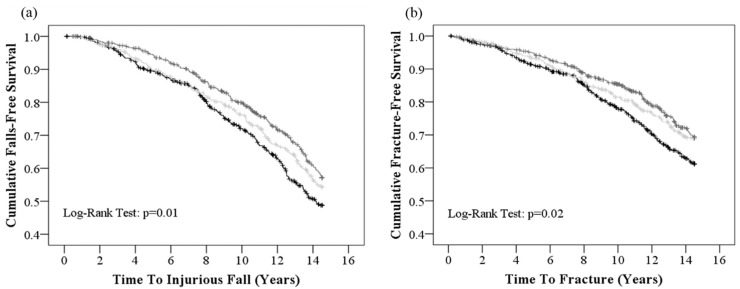
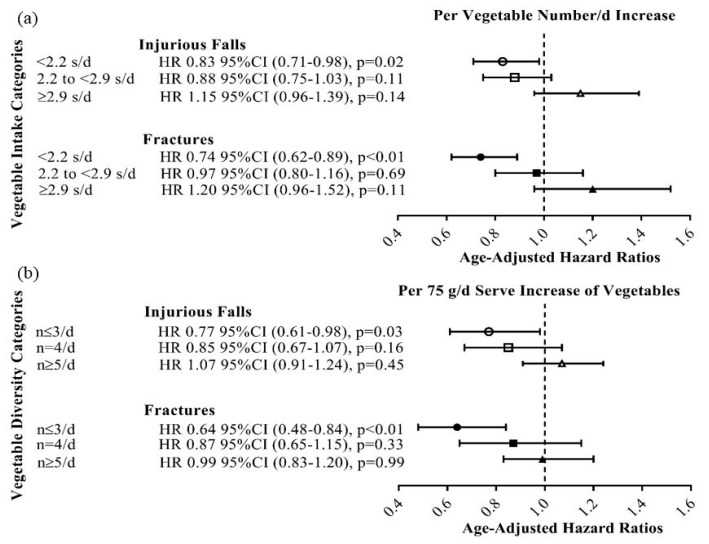
The importance of vegetable diversity for the risk of falling and fractures is unclear. Our objective was to examine the relationship between vegetable diversity with injurious falling and fractures leading to hospitalization in a prospective cohort of older Australian women ( = 1429, ≥70 years). Vegetable diversity was quantified by assessing the number of different vegetables consumed daily. Vegetable intake (75 g servings/day) was estimated using a validated food frequency questionnaire at baseline (1998). Over 14.5 years, injurious falls (events = 568, 39.7%), and fractures (events = 404, 28.3%) were captured using linked health records. In multivariable-adjusted Cox regression models, women with greater vegetable diversity (per increase in one different vegetable/day) had lower relative hazards for falls (8%; = 0.02) and fractures (9%; = 0.03). A significant interaction between daily vegetable diversity (number/day) and total vegetable intake (75 g servings/day) was observed for falls ( = 0.03) and fractures ( < 0.001). The largest benefit of higher vegetable diversity were observed in the one third of women with the lowest vegetable intake (<2.2 servings/day; falls HR 0.83 95% CI (0.71⁻0.98); fractures HR 0.74 95% CI (0.62⁻0.89)). Increasing vegetable diversity especially in older women with low vegetable intake may be an effective way to reduce injurious fall and fracture risk.
蔬菜多样性对跌倒和骨折风险的重要性尚不清楚。我们的目的是在一项前瞻性队列研究中,研究澳大利亚老年女性(n = 1429,年龄≥70 岁)中蔬菜多样性与伤害性跌倒和导致住院的骨折之间的关系。蔬菜多样性通过评估每天食用的不同蔬菜种类数量来量化。蔬菜摄入量(75 克份/天)是在基线(1998 年)使用经过验证的食物频率问卷来估计的。在 14.5 年的随访期间,使用链接的健康记录记录伤害性跌倒(事件=568,39.7%)和骨折(事件=404,28.3%)。在多变量调整的 Cox 回归模型中,蔬菜多样性更高的女性(每天增加一种不同的蔬菜)跌倒(8%;=0.02)和骨折(9%;=0.03)的相对风险较低。每天蔬菜多样性(数量/天)与总蔬菜摄入量(75 克份/天)之间存在显著交互作用跌倒(=0.03)和骨折(<0.001)。在蔬菜摄入量最低的三分之一女性(<2.2 份/天;跌倒 HR 0.83 95%CI(0.71-0.98);骨折 HR 0.74 95%CI(0.62-0.89))中,更高蔬菜多样性的最大获益。特别在蔬菜摄入量低的老年女性中增加蔬菜多样性可能是降低伤害性跌倒和骨折风险的有效方法。