McGovern Institute for Brain Research, Massachusetts Institute of Technology, Cambridge, Massachusetts, United States of America.
Laboratory for Neuroanatomy and Cerebellar Neurobiology, Department of Neurology, Massachusetts General Hospital, Harvard Medical School, Boston, Massachusetts, United States of America.
PLoS One. 2019 Jan 16;14(1):e0210028. doi: 10.1371/journal.pone.0210028. eCollection 2019.
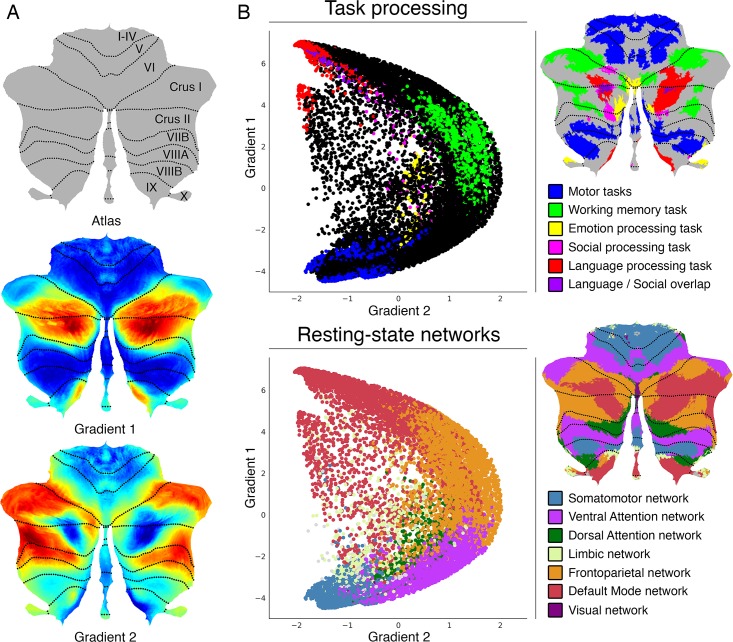
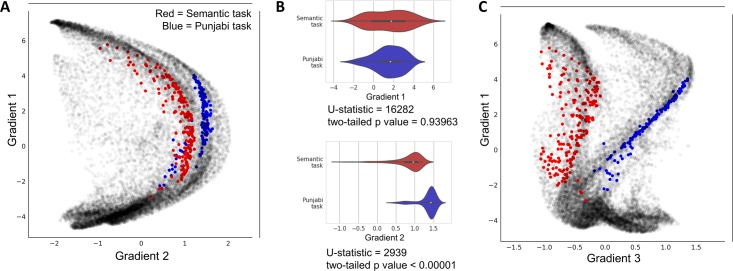
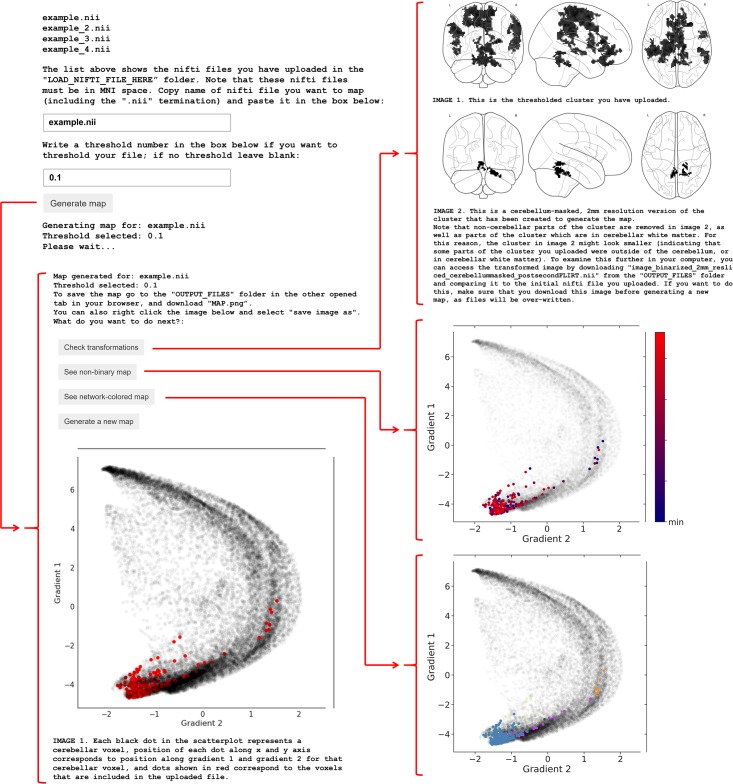
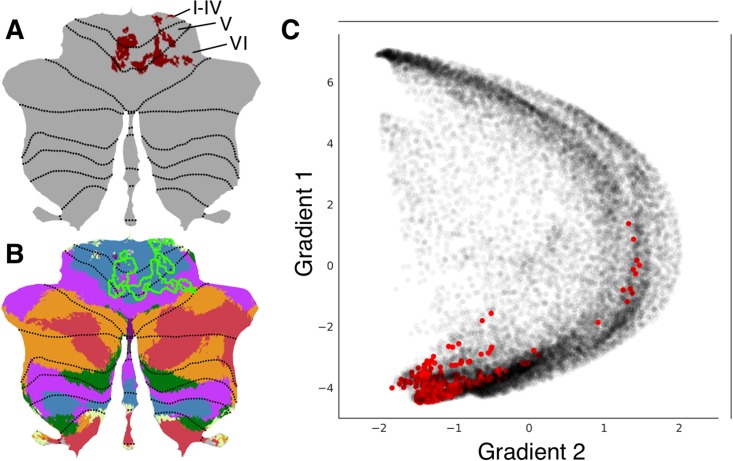
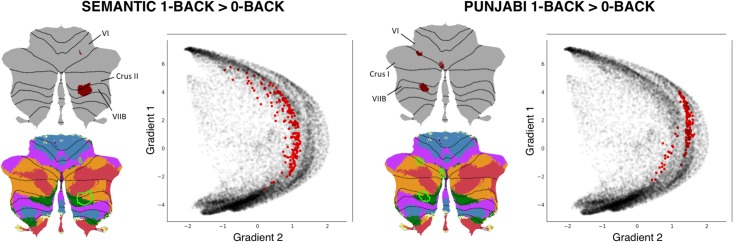
Gradient-based approaches to brain function have recently unmasked fundamental properties of brain organization. Diffusion map embedding analysis of resting-state fMRI data revealed a primary-to-transmodal axis of cerebral cortical macroscale functional organization. The same method was recently used to analyze resting-state data within the cerebellum, revealing for the first time a sensorimotor-fugal macroscale organization principle of cerebellar function. Cerebellar gradient 1 extended from motor to non-motor task-unfocused (default-mode network) areas, and cerebellar gradient 2 isolated task-focused processing regions. Here we present a freely available and easily accessible tool that applies this new knowledge to the topographical interpretation of cerebellar neuroimaging findings. LittleBrain illustrates the relationship between cerebellar data (e.g., volumetric patient study clusters, task activation maps, etc.) and cerebellar gradients 1 and 2. Specifically, LittleBrain plots all voxels of the cerebellum in a two-dimensional scatterplot, with each axis corresponding to one of the two principal functional gradients of the cerebellum, and indicates the position of cerebellar neuroimaging data within these two dimensions. This novel method of data mapping provides alternative, gradual visualizations that complement discrete parcellation maps of cerebellar functional neuroanatomy. We present application examples to show that LittleBrain can also capture subtle, progressive aspects of cerebellar functional neuroanatomy that would be difficult to visualize using conventional mapping techniques. Download and use instructions can be found at https://xaviergp.github.io/littlebrain.
基于梯度的大脑功能方法最近揭示了大脑组织的基本属性。静息态 fMRI 数据的扩散映射嵌入分析揭示了大脑皮质宏观功能组织的从初级到跨模态的轴。最近,同样的方法被用于分析小脑的静息态数据,首次揭示了小脑功能的感觉运动-远心性宏观组织原则。小脑梯度 1 从运动延伸到非运动无焦点(默认模式网络)区域,小脑梯度 2 则分离了专注于任务的处理区域。在这里,我们提供了一个免费且易于访问的工具,该工具将这一新知识应用于小脑神经影像学发现的地形学解释。LittleBrain 说明了小脑数据(例如,容积患者研究簇、任务激活图等)与小脑梯度 1 和 2 之间的关系。具体来说,LittleBrain 在二维散点图中绘制了小脑的所有体素,每个轴对应于小脑的两个主要功能梯度之一,并指示小脑神经影像学数据在这两个维度中的位置。这种新的数据映射方法提供了替代的、渐进的可视化效果,补充了小脑功能神经解剖的离散分割图。我们展示了应用示例,表明 LittleBrain 还可以捕捉到小脑功能神经解剖中难以用传统映射技术可视化的微妙的、渐进的方面。下载和使用说明可以在 https://xaviergp.github.io/littlebrain 找到。