Dong Ping, Feng Jing-Jing, Yan Dong-Yong, Lyu Yu-Jing, Xu Xiu
Department of Child Healthcare, Children's Hospital of Fudan University, 399 Wanyuan Road, Shanghai 201102, PR China.
Saudi J Biol Sci. 2018 Jul;25(5):875-880. doi: 10.1016/j.sjbs.2017.11.051. Epub 2017 Nov 28.
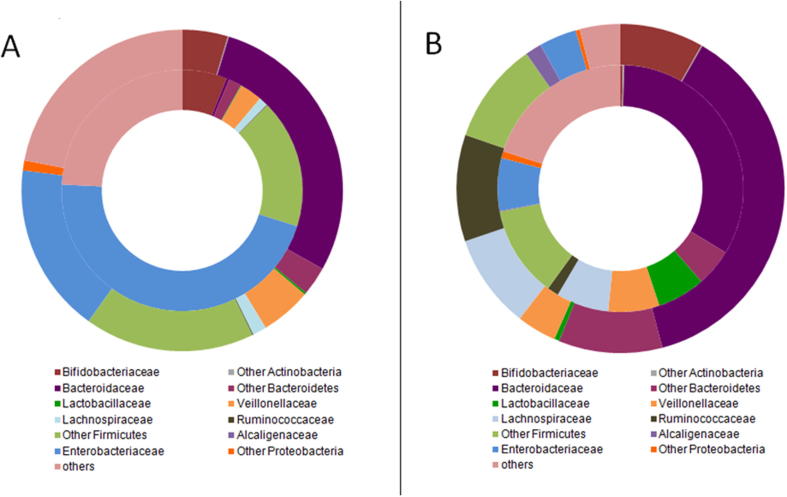
Increasing evidence suggests that perturbations in the intestinal microbiota in early infancy are implicated in the pathogenesis of food allergy (FA); existing evidence on the structure and composition of the intestinal microbiota in human beings with FA is limited and conflicting. The main object of the study was to compare the faecal microbiota between healthy and cow's milk allergy (CMA) infants at the baseline immediately after the diagnosis, and to evaluate the changes in the faecal microbiota after 6 months of treatment of CMA infants with hypoallergenic formula (HF), compared with healthy children fed on standard milk formulae. Sixty infants younger than 4 months of age with challenge-proven CMA and 60 healthy age-matched children were investigated in this prospective case - control follow-up study. Faecal samples were collected at baseline and at 6 months of follow-up, microbial diversity and composition were characterized by high-throughput 16S rRNA sequencing. The average age (±SD) of the infants at inclusion was 2.9 ± 1.0 months. Children with CMA have lower gut microbiota diversity and an elevated Enterobacteriaceae to Bacteroidaceae (E/B ratio) in early infancy compared with healthy children (115.8 vs. 0.8, P = 0.0002). After 6 months of treatment with HF, CMA infants had a higher Lactobacillaceae (6.3% vs. 0.5%, P = 0.04) and lower Bifidobacteriaceae (0.3% vs. 8.2%, P = 0.03) and Ruminococcaceae (1.5% vs. 10.5%, P = 0.03) abundance compared with control children. : Low gut microbiota diversity and an elevated E/B ratio in early infancy may contribute to the development of FA, including CMA. A strict elimination diet may weaken FA by reducing E/B ratio and promoting a gut microbiota that would benefit the acquisition of oral tolerance.
越来越多的证据表明,婴儿早期肠道微生物群的紊乱与食物过敏(FA)的发病机制有关;关于FA患者肠道微生物群的结构和组成的现有证据有限且相互矛盾。本研究的主要目的是比较诊断后立即处于基线水平的健康婴儿和牛奶过敏(CMA)婴儿的粪便微生物群,并评估CMA婴儿用低敏配方奶粉(HF)治疗6个月后粪便微生物群的变化,与喂养标准牛奶配方奶粉的健康儿童进行比较。在这项前瞻性病例对照随访研究中,对60名4个月以下经激发试验证实患有CMA的婴儿和60名年龄匹配的健康儿童进行了调查。在基线和随访6个月时采集粪便样本,通过高通量16S rRNA测序对微生物多样性和组成进行表征。纳入研究的婴儿的平均年龄(±标准差)为2.9±1.0个月。与健康儿童相比,CMA儿童在婴儿早期肠道微生物群多样性较低,肠杆菌科与拟杆菌科的比例(E/B比)升高(115.8对0.8,P = 0.0002)。用HF治疗6个月后,与对照儿童相比,CMA婴儿的乳酸杆菌科丰度更高(6.3%对0.5%,P = 0.04),双歧杆菌科和瘤胃球菌科丰度更低(0.3%对8.2%,P = 0.03;1.5%对10.5%,P = 0.03)。婴儿早期肠道微生物群多样性低和E/B比升高可能导致包括CMA在内的FA的发生。严格的消除饮食可能通过降低E/B比和促进有利于获得口服耐受性的肠道微生物群来减轻FA。