Zhi Dongmei, Calhoun Vince D, Lv Luxian, Ma Xiaohong, Ke Qing, Fu Zening, Du Yuhui, Yang Yongfeng, Yang Xiao, Pan Miao, Qi Shile, Jiang Rongtao, Yu Qingbao, Sui Jing
Brainnetome Center and National Laboratory of Pattern Recognition, Institute of Automation, Chinese Academy of Sciences, Beijing, China.
University of Chinese Academy of Sciences, Beijing, China.
Front Psychiatry. 2018 Jul 31;9:339. doi: 10.3389/fpsyt.2018.00339. eCollection 2018.
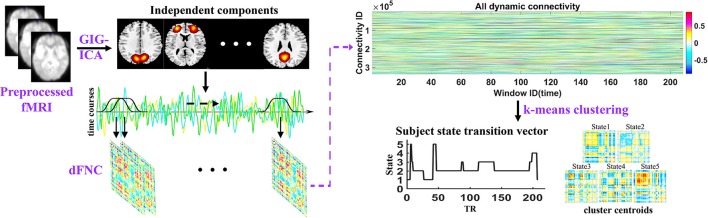
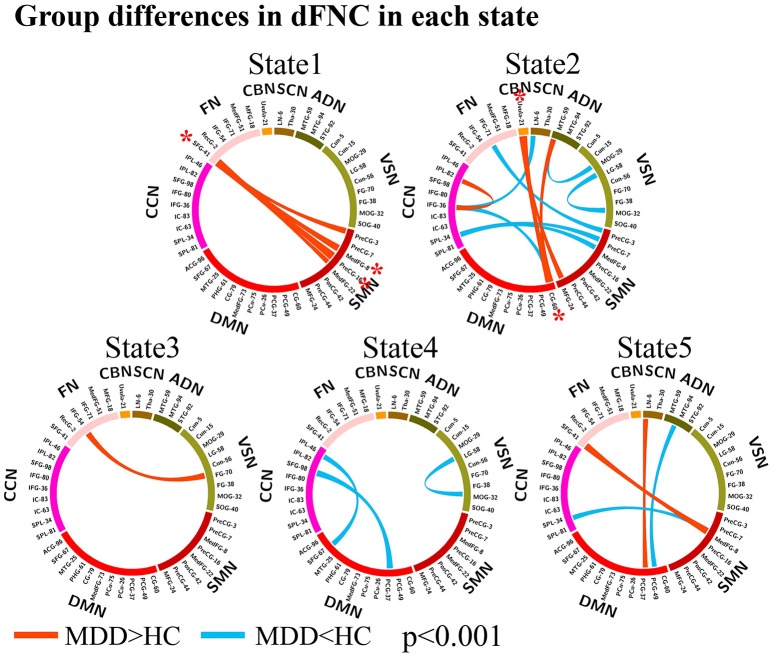
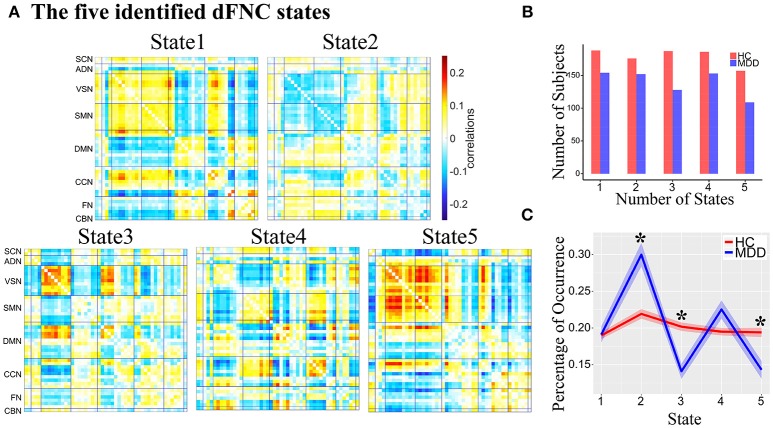
Major depressive disorder (MDD) is a complex mood disorder characterized by persistent and overwhelming depression. Previous studies have identified abnormalities in large scale functional brain networks in MDD, yet most of them were based on static functional connectivity. In contrast, here we explored disrupted topological organization of dynamic functional network connectivity (dFNC) in MDD based on graph theory. One hundred and eighty-two MDD patients and 218 healthy controls were included in this study, all Chinese Han people. By applying group information guided independent component analysis (GIG-ICA) to resting-state functional magnetic resonance imaging (fMRI) data, the dFNCs of each subject were estimated using a sliding window method and k-means clustering. Network properties including global efficiency, local efficiency, node strength and harmonic centrality, were calculated for each subject. Five dynamic functional states were identified, three of which demonstrated significant group differences in their percentage of state occurrence. Interestingly, MDD patients spent much more time in a weakly-connected State 2, which includes regions previously associated with self-focused thinking, a representative feature of depression. In addition, the FNCs in MDD were connected differently in different states, especially among prefrontal, sensorimotor, and cerebellum networks. MDD patients exhibited significantly reduced harmonic centrality primarily involving parietal lobule, lingual gyrus and thalamus. Moreover, three dFNCs with disrupted node properties were commonly identified in different states, and also correlated with depressive symptom severity and cognitive performance. This study is the first attempt to investigate the dynamic functional abnormalities in MDD in a Chinese population using a relatively large sample size, which provides new evidence on aberrant time-varying brain activity and its network disruptions in MDD, which might underscore the impaired cognitive functions in this mental disorder.
重度抑郁症(MDD)是一种复杂的情绪障碍,其特征为持续且强烈的抑郁情绪。以往研究已发现MDD患者大脑大规模功能网络存在异常,但其中大多数基于静态功能连接。相比之下,我们在此基于图论探究了MDD患者动态功能网络连接性(dFNC)的拓扑组织破坏情况。本研究纳入了182例MDD患者和218名健康对照,均为中国汉族人群。通过将组信息引导的独立成分分析(GIG-ICA)应用于静息态功能磁共振成像(fMRI)数据,使用滑动窗口法和k均值聚类估计每个受试者的dFNC。计算每个受试者的网络属性,包括全局效率、局部效率、节点强度和谐波中心性。识别出五种动态功能状态,其中三种状态的出现百分比存在显著组间差异。有趣的是,MDD患者在弱连接的状态2中花费的时间更多,该状态包括先前与自我聚焦思维相关的区域,这是抑郁症的一个典型特征。此外,MDD患者的功能网络连接性在不同状态下存在差异,尤其是前额叶、感觉运动和小脑网络之间。MDD患者的谐波中心性显著降低,主要涉及顶叶小叶、舌回和丘脑。此外,在不同状态下共同识别出三个节点属性破坏的dFNC,它们还与抑郁症状严重程度和认知表现相关。本研究首次尝试使用相对大的样本量调查中国人群MDD患者的动态功能异常,为MDD患者异常的随时间变化的脑活动及其网络破坏提供了新证据,这可能突出了这种精神障碍中受损的认知功能。