Singapore Eye Research Institute, Singapore National Eye Centre.
Academic Clinical Program, Duke-NUS Medical School.
J Hypertens. 2019 Mar;37(3):572-580. doi: 10.1097/HJH.0000000000001916.
Reduction in capillary density or rarefaction is a hallmark of essential hypertension. We measured the retinal capillary density using noninvasive optical coherence tomographic angiography (OCT-A) in adults with treated systemic hypertension and determined possible correlations with ambulatory blood pressure (BP) and renal parameters.
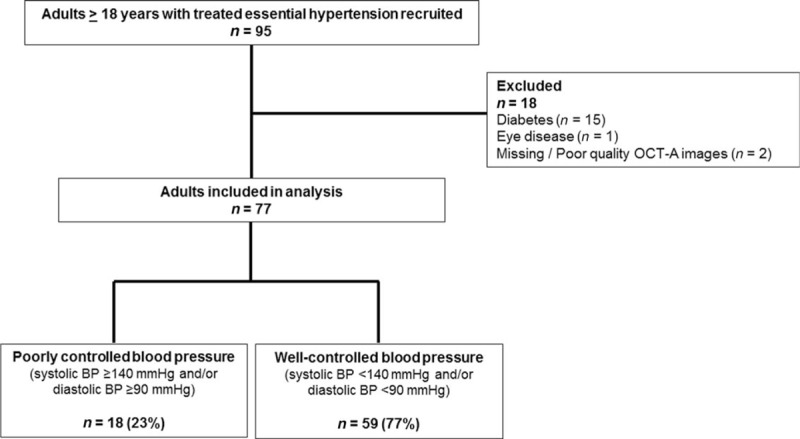
This observational cross-sectional study consisted of 153 normal eyes from 77 nondiabetic hypertensive adults [mean (SD) age, 58 (9) years; 49% women; 23% poorly controlled BP]. Data on 24-h ambulatory BP monitoring, serum creatinine, and urine microalbumin/creatinine ratio (MCR) were collected. Estimated glomerular filtration rate (eGFR) was calculated based on CKD-EPI Creatinine Equation. Retinal capillary density measured with the OCT-A (AngioVue) at superficial (SVP) and deep vascular plexuses (DVP). Linear regression was used to investigate the association of risk factors with capillary density.
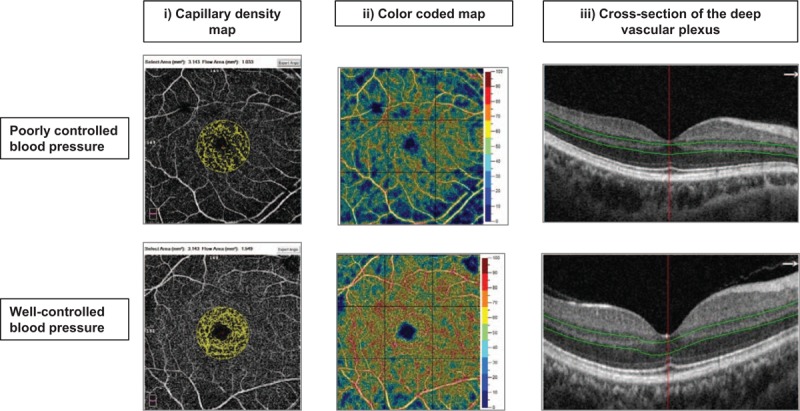
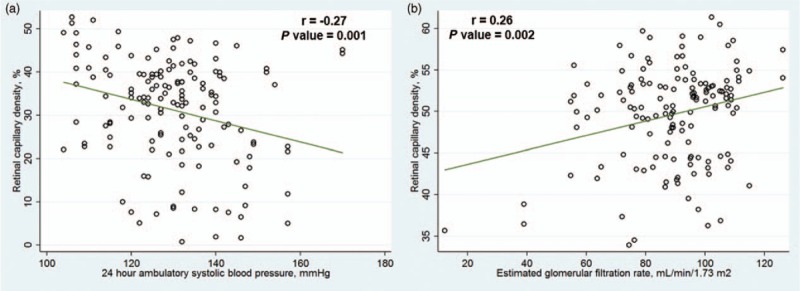
Retinal capillary density (percentage) at DVP was reduced in patients with poorly controlled BP (SBP = 148 ± 8 mmHg; 27.2 ± 13.0) compared with those with well controlled BP (SBP = 125 ± 9 mmHg; 34.7 ± 11.3). In the multivariable analysis, poorly controlled BP [β = -6.49, 95% confidence interval (CI), -12.39 to -0.59], higher SBP (β = -0.23, 95% CI -0.44 to -0.02) and lower eGFR (β = 6.42, 95% CI 1.25-11.60) were associated with sparser retinal capillary density. Systemic factors were not associated with capillary density at SVP (all P > 0.05).
In adults with treated systemic hypertension, retinal capillary density reduced with higher BP and poorer eGFR. These findings highlight the potential role of OCT-A to study early microvascular changes because of systemic hypertension.
毛细血管密度降低或稀疏是原发性高血压的一个标志。我们使用非侵入性光学相干断层扫描血管造影(OCT-A)测量了接受治疗的系统性高血压成年人的视网膜毛细血管密度,并确定了与动态血压(BP)和肾脏参数的可能相关性。
这项观察性横断面研究包括 77 名非糖尿病高血压成年人的 153 只正常眼[平均(SD)年龄,58(9)岁;49%为女性;23%血压控制不佳]。收集 24 小时动态血压监测、血清肌酐和尿微量白蛋白/肌酐比值(MCR)的数据。根据 CKD-EPI Creatinine Equation 计算估计肾小球滤过率(eGFR)。使用 OCT-A(AngioVue)测量浅层(SVP)和深层血管丛(DVP)的视网膜毛细血管密度。线性回归用于研究危险因素与毛细血管密度的关系。
血压控制不佳的患者(SBP = 148 ± 8 mmHg;27.2 ± 13.0)的 DVP 处视网膜毛细血管密度(百分比)低于血压控制良好的患者(SBP = 125 ± 9 mmHg;34.7 ± 11.3)。在多变量分析中,血压控制不佳[β=-6.49,95%置信区间(CI)-12.39 至-0.59]、较高的 SBP(β=-0.23,95%CI-0.44 至-0.02)和较低的 eGFR(β=6.42,95%CI 1.25-11.60)与视网膜毛细血管密度稀疏相关。系统因素与 SVP 处的毛细血管密度无关(所有 P > 0.05)。
在接受治疗的系统性高血压成年人中,视网膜毛细血管密度随血压升高和 eGFR 降低而降低。这些发现强调了 OCT-A 用于研究系统性高血压引起的早期微血管变化的潜力。