Sensory-Motor Systems Lab, Department of Health Sciences and Technology, Swiss Federal Institute of Technology (ETH Zurich), Tannenstrasse 1, Zurich, 8092, Switzerland.
Spinal Cord Injury Center, University Hospital Balgrist, University of Zurich, Forchstrasse 340, Zurich, 8008, Switzerland.
J Neuroeng Rehabil. 2018 Aug 16;15(1):79. doi: 10.1186/s12984-018-0413-8.
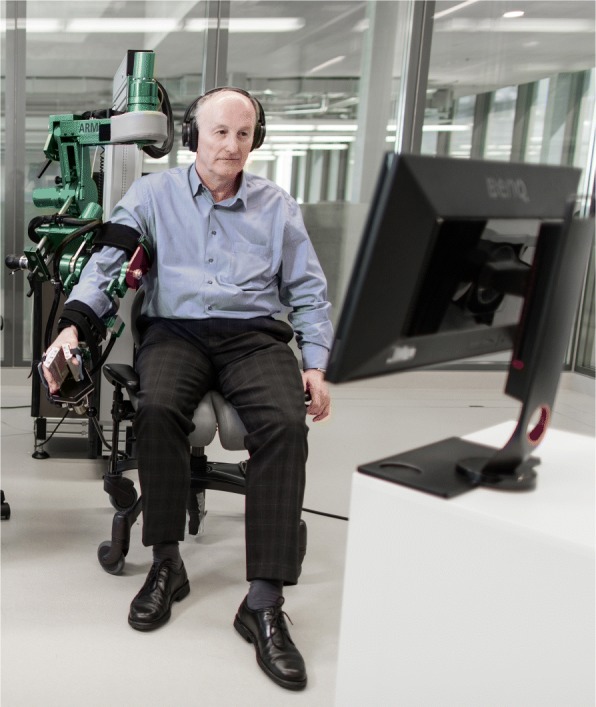
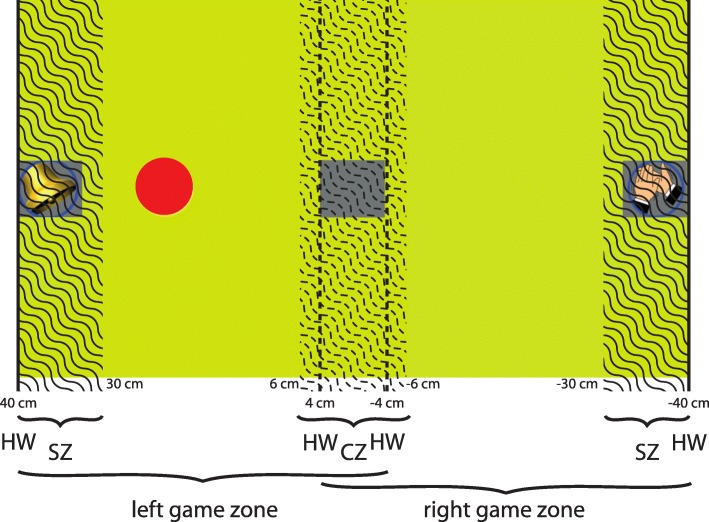
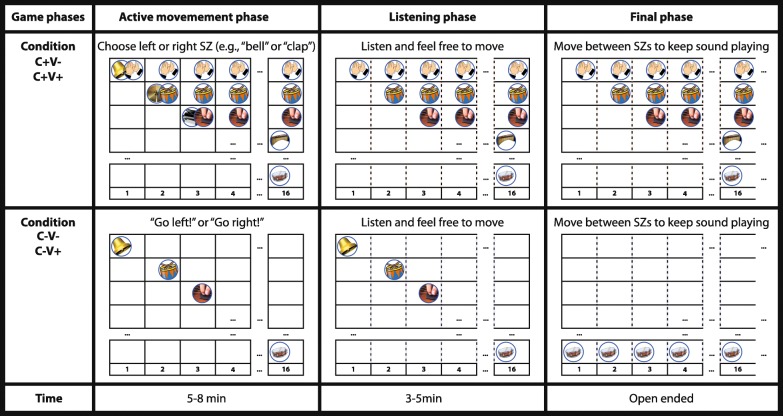
Robots have been successfully applied in motor training during neurorehabilitation. As music is known to improve motor function and motivation in neurorehabilitation training, we aimed at integrating music creation into robotic-assisted motor therapy. We developed a virtual game-like environment with music for the arm therapy robot ARMin, containing four different motion training conditions: a condition promoting creativity (C+) and one not promoting creativity (C-), each in a condition with (V+) and without (V-) a visual display (i.e., a monitor). The visual display was presenting the game workspace but not contributing to the creative process itself. In all four conditions the therapy robot haptically displayed the game workspace. Our aim was to asses the effects of creativity and visual display on motivation.
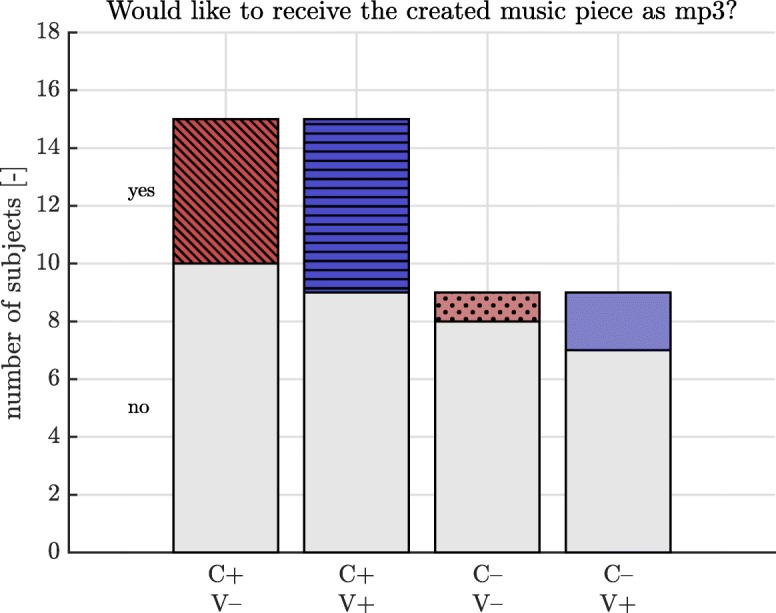
In a prospective randomized single-center study, healthy participants were randomly assigned to play two of the four training conditions, either with (V+) or without visual display (V-). In the third round, the participants played a repetition of the preferred condition of the two first rounds, this time with a new V condition (i.e., with or without visual display). For each of the three rounds, motivation was measured with the Intrinsic Motivation Inventory (IMI) in the subscales interest/enjoyment, perceived choice, value/usefulness, and man-machine-relation. We recorded the actual training time, the time of free movement, and the velocity profile and administered a questionnaire to measure perceived training time and perceived effort. All measures were analysed using linear mixed models. Furthermore, we asked if the participants would like to receive the created music piece.
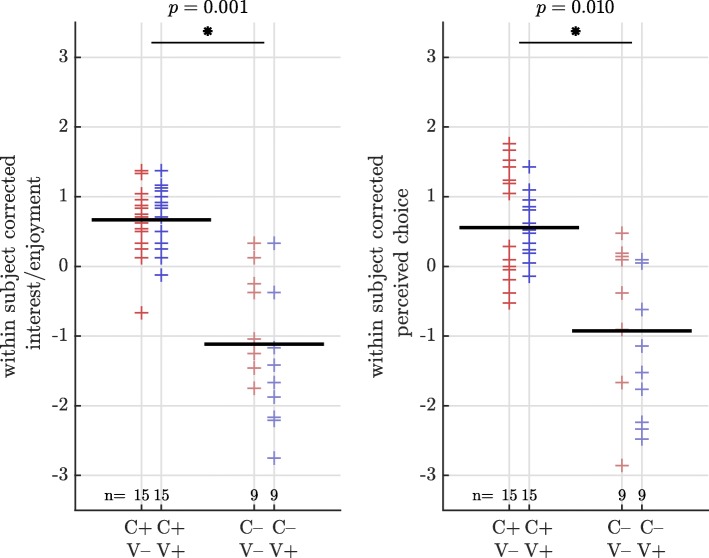
Sixteen healthy subjects (ten males, six females, mean age: 27.2 years, standard deviation: 4.1 years) with no known motor or cognitive deficit participated. Promotion of creativity (i.e., C+ instead of C-) significantly increased the IMI-item interest/enjoyment (p=0.001) and the IMI-item perceived choice (p=0.010). We found no significant effects in the IMI-items man-machine relation and value/usefulness. Conditions promoting creativity (with or without visual display) were preferred compared to the ones not promoting creativity. An interaction effect of promotion of creativity and omission of visual display was present for training time (p=0.013) and training intensity (p<0.001). No differences in relative perceived training time, perceived effort, and perceived value among the four training conditions were found.
Promoting creativity in a visuo-audio-haptic or audio-haptic environment increases motivation in robot-assisted therapy. We demonstrated the feasibility of performing an audio-haptic music creation task and recommend to try the system on patients with neuromuscular disorders.
ClinicalTrials.gov, NCT02720341. Registered 25 March 2016, https://clinicaltrials.gov/ct2/show/NCT02720341.
机器人已成功应用于神经康复中的运动训练。众所周知,音乐可以改善神经康复训练中的运动功能和动机,因此我们旨在将音乐创作融入到机器人辅助的运动治疗中。我们为 ARMin 手臂治疗机器人开发了一个具有音乐的虚拟游戏环境,其中包含四种不同的运动训练条件:一种促进创造力的条件(C+)和一种不促进创造力的条件(C-),每种条件都有(V+)和没有(V-)视觉显示(即监视器)。视觉显示呈现游戏工作区,但本身并不有助于创造过程。在所有四种条件下,治疗机器人触觉地显示游戏工作区。我们的目的是评估创造力和视觉显示对动机的影响。
在一项前瞻性随机单中心研究中,健康参与者被随机分配到四种训练条件中的两种进行游戏,分别是有(V+)或没有视觉显示(V-)。在第三轮中,参与者玩了前两轮中他们更喜欢的两种条件之一,这次是新的 V 条件(即有或没有视觉显示)。对于每一轮,动机都使用内在动机量表(IMI)的兴趣/享受、感知选择、价值/有用性和人机关系子量表进行测量。我们记录了实际训练时间、自由运动时间、速度曲线,并进行了一项问卷调查,以测量感知的训练时间和感知的努力。所有测量值均使用线性混合模型进行分析。此外,我们询问参与者是否希望收到创作的音乐作品。
16 名健康受试者(10 名男性,6 名女性,平均年龄:27.2 岁,标准差:4.1 岁)参加了研究,他们没有已知的运动或认知障碍。创造力的促进(即 C+而不是 C-)显著增加了 IMI 项目的兴趣/享受(p=0.001)和 IMI 项目的感知选择(p=0.010)。我们在 IMI 项目人机关系和价值/有用性方面没有发现显著影响。促进创造力的条件(有或没有视觉显示)比不促进创造力的条件更受欢迎。创造力的促进和视觉显示的省略之间存在交互作用效应在训练时间(p=0.013)和训练强度(p<0.001)上。在四种训练条件中,没有发现相对感知训练时间、感知努力和感知价值的差异。
在视、听、触或听、触环境中促进创造力会增加机器人辅助治疗中的动机。我们证明了执行音频触觉音乐创作任务的可行性,并建议在患有神经肌肉疾病的患者中尝试该系统。
ClinicalTrials.gov,NCT02720341。于 2016 年 3 月 25 日注册,https://clinicaltrials.gov/ct2/show/NCT02720341。