Behaviour and Health Research Unit, University of Cambridge, Cambridge, UK.
Nuffield Department of Primary Care Health Sciences, University of Oxford, Oxford, UK.
Int J Behav Nutr Phys Act. 2018 Aug 16;15(1):78. doi: 10.1186/s12966-018-0705-1.
Reducing the portion sizes of foods available in restaurants and cafeterias is one promising approach to reducing energy intake, but there is little evidence of its impact from randomised studies in field settings. This study aims to i. examine the feasibility and acceptability, and ii. estimate the impact on energy purchased, of reducing portion sizes in worksite cafeterias.
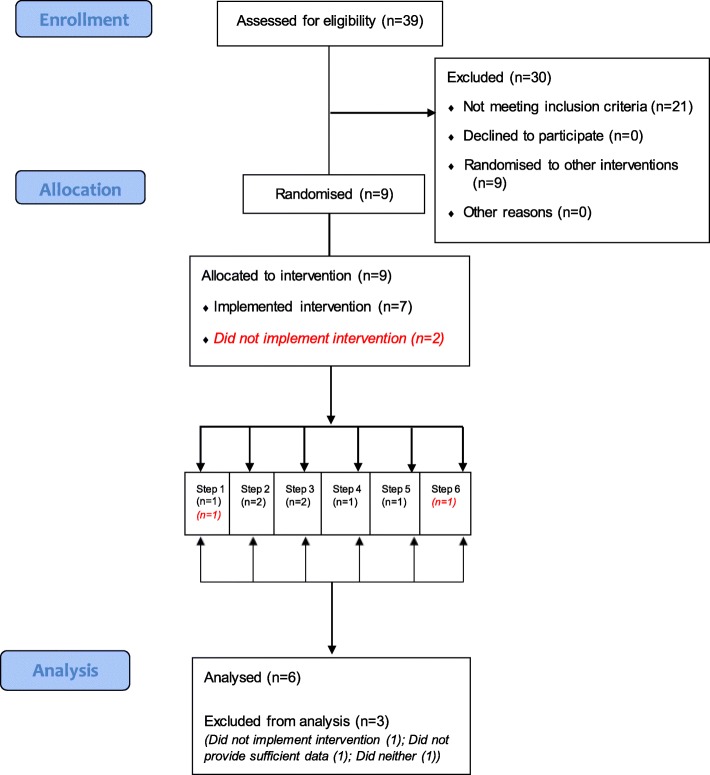
Nine worksites in England were recruited to reduce by at least 10% the portion sizes of foods available in their cafeterias from targeted categories (main meals, sides, desserts, cakes). In a stepped wedge randomised controlled pilot trial, each site was randomised to a date of implementation, staggered fortnightly, following a baseline period of four weeks. Impact on energy purchased was analysed using generalised linear mixed modelling. We also assessed feasibility, acceptability, and fidelity of intervention implementation.
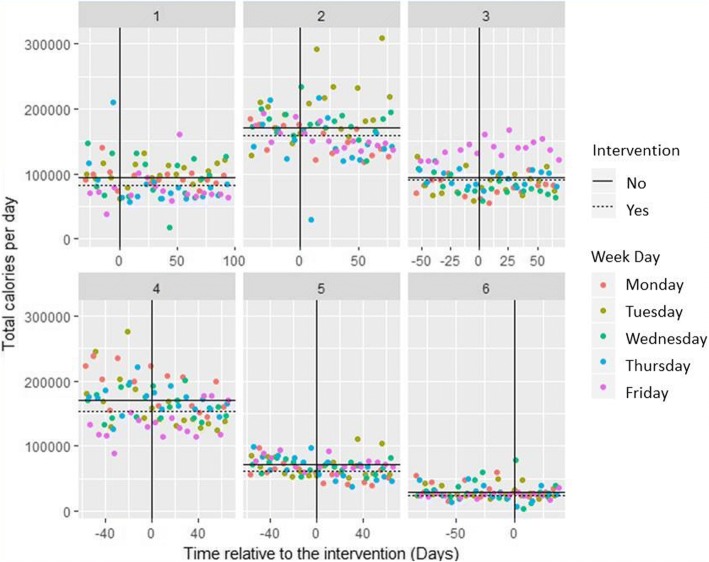
Data from six of the nine randomised sites were analysed, with three sites excluded for not providing sufficient data and/or not implementing the intervention. The extent to which the intervention was implemented varied by site, with between 6 and 49% of products altered within targeted categories. Feedback following the intervention suggested it was broadly acceptable to customers and cafeteria staff. For the primary outcome of daily energy (kcal) purchased from intervention categories, there was no statistically significant change when data from all six sites were pooled: percentage change - 8.9% (95% CI: -16.7, - 0.4; p = 0.081). Each of these six sites showed reductions in energy purchased, ranging from - 15.6 to - 0.3%, which were borderline statistically significant at two sites (respective percentage changes (95% CIs): - 15.6% (- 26.7, - 2.8); - 14.0% (- 25.0, - 1.2)). Secondary outcome data are suggestive of a compensatory increase in energy purchased from food categories not targeted by the intervention, with no overall effect observed on energy purchased across all categories.
The results of this pilot trial suggest that reducing portion sizes could be effective in reducing energy purchased and consumed from targeted food categories, and merits investigation in a larger trial. Future studies will need to address factors that prevented optimal implementation including site dropout and application across a limited range of products.
( ISRCTN52923504 ). Registered on 20th September 2016.
减少餐馆和自助餐厅提供的食物份量是一种很有前途的减少能量摄入的方法,但在现场环境中,随机研究几乎没有证据表明其具有影响力。本研究旨在 i. 检验其可行性和可接受性,以及 ii. 估计减少工作场所自助餐厅食品份量对购买的能量的影响。
在英格兰招募了 9 个工作场所,要求他们从有针对性的类别(主餐、配菜、甜点、蛋糕)中至少减少 10%食物份量。在一个逐步楔形随机对照试点试验中,每个地点按照基线期(四周)后每隔两周的时间随机分配实施日期。使用广义线性混合模型分析购买的能量的影响。我们还评估了干预实施的可行性、可接受性和保真度。
对来自九个随机地点的六个地点的数据进行了分析,有三个地点因未提供足够的数据和/或未实施干预而被排除在外。干预实施的程度因地点而异,在目标类别内有 6%至 49%的产品发生了变化。干预后的反馈表明,它得到了顾客和自助餐厅工作人员的广泛认可。对于从干预类别购买的日常能量(千卡)的主要结果,当将所有六个地点的数据合并时,没有统计学上的显著变化:百分比变化-8.9%(95%CI:-16.7,-0.4;p=0.081)。这六个地点中的每一个都显示出购买的能量减少,范围从-15.6%到-0.3%,其中两个地点的变化具有边缘统计学意义(相应的百分比变化(95%CI):-15.6%(-26.7,-2.8);-14.0%(-25.0,-1.2))。次要结果数据表明,在未受干预的食物类别中,能量购买量可能会出现补偿性增加,但在所有类别中,没有观察到能量购买量的总体影响。
本试点试验的结果表明,减少份量可能有效减少从目标食物类别购买和消耗的能量,值得在更大的试验中进行研究。未来的研究需要解决阻止最佳实施的因素,包括地点退出和在有限的产品范围内应用。
(ISRCTN52923504)。2016 年 9 月 20 日注册。