Department of Pediatric Surgery, University Medical Center Hamburg-Eppendorf, Martinistrasse 52, 20246, Hamburg, Germany.
Department of Experimental Animal Research, University Medical Center Hamburg-Eppendorf, Martinistrasse 52, 20246, Hamburg, Germany.
Sci Rep. 2018 Aug 22;8(1):12612. doi: 10.1038/s41598-018-31087-0.
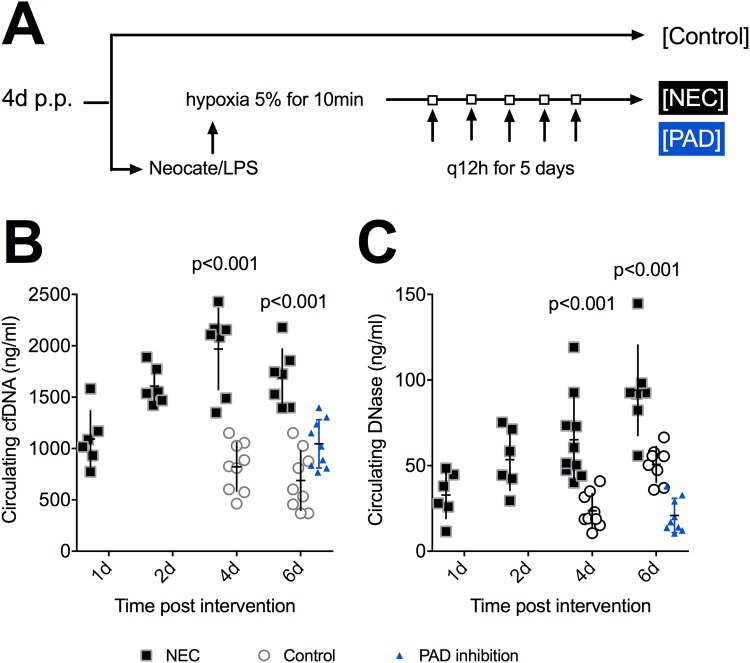
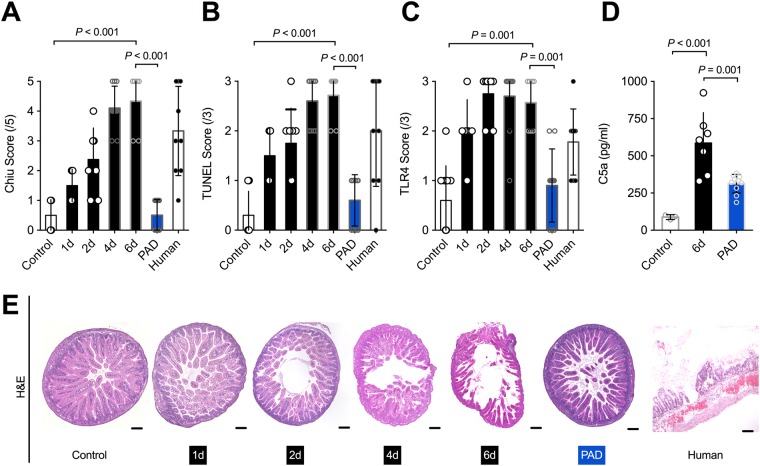
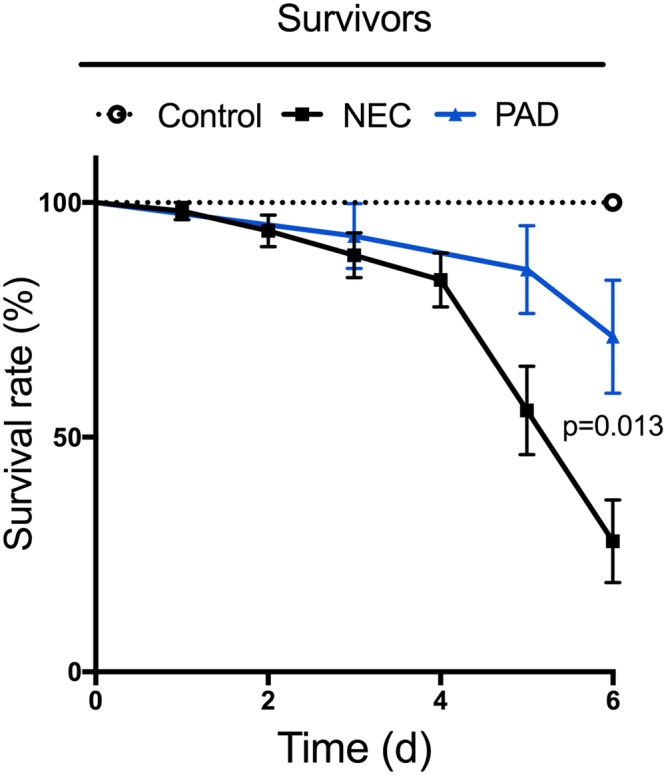
Necrotizing enterocolitis (NEC) is one of the most devastating diseases affecting premature and mature infants. It is hypothesized that NEC is the result of neutrophils' active role in hyperinflammation after bacterial gut colonization, through their nuclear DNA release and formation of neutrophil extracellular traps (NETs) to combat pathogens. The aim of this study was to evaluate the importance of NETs in NEC pathogenesis, as well as to identify and validate markers of NETosis to predict NEC. NEC was induced in mice by gavage feeding of Neocate and lipopolysaccharide, followed by ten minutes of hypoxia (5% O2) q12h for five days, starting on day four postpartum (p.p.). The interrelation of NEC and neutrophils, including NETs, was assessed macroscopically (i.e. NEC score, SYTOX Orange), microscopically (i.e. Chiu score, citrullinated histone H3, neutrophil elastase), and in blood samples (i.e. cell-free DNA (cfDNA), DNase). In order to determine the exact role of NETs in NEC pathogenesis, a protein arginine deiminase (PAD) inhibition model was established (preventing NETs formation in mice) by injecting BB-Cl-amidine once daily, starting on day one p.p. Additionally, human intestinal samples of diagnostically verified NEC were analyzed. In total, 76 mice were analyzed in the experiment. Serum cfDNA correlated positively with NEC manifestation, as measured by macroscopic NEC score (r = 0.53, p = 0.001), and microscopic evaluation with Chiu score (r = 0.56, p < 0.001). Markers of neutrophil activation and NETosis were significantly increased in animals with NEC and in human samples as compared to controls. Further, prevention of NETosis by protein arginine deiminase (PAD) inhibition in mice significantly reduced mortality, tissue damage, and inflammation in mice induced with NEC. Our results suggest that the hyperinflammation observed in NEC is a NETs-dependent process, as NEC severity was significantly reduced in mice incapable of forming NETs (PAD inhibition) and markers for NEC and NETs correlated positively during the time course of NEC induction. Further, serum surrogate markers of NETosis (such as cfDNA and DNase) appear to predict NEC in neonatal mice. As findings of the mouse NEC model correlate positively with human NEC samples immunohistochemically, the hyperinflammation reaction observed in mice could potentially be applied to human NEC pathogenesis.
坏死性小肠结肠炎(NEC)是影响早产儿和足月儿的最具破坏性疾病之一。据推测,NEC 是由于肠道细菌定植后中性粒细胞在过度炎症中发挥积极作用,通过核 DNA 释放和形成中性粒细胞胞外陷阱(NETs)来对抗病原体引起的。本研究旨在评估 NETs 在 NEC 发病机制中的重要性,并确定和验证 NETosis 的标志物以预测 NEC。通过在产后第四天(p.p.)开始,每天给新生小鼠灌胃 Neocate 和脂多糖,然后每隔 12 小时进行 10 分钟缺氧(5%O2)处理,共 5 天,诱导 NEC。通过宏观(即 NEC 评分、SYTOX Orange)、微观(即 Chiu 评分、瓜氨酸化组蛋白 H3、中性粒细胞弹性蛋白酶)和血液样本(即无细胞 DNA(cfDNA)、DNase)评估 NEC 与中性粒细胞之间的相互关系,包括 NETs。为了确定 NETs 在 NEC 发病机制中的确切作用,通过每天在 p.p. 第一天注射 BB-Cl-amidine 建立蛋白精氨酸脱亚氨酶(PAD)抑制模型(防止小鼠形成 NETs)。此外,还分析了经诊断证实的 NEC 人类肠道样本。总共对 76 只小鼠进行了实验分析。血清 cfDNA 与 NEC 表现呈正相关,通过宏观 NEC 评分(r=0.53,p=0.001)和微观评估的 Chiu 评分(r=0.56,p<0.001)进行测量。与对照组相比,患有 NEC 的动物和人类样本中的中性粒细胞激活和 NETosis 标志物明显增加。此外,在诱导 NEC 的小鼠中,通过蛋白精氨酸脱亚氨酶(PAD)抑制来阻止 NETosis 的形成,可显著降低死亡率、组织损伤和炎症。我们的结果表明,NEC 中观察到的过度炎症是 NETs 依赖性的过程,因为无法形成 NETs 的小鼠(PAD 抑制)中 NEC 严重程度显著降低,并且在 NEC 诱导过程中,NEC 和 NETs 的标志物呈正相关。此外,NETosis 的血清替代标志物(如 cfDNA 和 DNase)似乎可以预测新生小鼠的 NEC。由于小鼠 NEC 模型的发现与人类 NEC 样本在组织化学上呈正相关,因此在小鼠中观察到的过度炎症反应可能适用于人类 NEC 的发病机制。