Department of Non-Ionizing Radiation, National Public Health Institute, Budapest, Hungary.
Department of Physics, Budapest University of Technology and Economics and MTA-BME Lendület Spintronics Research Group (PROSPIN), Po. Box 91, H-1521, Budapest, Hungary.
Sci Rep. 2018 Aug 23;8(1):12667. doi: 10.1038/s41598-018-30981-x.
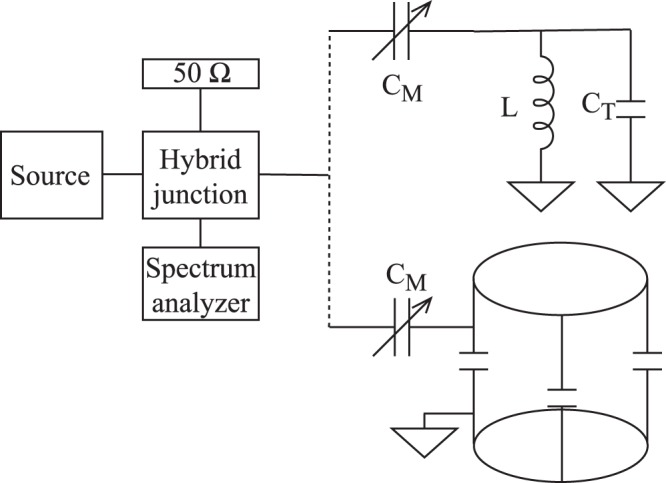
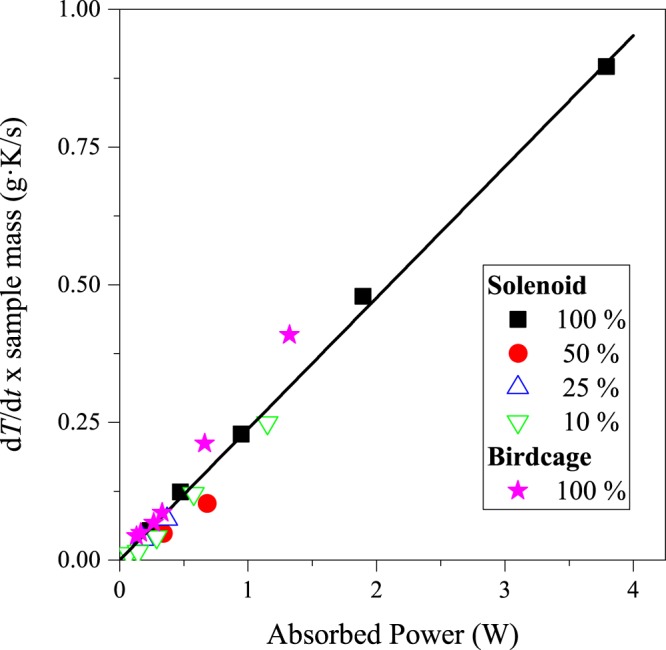
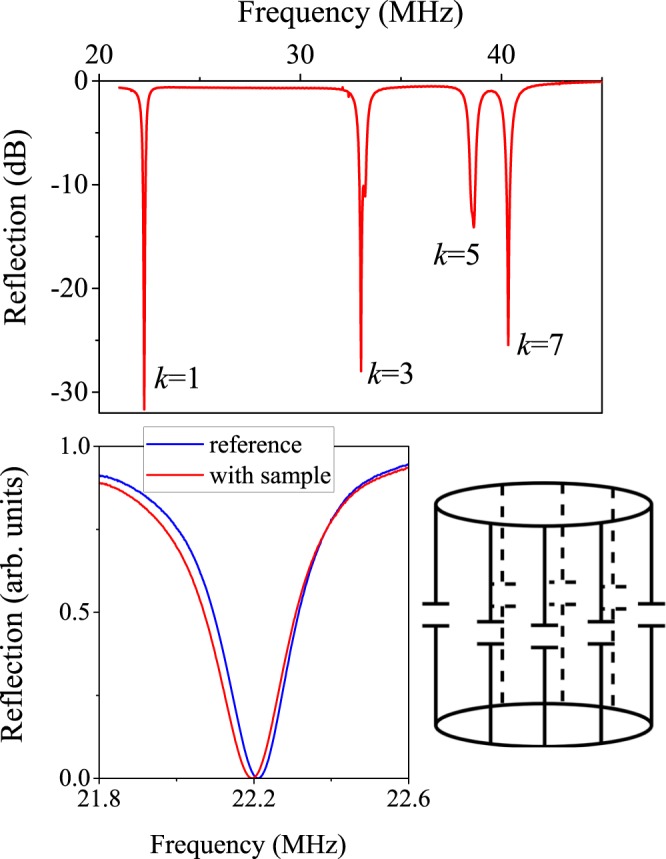
Nanomagnetic hyperthermia (NMH) is intensively studied with the prospect of cancer therapy. A major challenge is to determine the dissipated power during in vivo conditions and conventional methods are either invasive or inaccurate. We present a non-calorimetric method which yields the heat absorbed during hyperthermia: it is based on accurately measuring the quality factor change of a resonant radio frequency circuit which is employed for the irradiation. The approach provides the absorbed power in real-time, without the need to monitor the sample temperature as a function of time. As such, it is free from the problems caused by the non-adiabatic heating conditions of the usual calorimetry. We validate the method by comparing the dissipated power with a conventional calorimetric measurement. We present the validation for two types of resonators with very different filling factors: a solenoid and a so-called birdcage coil. The latter is a volume coil, which is generally used in magnetic resonance imaging (MRI) under in vivo condition. The presented method therefore allows to effectively combine MRI and thermotherapy and is thus readily adaptable to existing imaging hardware.
纳米磁热疗(NMH)作为癌症治疗的一种有前景的方法正在被深入研究。一个主要的挑战是确定体内条件下的耗散功率,而传统的方法要么具有侵入性,要么不够准确。我们提出了一种非量热法,可在磁热疗期间测量吸收的热量:它基于精确测量用于辐照的谐振射频电路的品质因数变化。该方法实时提供吸收的功率,而无需随时间监测样品温度。因此,它避免了常规量热法中由于非绝热加热条件引起的问题。我们通过将耗散功率与传统量热测量进行比较来验证该方法。我们为两种具有非常不同填充因子的谐振器验证了该方法:螺线管和所谓的鸟笼线圈。后者是一种体积线圈,通常在体内磁共振成像(MRI)条件下使用。因此,所提出的方法可以有效地将 MRI 和热疗结合起来,并且易于适应现有的成像硬件。