FCNAUP-Faculdade de Ciências da Nutrição e Alimentação, Universidade do Porto, Porto, Portugal.
I3S - Instituto de Investigação e Inovação em Saúde, Universidade do Porto, Porto, Portugal.
PLoS One. 2018 Aug 28;13(8):e0198650. doi: 10.1371/journal.pone.0198650. eCollection 2018.
Vitamin D deficiency is common in older adults and has been linked with frailty and obesity, but it remains to be studied whether frail obese older adults are at higher risk of vitamin D deficiency. Therefore, the aim of this study is to explore the association between frailty, obesity indices and serum 25(OH)D concentrations.
1447 individuals with 65 years or older, participating in a cross-sectional study (Nutrition UP 65) were included. Frailty, according to Fried et al., body mass index (BMI), waist circumference (WC), body roundness index (BRI) and body shape index (ABSI) were evaluated. A stepwise multinomial logistic regression was carried out to quantify the association between 25(OH)D quartiles and independent variables.
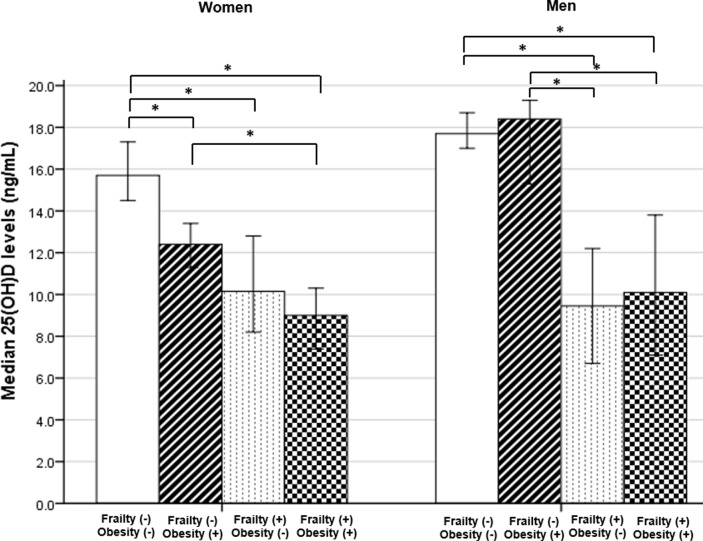
Median 25(OH)D levels were lower in individuals presenting both frailty and obesity (p<0.001). In the multivariate analysis, pre-frailty (OR: 2.65; 95% CI: 1.63-4.33) and frailty (OR: 3.77; 95% CI: 2.08-6.83) were associated with increased odds of lower 25(OH)D serum levels (first quartile). Regarding obesity indices, the highest categories of BMI (OR: 1.74; 95% CI: 1.06-2.86), WC (OR: 3.46; 95% CI: 1.95-6.15), BRI (OR: 4.35; 95% CI: 2.60-7.29) and ABSI (OR: 3.17 95% CI: 1.86-5.38) were directly associated with lower 25(OH)D serum levels (first quartile).
A positive association between frailty or obesity and lower vitamin D levels was found. Moreover, besides BMI and WC, other indicators of body adiposity, such as BRI and ABSI, were associated with lower 25(OH)D serum concentrations.
老年人普遍存在维生素 D 缺乏的情况,并且与虚弱和肥胖有关,但目前仍不清楚虚弱肥胖的老年人是否有更高的维生素 D 缺乏风险。因此,本研究旨在探讨虚弱、肥胖指数与血清 25(OH)D 浓度之间的关系。
纳入了参加横断面研究(Nutrition UP 65)的 1447 名 65 岁或以上的个体。根据 Fried 等人的标准评估虚弱、体重指数(BMI)、腰围(WC)、身体圆润指数(BRI)和身体形状指数(ABSI)。采用逐步多项逻辑回归来量化 25(OH)D 四分位数与独立变量之间的关联。
同时存在虚弱和肥胖的个体的中位 25(OH)D 水平较低(p<0.001)。在多变量分析中,前虚弱状态(OR:2.65;95%CI:1.63-4.33)和虚弱状态(OR:3.77;95%CI:2.08-6.83)与较低的 25(OH)D 血清水平(第一四分位数)呈正相关。关于肥胖指数,最高 BMI(OR:1.74;95%CI:1.06-2.86)、WC(OR:3.46;95%CI:1.95-6.15)、BRI(OR:4.35;95%CI:2.60-7.29)和 ABSI(OR:3.17;95%CI:1.86-5.38)类别与较低的 25(OH)D 血清水平(第一四分位数)呈直接相关。
发现虚弱或肥胖与较低的维生素 D 水平之间存在正相关。此外,除 BMI 和 WC 外,身体脂肪的其他指标,如 BRI 和 ABSI,也与较低的 25(OH)D 血清浓度相关。