Mirzaei Alireza, Zabihiyeganeh Mozhdeh, Jahed Seyed Adel, Khiabani Elnaz, Nojomi Marzieh, Ghaffari Salman
Bone and Joint Reconstruction Research Center, Shafa Orthopedic Hospital, Iran University of Medical Sciences, Tehran, Iran.
Research Center for Prevention of Cardiovascular Diseases, Institute of Endocrinology and Metabolism, Iran University of Medical Sciences, Tehran, Iran.
Med J Islam Repub Iran. 2018 Apr 5;32:29. doi: 10.14196/mjiri.32.29. eCollection 2018.
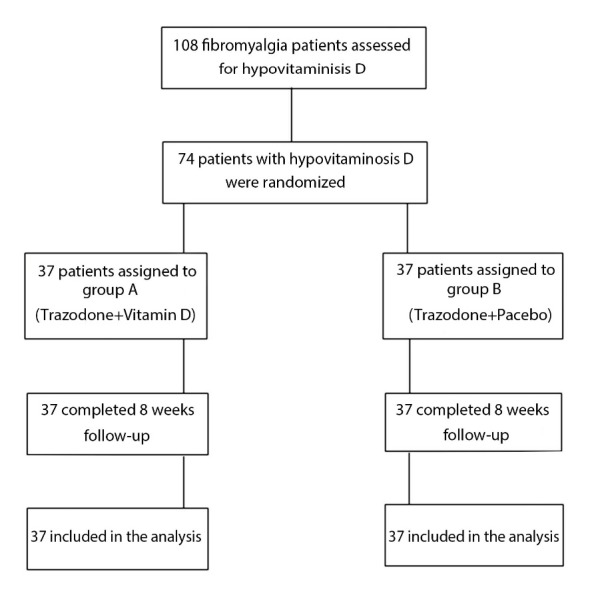
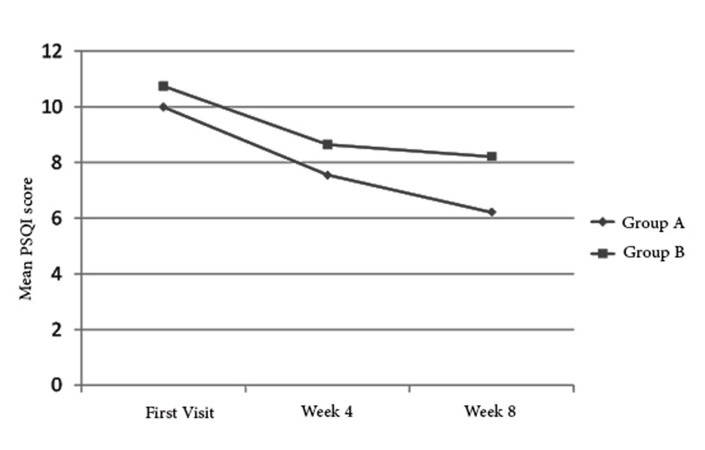
Numerous studies have been conducted to evaluate the frequency of hypovitaminosis D in patients with fibromyalgia syndrome (FMS) and its association with FMS symptoms. This study aimed at assessing the effect of hypovitaminosis D on the symptoms and quality of life of patients with fibromyalgia. A total of 74 FMS patients with hypovitaminosis D were randomly assigned into group A (Trazodone 25 mg at bedtime + vitamin D 50 000 IU weekly) and group B (Trazodone 25 mg at bedtime + placebo). Serum vitamin D level, Widespread Pain Index (WPI), Fibromyalgia Impact Questionnaire (FIQ), Pittsburgh Sleep Quality Index (PSQI), and Short Form Health Survey (SF-36) were used at the beginning of the treatment and 4 and 8 weeks post treatment. Significant improvements were observed in WPI, FIQ, and PSQI scores in both groups. Moreover, combination of vitamin D and Trazodone resulted in significant improvement of SF-36 scores compared to Trazodone therapy. Improvement in pain-related indices including the WPI and the physical component score (PCS) fraction of SF-36 was more noticeable in vitamin D/Trazodone combination therapy. This study suggests that vitamin D supplementation has significant therapeutic benefits in the management of FMS, especially in pain reduction of patients with fibromyalgia. According to our results, a combination of vitamin D supplements and a conventional antidepressant, when given to vitamin D-deficient fibromyalgia patients, could significantly improve both physical and psychological symptoms.
已经开展了大量研究来评估纤维肌痛综合征(FMS)患者维生素D缺乏症的发生率及其与FMS症状的关联。本研究旨在评估维生素D缺乏症对纤维肌痛患者症状和生活质量的影响。总共74名患有维生素D缺乏症的FMS患者被随机分为A组(睡前服用曲唑酮25毫克+每周服用维生素D 50000国际单位)和B组(睡前服用曲唑酮25毫克+安慰剂)。在治疗开始时以及治疗后4周和8周时,检测血清维生素D水平、广泛性疼痛指数(WPI)、纤维肌痛影响问卷(FIQ)、匹兹堡睡眠质量指数(PSQI)和简短健康调查问卷(SF-36)。两组的WPI、FIQ和PSQI评分均有显著改善。此外,与曲唑酮治疗相比,维生素D和曲唑酮联合使用使SF-36评分有显著改善。在维生素D/曲唑酮联合治疗中,包括WPI和SF-36身体成分评分(PCS)部分在内的疼痛相关指标的改善更为明显。本研究表明,补充维生素D在FMS的管理中具有显著的治疗益处,尤其是在减轻纤维肌痛患者的疼痛方面。根据我们的结果,当给维生素D缺乏的纤维肌痛患者服用维生素D补充剂和传统抗抑郁药时,可以显著改善身体和心理症状。