Cell Biology Program, The Hospital for Sick Children, Toronto, Canada.
Princess Margaret Cancer Centre, University Health Network, Toronto, Canada.
Elife. 2018 Aug 31;7:e37846. doi: 10.7554/eLife.37846.
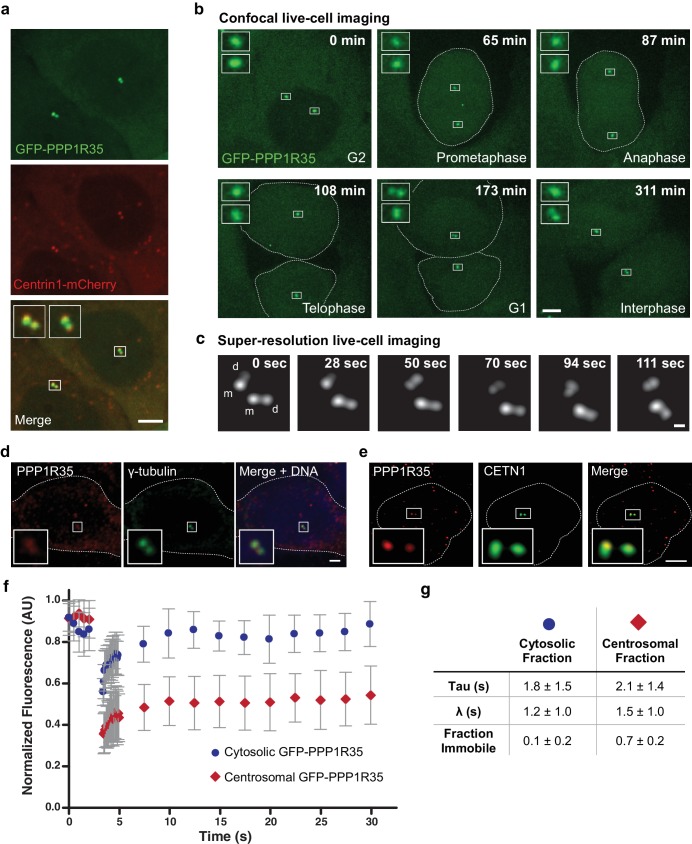
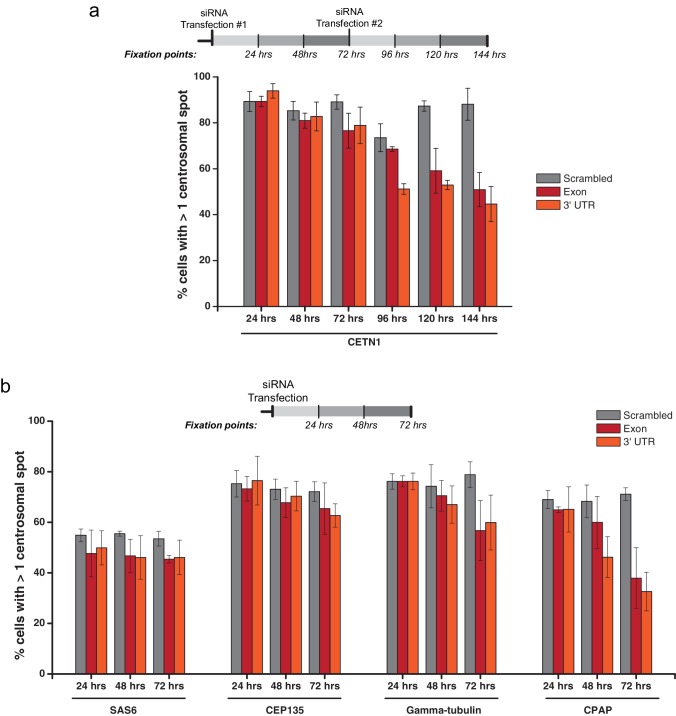
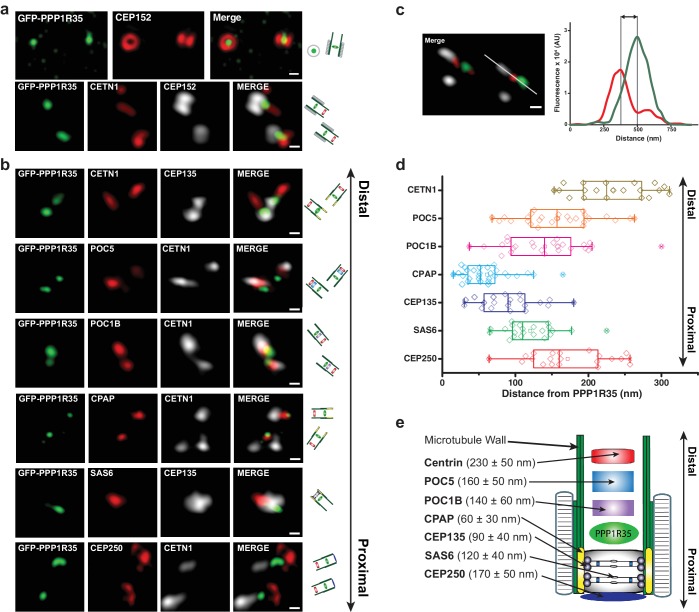
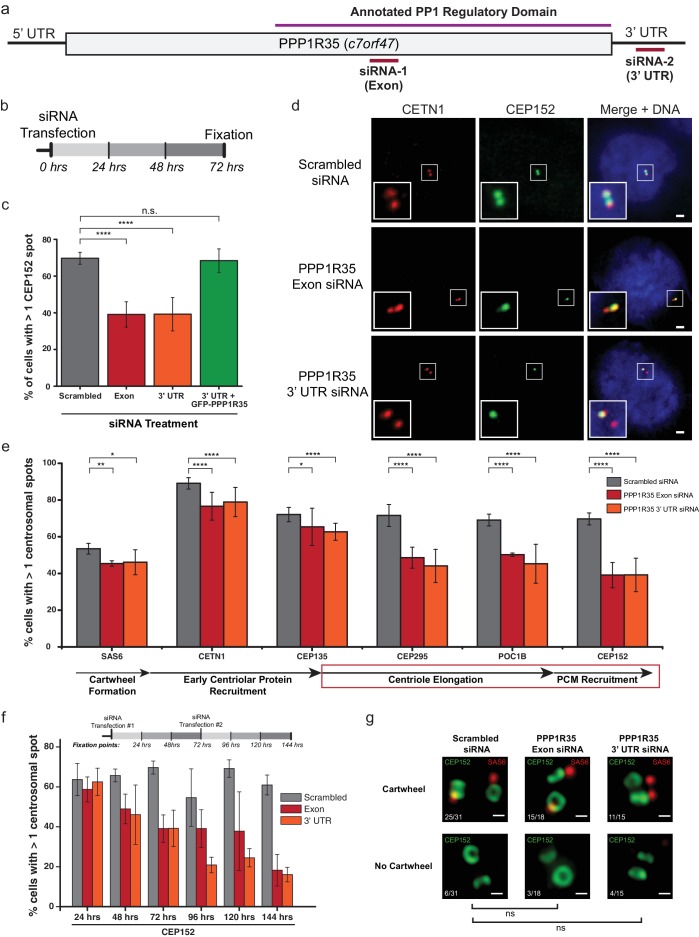
Centrosome structure, function, and number are finely regulated at the cellular level to ensure normal mammalian development. Here, we characterize PPP1R35 as a novel bona fide centrosomal protein and demonstrate that it is critical for centriole elongation. Using quantitative super-resolution microscopy mapping and live-cell imaging we show that PPP1R35 is a resident centrosomal protein located in the proximal lumen above the cartwheel, a region of the centriole that has eluded detailed characterization. Loss of PPP1R35 function results in decreased centrosome number and shortened centrioles that lack centriolar distal and microtubule wall associated proteins required for centriole elongation. We further demonstrate that PPP1R35 acts downstream of, and forms a complex with, RTTN, a microcephaly protein required for distal centriole elongation. Altogether, our study identifies a novel step in the centriole elongation pathway centered on PPP1R35 and elucidates downstream partners of the microcephaly protein RTTN.
中心体的结构、功能和数量在细胞水平上受到精细调节,以确保正常的哺乳动物发育。在这里,我们将 PPP1R35 鉴定为一种新的真正的中心体蛋白,并证明其对中心体拉长至关重要。通过定量超分辨率显微镜作图和活细胞成像,我们表明 PPP1R35 是一种位于中心粒_cartwheel 上方近腔的常驻中心体蛋白,该区域的中心粒一直难以进行详细表征。PPP1R35 功能丧失会导致中心体数量减少和中心粒缩短,而这些中心粒缺乏用于中心体拉长的中心粒远端和微管壁相关蛋白。我们进一步证明 PPP1R35 作用于微小头蛋白 RTTN 的下游,并与 RTTN 形成复合物,而 RTTN 是用于远端中心体拉长所必需的微小头蛋白。总的来说,我们的研究确定了以 PPP1R35 为中心的中心体拉长途径中的一个新步骤,并阐明了微小头蛋白 RTTN 的下游伙伴。