Department of Applied Chemistry, Keio University, 3-14-1 Hiyoshi, Kohoku-ku, 223-8522, Yokohama, Japan.
Department of Biomedical Engineering and Institute for Complex Molecular Systems (ICMS), Eindhoven University of Technology, P.O. Box 513, 5600, MB, Eindhoven, The Netherlands.
Angew Chem Int Ed Engl. 2018 Nov 19;57(47):15369-15373. doi: 10.1002/anie.201808070. Epub 2018 Sep 19.
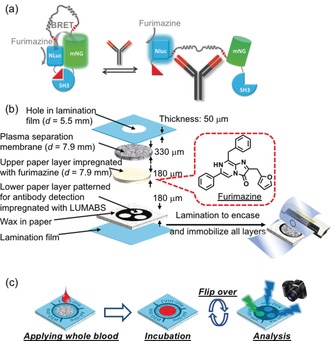
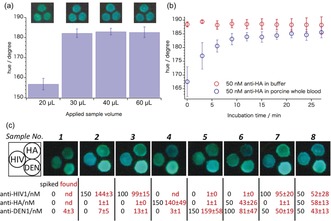
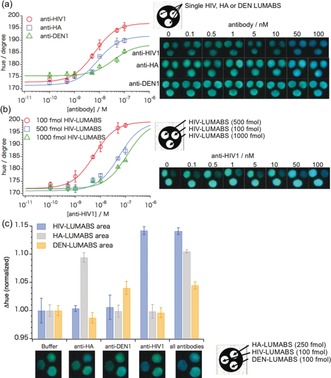
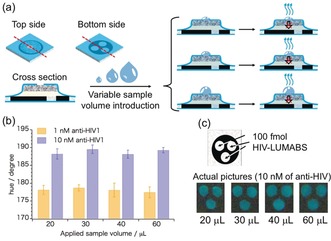
This work reports on fully integrated "sample-in-signal-out" microfluidic paper-based analytical devices (μPADs) relying on bioluminescence resonance energy transfer (BRET) switches for analyte recognition and colorimetric signal generation. The devices use BRET-based antibody sensing proteins integrated into vertically assembled layers of functionalized paper, and their design enables sample volume-independent and fully reagent-free operation, including on-device blood plasma separation. User operation is limited to the application of a single drop (20-30 μL) of sample (serum, whole blood) and the acquisition of a photograph 20 min after sample introduction, with no requirement for precise pipetting, liquid handling, or analytical equipment except for a camera. Simultaneous detection of three different antibodies (anti-HIV1, anti-HA, and anti-DEN1) in whole blood was achieved. Given its simplicity, this type of device is ideally suited for user-friendly point-of-care testing in low-resource environments.
本文报道了一种完全集成的“样品进信号出”微流控纸基分析器件(μPAD),该器件依赖于生物发光共振能量转移(BRET)开关进行分析物识别和比色信号产生。该器件使用集成在功能化纸垂直组装层中的基于 BRET 的抗体传感蛋白,其设计实现了与样品体积无关且完全无试剂的操作,包括在设备上进行血浆分离。用户操作仅限于施加单个样本(血清、全血)液滴(20-30 μL),并在样品引入 20 分钟后获取照片,除了相机之外,不需要精确移液、液体处理或分析设备。该方法可实现全血中三种不同抗体(抗 HIV1、抗 HA 和抗 DEN1)的同时检测。鉴于其简单性,这种类型的器件非常适合在资源匮乏环境中进行用户友好的即时检测。