Cardiovascular ICCC-Program, Research Institute Hospital de la Santa Creu i Sant Pau, IIB-Sant Pau, 08025 Barcelona, Spain.
CIBERCV Instituto de Salud Carlos III, 28029 Madrid, Spain.
Nutrients. 2018 Sep 5;10(9):1237. doi: 10.3390/nu10091237.
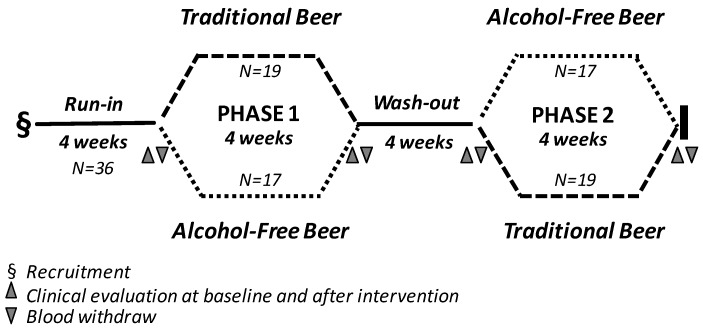
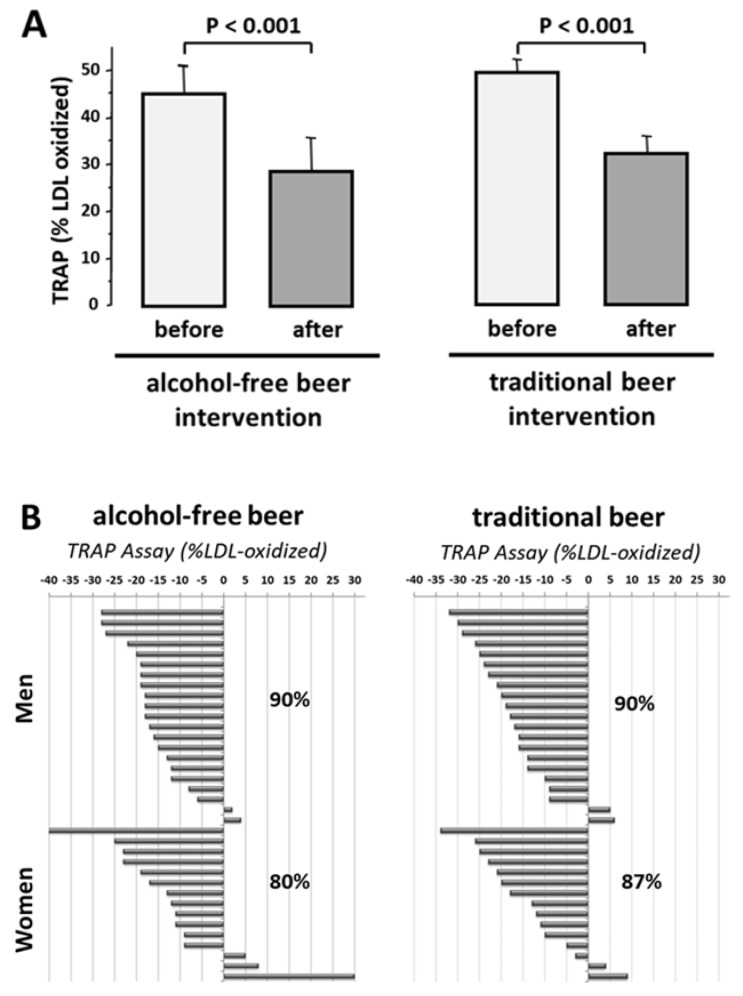
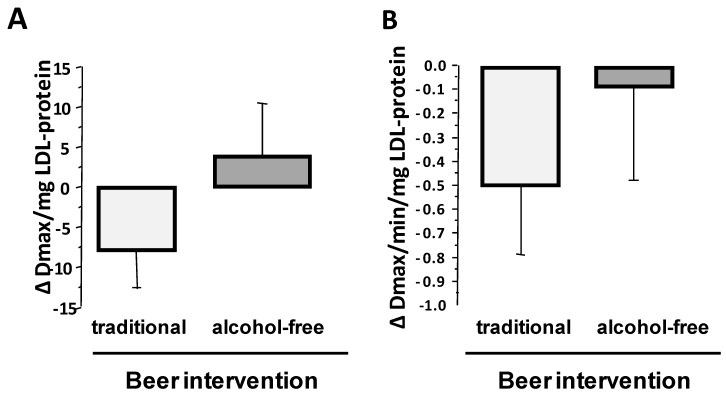
Consistent epidemiological evidence indicates that low-to-moderate alcohol consumption is inversely associated with cardiovascular event presentation, while high levels of alcohol intake are associated to increased cardiovascular risk. Little is known on the effects of moderate beer intake in the metabolic syndrome. The aim of this study is to investigate the effects of moderate and regular daily intake of beer with meals in overweight (body mass index (BMI) of 28⁻29.9 kg/m²) or obese class 1 (BMI of 30⁻35 kg/m²) individuals without other cardiovascular risk factors (dyslipidemia, type 2-diabetes, hypertension) focusing on the effects related to changes in weight, in lipoproteins and vascular endothelial function. We have performed an open, prospective two-arms longitudinal crossover study to investigate the effects associated with regular consumption (four week) of alcohol-free-beer (0 g alcohol/day) or traditional-beer (30 g alcohol/day in men and 15 g alcohol/day in women) on anthropometrical and biochemical parameters, liver and kidney function biomarkers, and vascular endothelial function. After four-week intervention with traditional and/or alcohol-free beer, BMI did not show any significant change and values for liver and kidney functions were within the normal levels. Moderate traditional beer intake did not affect lipid levels-however it significantly increased the antioxidant capacity of high density lipoprotein (HDL). In addition, apoB-depleted serum (after the four-week intervention period) showed a higher potential to promote cholesterol efflux from macrophages. Beer consumption did not induce vascular endothelial dysfunction or stiffness. In summary, our results based on a 12-week prospective study provide evidence that moderate intake of beer (traditional and alcohol-free) does not exert vascular detrimental effects nor increases body weight in obese healthy individuals. In contrast, moderate intake of beer increases the anti-oxidative properties of HDL and facilitates cholesterol efflux, which may prevent lipid deposition in the vessel wall.
一致的流行病学证据表明,低至中度饮酒与心血管事件发生呈负相关,而大量饮酒与心血管风险增加相关。对于适度啤酒摄入在代谢综合征中的影响知之甚少。本研究旨在研究超重(体重指数(BMI)为 28-29.9 kg/m²)或肥胖 1 级(BMI 为 30-35 kg/m²)个体中适量且规律的每日啤酒摄入(与餐同服)的影响,这些个体没有其他心血管风险因素(血脂异常、2 型糖尿病、高血压),重点关注与体重变化、脂蛋白和血管内皮功能变化相关的影响。我们进行了一项开放、前瞻性、双臂纵向交叉研究,以调查定期饮用(四周)无酒精啤酒(每天 0 克酒精)或传统啤酒(男性每天 30 克酒精,女性每天 15 克酒精)对人体测量和生化参数、肝肾功能生物标志物以及血管内皮功能的影响。在四周的传统啤酒和/或无酒精啤酒干预后,BMI 没有显示出任何显著变化,肝肾功能值仍在正常范围内。适度的传统啤酒摄入不会影响血脂水平,但会显著增加高密度脂蛋白(HDL)的抗氧化能力。此外,在四周干预后,载脂蛋白 B 耗尽的血清(apoB-depleted serum)显示出从巨噬细胞中促进胆固醇流出的更高潜力。啤酒消费不会引起血管内皮功能障碍或僵硬。总之,我们基于 12 周前瞻性研究的结果提供了证据,证明适量摄入啤酒(传统啤酒和无酒精啤酒)不会对肥胖健康个体的血管产生有害影响,也不会增加体重。相反,适量摄入啤酒会增加 HDL 的抗氧化特性,并促进胆固醇流出,从而防止脂质在血管壁沉积。