Qiu Cheng, Jung Jae-Hyun, Tuccar-Burak Merve, Spano Lauren, Goldstein Robert, Peli Eli
Schepens Eye Research Institute, Massachusetts Eye and Ear, Department of Ophthalmology, Harvard Medical School, Boston, MA, USA.
Transl Vis Sci Technol. 2018 Sep 4;7(5):1. doi: 10.1167/tvst.7.5.1. eCollection 2018.
Peripheral field loss (PFL) due to retinitis pigmentosa, choroideremia, or glaucoma often results in a highly constricted residual central field, which makes it difficult for patients to avoid collision with approaching pedestrians. We developed a virtual environment to evaluate the ability of patients to detect pedestrians and judge potential collisions. We validated the system with both PFL patients and normally sighted subjects with simulated PFL. We also tested whether properly placed high-power prisms may improve pedestrian detection.
A virtual park-like open space was rendered using a driving simulator (configured for walking speeds), and pedestrians in testing scenarios appeared within and outside the residual central field. Nine normally sighted subjects and eight PFL patients performed the pedestrian detection and collision judgment tasks. The performance of the subjects with simulated PFL was further evaluated with field of view expanding prisms.
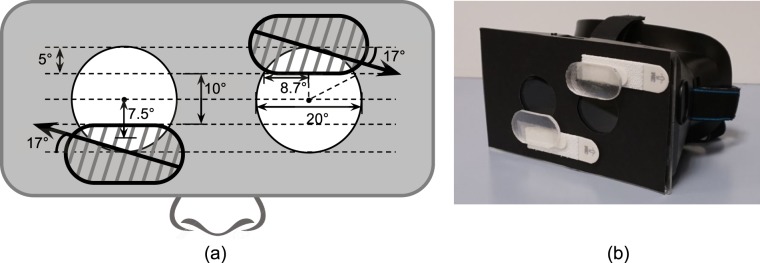
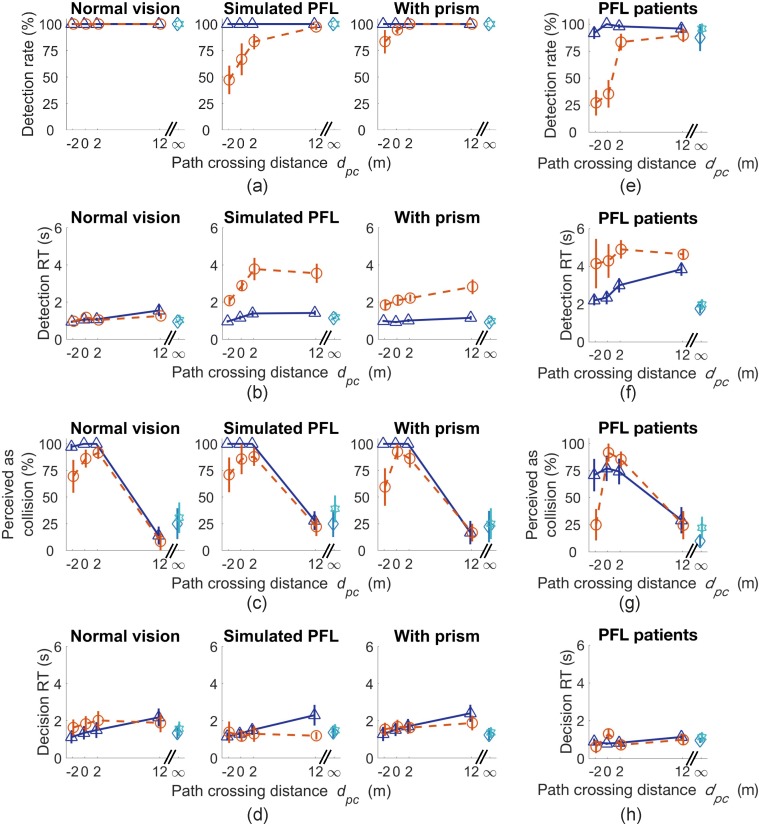
The virtual system for testing pedestrian detection and collision judgment was validated. The performance of PFL patients and normally sighted subjects with simulated PFL were similar. The prisms for simulated PFL improved detection rates, reduced detection response times, and supported reasonable collision judgments in the prism-expanded field; detections and collision judgments in the residual central field were not influenced negatively by the prisms.
The scenarios in a virtual environment are suitable for evaluating PFL and the impact of field of view expanding devices.
This study validated an objective means to evaluate field expansion devices in reproducible near-real-life settings.
视网膜色素变性、脉络膜缺损或青光眼所致的周边视野缺损(PFL)常导致残余中心视野极度狭窄,这使得患者难以避免与靠近的行人发生碰撞。我们开发了一个虚拟环境来评估患者检测行人及判断潜在碰撞的能力。我们用PFL患者和模拟PFL的正常视力受试者对该系统进行了验证。我们还测试了放置合适的高倍棱镜是否可改善行人检测。
使用驾驶模拟器(配置为步行速度)创建一个类似公园的虚拟开放空间,测试场景中的行人出现在残余中心视野之内和之外。9名正常视力受试者和8名PFL患者执行行人检测和碰撞判断任务。使用视野扩展棱镜进一步评估模拟PFL受试者的表现。
验证了用于测试行人检测和碰撞判断的虚拟系统。PFL患者和模拟PFL的正常视力受试者的表现相似。模拟PFL的棱镜提高了检测率,缩短了检测反应时间,并在棱镜扩展视野中支持合理的碰撞判断;棱镜对残余中心视野中的检测和碰撞判断没有负面影响。
虚拟环境中的场景适用于评估PFL及视野扩展装置的影响。
本研究验证了一种在可重复的近现实生活环境中评估视野扩展装置的客观方法。