International Medical Center, Tianjin First Central Hospital, Tianjin, China (mainland).
Department of Bone and Soft Tissue Tumors, Tianjin Medical University Cancer Institute and Hospital, National Clinical Research Center for Cancer, Key Laboratory of Cancer Prevention and Therapy, Tianjin Clinical Research Center for Cancer, Tianjin, China (mainland).
Med Sci Monit. 2018 Sep 12;24:6387-6397. doi: 10.12659/MSM.912071.
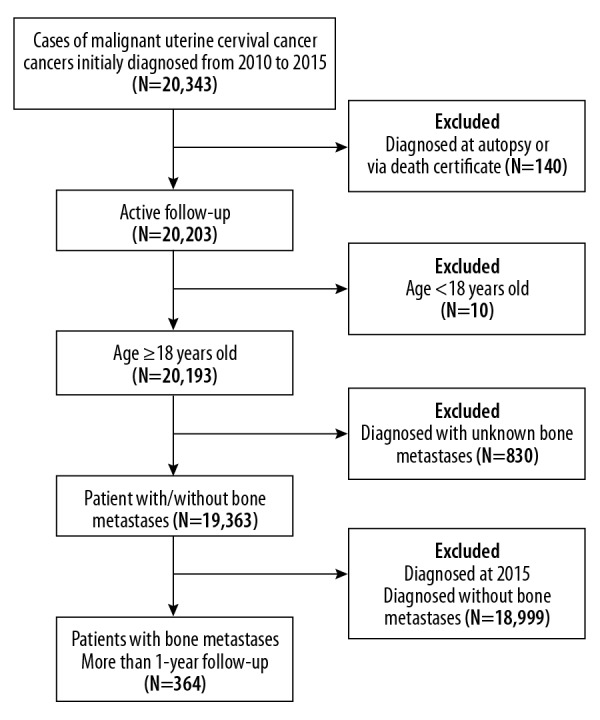
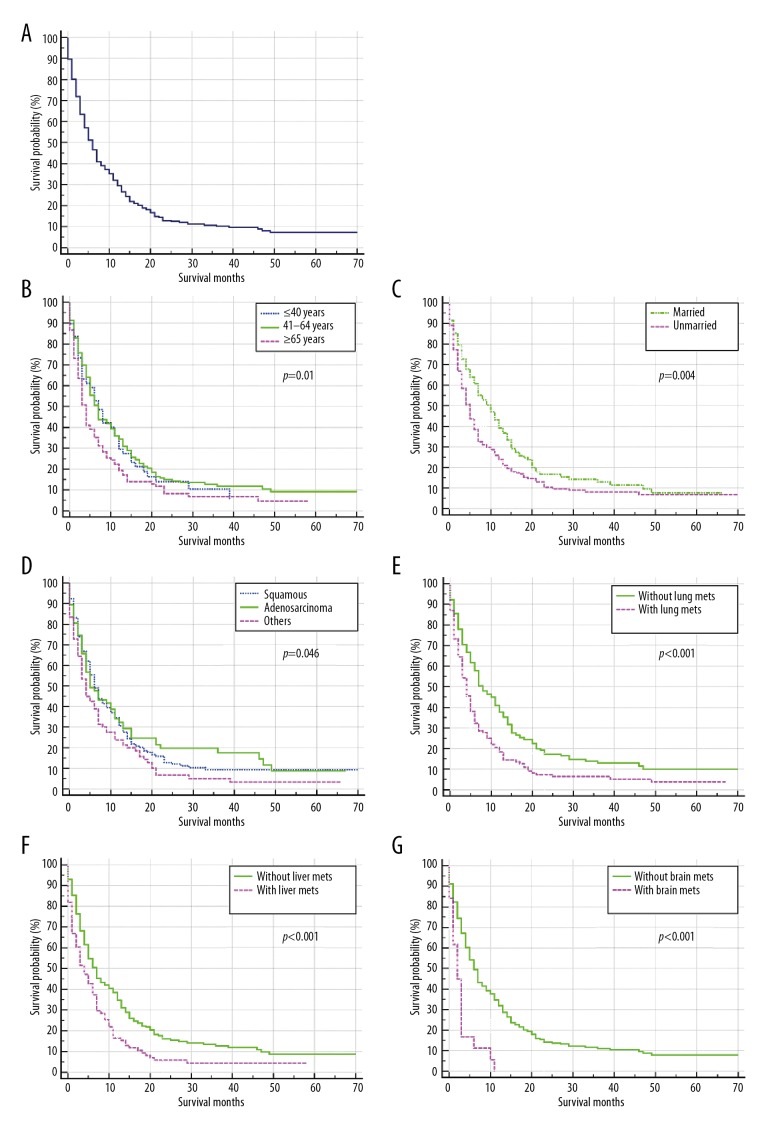
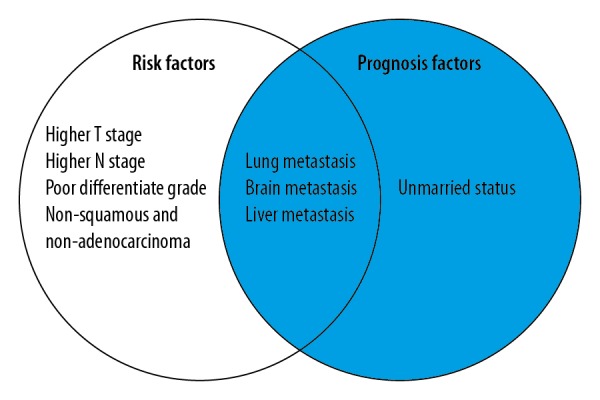
BACKGROUND The aims of this study were to investigate the incidence and risk factors for the development of bone metastases and prognosis in women with cancer of the uterine cervix using database analysis. MATERIAL AND METHODS The National Cancer Institute (NCI) Surveillance, Epidemiology, and End Results (SEER) database was analyzed for the incidence and survival rates of women diagnosed with uterine cervical cancer in the United States between 2010-2015. Multivariate logistic regression analysis identified risk factors for bone metastases. Kaplan-Meier analysis estimated the overall survival. Proportional hazard regression analysis estimated prognostic factors associated with bone metastases. RESULTS There were 19,363 women with uterine cervical cancer, and 469 women were diagnosed with bone metastases on initial diagnosis (2.42%). Increased T-stage, N-stage, non-squamous and non-adenocarcinoma histology, high-grade tumors, and the presence of lung, liver, and brain metastases were all significantly associated with early bone metastases. There were 364 patients with cervical cancer and bone metastases on initial diagnosis who were followed-up for at least one year. Multivariate Cox regression analysis showed that unmarried status and lung, liver, and brain metastases were significantly associated with reduced overall survival. No other significant risk or prognostic associations were found. CONCLUSIONS SEER data analysis showed that women with uterine cervical cancer had some standard risk factors associated with bone metastases, and with prognosis, but a heterogeneous group of risk factors was also present. The findings of this study may have clinical application in screening for bone metastases in women with cervical cancer.
本研究旨在通过数据库分析,调查美国女性宫颈癌患者发生骨转移及预后的发生率和危险因素。
分析美国国家癌症研究所(NCI)监测、流行病学和最终结果(SEER)数据库 2010-2015 年期间诊断为宫颈癌的女性的发病率和生存率。多变量逻辑回归分析确定骨转移的危险因素。Kaplan-Meier 分析估计总生存率。比例风险回归分析估计与骨转移相关的预后因素。
共纳入 19363 例宫颈癌患者,其中 469 例患者在初诊时被诊断为骨转移(2.42%)。T 分期、N 分期、非鳞癌和非腺癌组织学、高级别肿瘤以及肺、肝、脑转移的存在均与早期骨转移显著相关。在初诊时就有 364 例宫颈癌和骨转移的患者进行了至少一年的随访。多变量 Cox 回归分析显示,未婚状态和肺、肝、脑转移与总生存率降低显著相关。未发现其他显著的风险或预后相关因素。
SEER 数据分析显示,女性宫颈癌患者存在一些与骨转移及预后相关的标准危险因素,但也存在异质性的危险因素。本研究的结果可能对筛查宫颈癌女性的骨转移具有临床应用价值。