Instituto de Investigación e Innovación en Bioingeniería, Universitat Politècnica de València, València, Spain.
Bioengineering and Robotics Research Centre E Piaggio & Department of Information Engineering, University of Pisa, Pisa, Italy.
Sci Rep. 2018 Sep 12;8(1):13657. doi: 10.1038/s41598-018-32063-4.
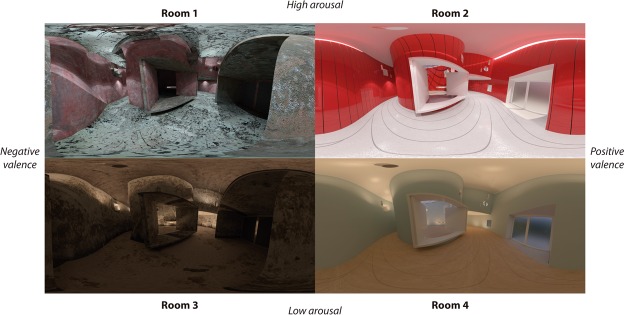
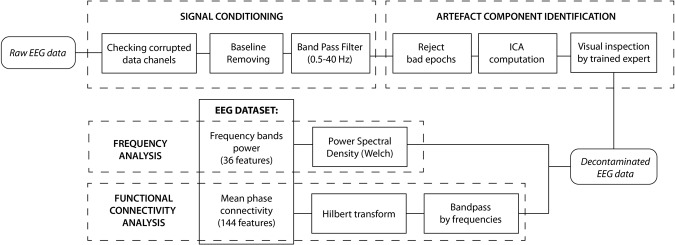
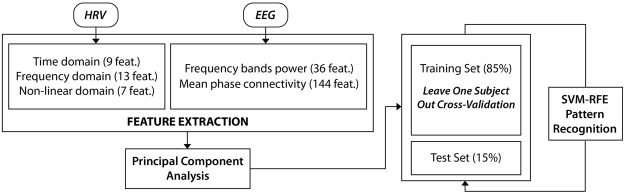
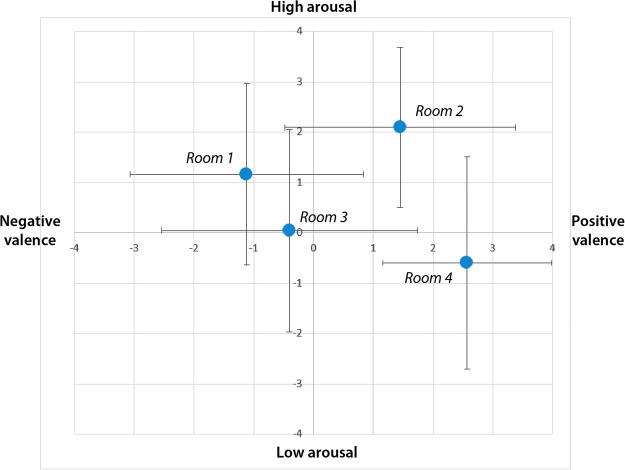
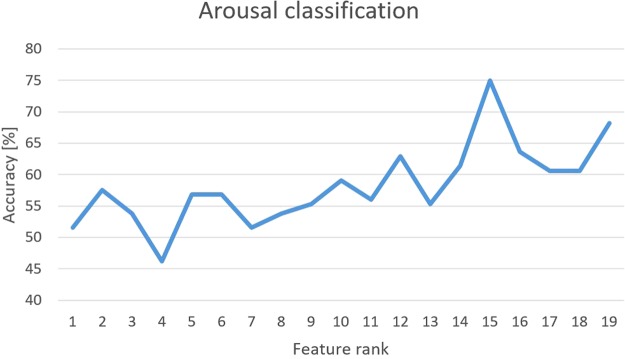
Affective Computing has emerged as an important field of study that aims to develop systems that can automatically recognize emotions. Up to the present, elicitation has been carried out with non-immersive stimuli. This study, on the other hand, aims to develop an emotion recognition system for affective states evoked through Immersive Virtual Environments. Four alternative virtual rooms were designed to elicit four possible arousal-valence combinations, as described in each quadrant of the Circumplex Model of Affects. An experiment involving the recording of the electroencephalography (EEG) and electrocardiography (ECG) of sixty participants was carried out. A set of features was extracted from these signals using various state-of-the-art metrics that quantify brain and cardiovascular linear and nonlinear dynamics, which were input into a Support Vector Machine classifier to predict the subject's arousal and valence perception. The model's accuracy was 75.00% along the arousal dimension and 71.21% along the valence dimension. Our findings validate the use of Immersive Virtual Environments to elicit and automatically recognize different emotional states from neural and cardiac dynamics; this development could have novel applications in fields as diverse as Architecture, Health, Education and Videogames.
情感计算已经成为一个重要的研究领域,旨在开发能够自动识别情感的系统。到目前为止,情感诱发一直是通过非沉浸式刺激来进行的。本研究旨在开发一种通过沉浸式虚拟环境来识别情感状态的情感识别系统。设计了四个替代的虚拟房间,以引发描述在情感的双因素模型的每个象限中的四个可能的唤醒-效价组合。进行了一项涉及记录六十名参与者的脑电图(EEG)和心电图(ECG)的实验。使用各种最先进的指标从这些信号中提取了一组特征,这些指标量化了大脑和心血管的线性和非线性动力学,将这些特征输入支持向量机分类器,以预测被试的唤醒和效价感知。该模型在唤醒维度上的准确率为 75.00%,在效价维度上的准确率为 71.21%。我们的研究结果验证了使用沉浸式虚拟环境从神经和心脏动力学中诱发和自动识别不同情感状态的有效性;这一发展可能在建筑、健康、教育和视频游戏等各个领域具有新颖的应用。