Cavendish Laboratory, University of Cambridge, JJ Thomson Ave., Cambridge, CB3 0HE, UK.
Cambridge Graphene Centre, University of Cambridge, Cambridge, CB3 0FA, UK.
Nat Commun. 2018 Sep 13;9(1):3721. doi: 10.1038/s41467-018-05632-4.
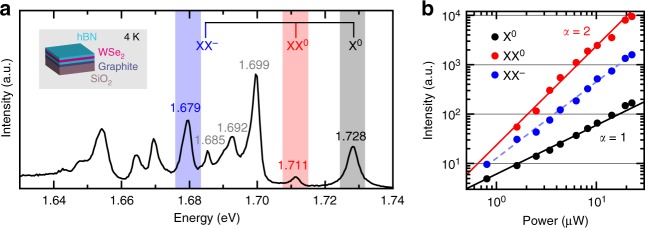
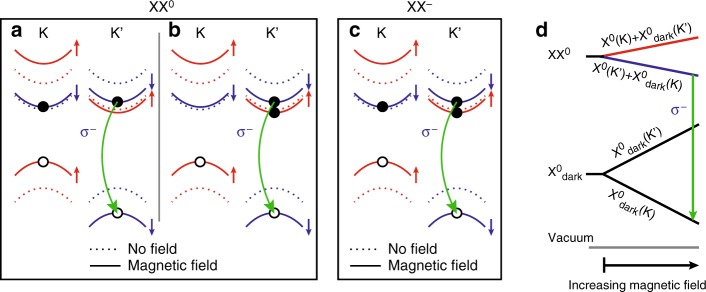
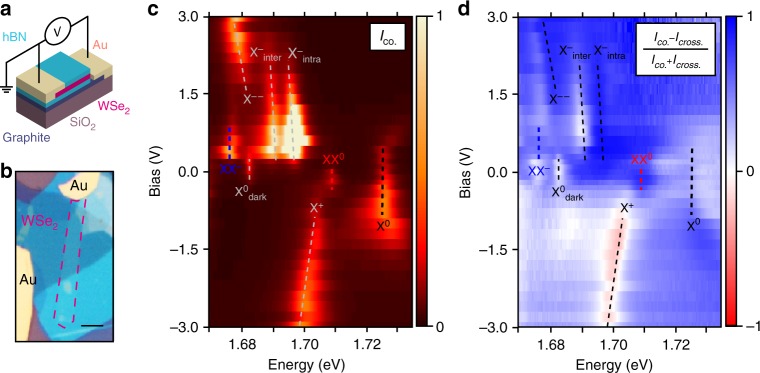
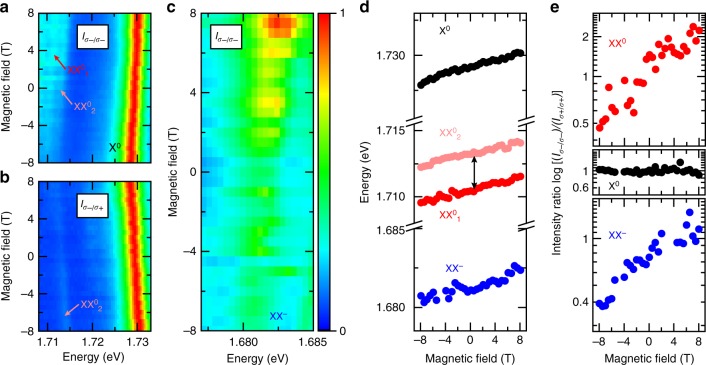
Monolayer transition metal dichalcogenides have strong Coulomb-mediated many-body interactions. Theoretical studies have predicted the existence of numerous multi-particle excitonic states. Two-particle excitons and three-particle trions have been identified by their optical signatures. However, more complex states such as biexcitons have been elusive due to limited spectral quality of the optical emission. Here, we report direct evidence of two biexciton complexes in monolayer tungsten diselenide: the four-particle neutral biexciton and the five-particle negatively charged biexciton. We distinguish these states by power-dependent photoluminescence and demonstrate full electrical switching between them. We determine the band states of the elementary particles comprising the biexcitons through magneto-optical spectroscopy. We also resolve a splitting of 2.5 meV for the neutral biexciton, which we attribute to the fine structure, providing reference for subsequent studies. Our results unveil the nature of multi-exciton complexes in transitionmetal dichalcogenides and offer direct routes towards deterministic control in many-body quantum phenomena.
单层过渡金属二卤化物具有强烈的库仑多体相互作用。理论研究预测了存在许多多粒子激子态。通过它们的光学特征已经确定了二粒子激子和三粒子三体。然而,由于光发射的光谱质量有限,更复杂的态如双激子仍然难以捉摸。在这里,我们报告了单层二硒化钨中两个双激子复合物的直接证据:四粒子中性双激子和五粒子带负电的双激子。我们通过功率依赖的光致发光来区分这些态,并证明它们之间的完全电切换。我们通过磁光光谱确定了构成双激子的基本粒子的能带态。我们还解析了中性双激子的 2.5 meV 分裂,我们将其归因于精细结构,为后续研究提供了参考。我们的结果揭示了过渡金属二卤化物中多激子复合物的性质,并为多体量子现象的确定性控制提供了直接途径。