Department of Biochemistry and Molecular Biology, Bloomberg School of Public Health, Johns Hopkins University, Baltimore, Maryland.
Department of Biochemistry and Molecular Biology, Bloomberg School of Public Health, Johns Hopkins University, Baltimore, Maryland; Department of Molecular Microbiology and Immunology, Bloomberg School of Public Health, Johns Hopkins University, Baltimore, Maryland; Department of Oncology and the Sidney Kimmel Comprehensive Cancer Center, Johns Hopkins University, Baltimore, Maryland.
Gastroenterology. 2018 Dec;155(6):1706-1715. doi: 10.1053/j.gastro.2018.08.056. Epub 2018 Sep 13.
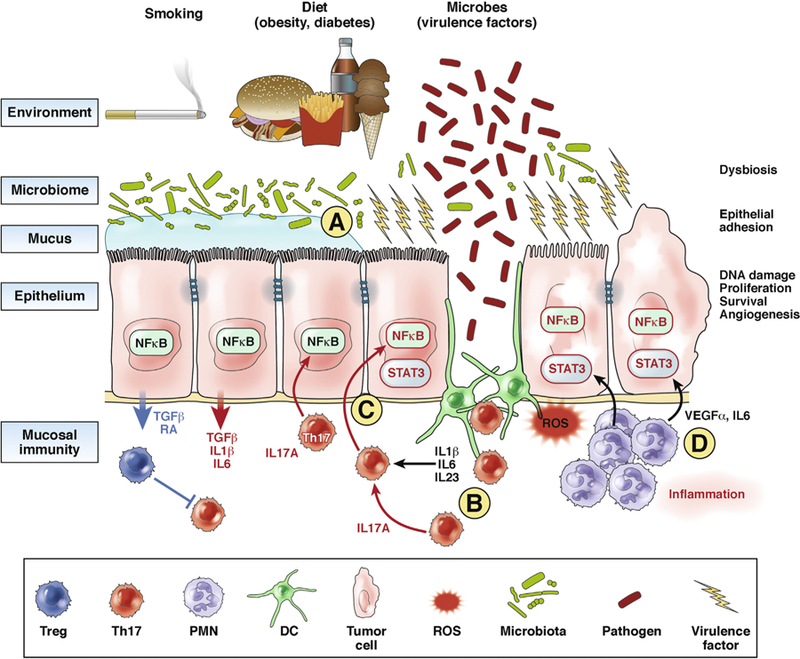
Sporadic colorectal cancer is one of the most common and lethal cancers worldwide. The locations and functions of immune cells in the colorectal tumor microenvironment are complex and heterogeneous. T-helper (Th)1 cell-mediated responses against established colorectal tumors are associated with better outcomes of patients (time of relapse-free or overall survival), whereas Th17 cell-mediated responses and production of interleukin 17A (IL17A) have been associated with worse outcomes of patients. Tumors that develop in mouse models of colorectal cancer are rarely invasive and differ in many ways from human colorectal tumors. However, these mice have been used to study the mechanisms by which Th17 cells and IL17A promote colorectal tumor initiation and growth, which appear to involve their direct effects on colon epithelial cells. Specific members of the colonic microbiota may promote IL17A production and IL17A-producing cell functions in the colonic mucosa to promote carcinogenesis. Increasing our understanding of the interactions between the colonic microbiota and the mucosal immune response, the roles of Th17 cells and IL17 in these interactions, and how these processes are altered during colon carcinogenesis, could lead to new strategies for preventing or treating colorectal cancer.
散发性结直肠癌是全球最常见和最致命的癌症之一。结直肠肿瘤微环境中免疫细胞的位置和功能复杂且具有异质性。针对已建立的结直肠肿瘤的辅助性 T 细胞 1(Th1)细胞介导的反应与患者更好的预后(无复发生存或总生存时间)相关,而 Th17 细胞介导的反应和白细胞介素 17A(IL17A)的产生与患者的预后较差相关。在结直肠癌小鼠模型中发展的肿瘤很少具有侵袭性,并且在许多方面与人类结直肠肿瘤不同。然而,这些小鼠已被用于研究 Th17 细胞和 IL17A 促进结直肠肿瘤起始和生长的机制,这些机制似乎涉及它们对结肠上皮细胞的直接作用。结肠微生物群的特定成员可能促进 IL17A 的产生和结肠黏膜中 IL17A 产生细胞的功能,以促进癌变。增加我们对结肠微生物群与黏膜免疫反应之间相互作用的理解、Th17 细胞和 IL17 在这些相互作用中的作用,以及这些过程在结直肠癌变过程中如何发生改变,可能会为预防或治疗结直肠癌提供新的策略。