Laboratório de Ecologia Química de Insetos Vetores, Departamento de Parasitologia, Instituto de Ciências Biológicas, Universidade Federal de Minas Gerais, Belo Horizonte, Brazil.
Environmental Health and Ecological Sciences Department, Ifakara Health Institute, Ifakara, Tanzania.
PLoS One. 2018 Oct 8;13(10):e0205358. doi: 10.1371/journal.pone.0205358. eCollection 2018.
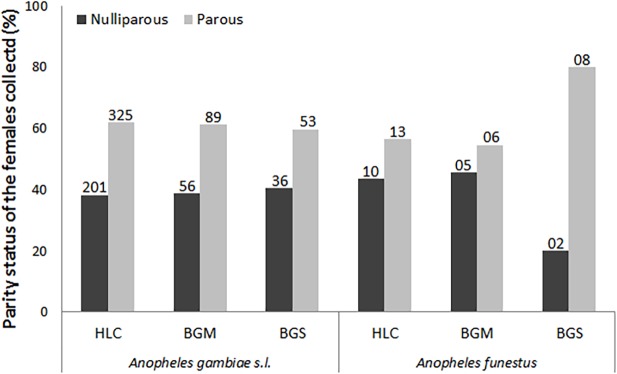
BG-Malaria (BGM) trap is a simple adaptation of the widely-used BG-Sentinel trap (BGS). It is proven to be highly effective for trapping the Brazilian malaria vector, Anopheles darlingi, in field conditions, and the African vector, Anopheles arabiensis, under controlled semi-field environments, but has not been field-tested in Africa. Here, we validated the BGM for field sampling of malaria vectors in south-eastern Tanzania. Using a series of Latin-Square experiments conducted nightly (6pm-7am) in rural villages, we compared mosquito catches between BGM, BGS and human landing catches (HLC). We also compared BGMs baited with different attractants (Ifakara-blend, Mbita-blend, BG-Lure and CO2). Lastly, we tested BGMs baited with Ifakara-blend from three odour-dispensing methods (BG-Cartridge, BG-Sachet and Nylon strips). One-tenth of the field-collected female Anopheles gambiae s.l. and Anopheles funestus were dissected to assess parity. BGM captured more An. gambiae s.l. than BGS (p < 0.001), but HLC caught more than either trap (p < 0.001). However, BGM captured more An. funestus than HLC. Proportions of parous An. gambiae s.l. and An. funestus consistently exceeded 50%, with no significant difference between methods. While the dominant species caught by HLC was An. gambiae s.l. (56.0%), followed by Culex spp. (33.1%) and Mansonia spp. (6.0%), the BGM caught mostly Culex (81.6%), followed by An. gambiae s.l. (10.6%) and Mansonia (5.8%). The attractant-baited BGMs were all significantly superior to un-baited controls (p < 0.001), although no difference was found between the specific attractants. The BG-Sachet was the most efficient dispenser for capturing An. gambiae s.l. (14.5(2.75-42.50) mosquitoes/trap/night), followed by BG-Cartridge (7.5(1.75-26.25)). The BGM caught more mosquitoes than BGS in field-settings, but sampled similar species diversity and physiological states as BGS. The physiological states of malaria vectors caught in BGM and BGS were similar to those naturally attempting to bite humans (HLC). The BGM was most efficient when baited with Ifakara blend, dispensed from BG-Sachet. We conclude that though BGM traps have potential for field-sampling of host-seeking African malaria vectors with representative physiological states, both BGM and BGS predominantly caught more culicines than Anopheles, compared to HLC, which caught mostly An. gambiae s.l.
BG-疟疾(BGM)诱捕器是一种广泛使用的 BG-哨兵诱捕器(BGS)的简单改编。它已被证明在野外条件下对捕获巴西疟蚊(Anopheles darlingi)非常有效,在半野外控制环境下对捕获非洲疟蚊(Anopheles arabiensis)非常有效,但尚未在非洲进行实地测试。在这里,我们验证了 BGM 在坦桑尼亚东南部进行疟疾媒介现场采样的有效性。使用一系列在农村村庄进行的夜间(6 点至 7 点)拉丁方实验,我们比较了 BGM、BGS 和人类着陆捕获(HLC)之间的蚊子捕获量。我们还比较了用不同引诱剂(Ifakara 混合物、Mbita 混合物、BG-Lure 和 CO2)诱饵的 BGM。最后,我们测试了用三种气味分配方法(BG-墨盒、BG-香包和尼龙条)诱饵的 Ifakara 混合物的 BGM。现场收集的雌性冈比亚按蚊和曼蚊的十分之一被解剖以评估产仔数。BGM 捕获的冈比亚按蚊多于 BGS(p<0.001),但 HLC 捕获的多于任何一种诱捕器(p<0.001)。然而,BGM 捕获的曼蚊多于 HLC。产仔的冈比亚按蚊和曼蚊的比例始终超过 50%,不同方法之间没有显著差异。虽然 HLC 捕获的主要物种是冈比亚按蚊(56.0%),其次是库蚊属(33.1%)和曼蚊属(6.0%),但 BGM 主要捕获库蚊(81.6%),其次是冈比亚按蚊(10.6%)和曼蚊属(5.8%)。用引诱剂诱饵的 BGM 均明显优于未诱饵对照(p<0.001),尽管特定引诱剂之间没有差异。BG-香包是捕获冈比亚按蚊(14.5(2.75-42.50)只/诱捕器/夜)最有效的分配器,其次是 BG-墨盒(7.5(1.75-26.25))。BGM 在野外环境中比 BGS 捕获的蚊子多,但采样的物种多样性和生理状态与 BGS 相似。BGM 和 BGS 捕获的疟蚊的生理状态与自然试图叮咬人类的蚊子(HLC)相似。用 Ifakara 混合物诱饵的 BGM 效果最好,从 BG-香包中分配。我们得出结论,尽管 BGM 诱捕器具有在野外采样具有代表性生理状态的非洲疟疾媒介的潜力,但与 HLC 相比,BGM 和 BGS 主要捕获更多的库蚊属,而不是按蚊属,而 HLC 主要捕获冈比亚按蚊(An. gambiae s.l.)。