Department of Urology, Fudan University Shanghai Cancer Center, Shanghai, China.
Department of Oncology, Shanghai Medical College, Fudan University, Shanghai, China.
Cancer Med. 2018 Nov;7(11):5431-5438. doi: 10.1002/cam4.1790. Epub 2018 Oct 10.
To compare the predictive value of the current AJCC stage grouping for renal cell carcinoma (RCC) to our modifications.
A total of 2120 patients with RCC from Fudan University Shanghai Cancer Center (FUSCC) database and 74 506 counterparts from SEER database were included. Cox regression was used to calculate the relative impacts between prognostic groups. The predictive accuracy of overall survival (OS) was assessed using the concordance index (C-index), which was compared by likelihood ratio test.
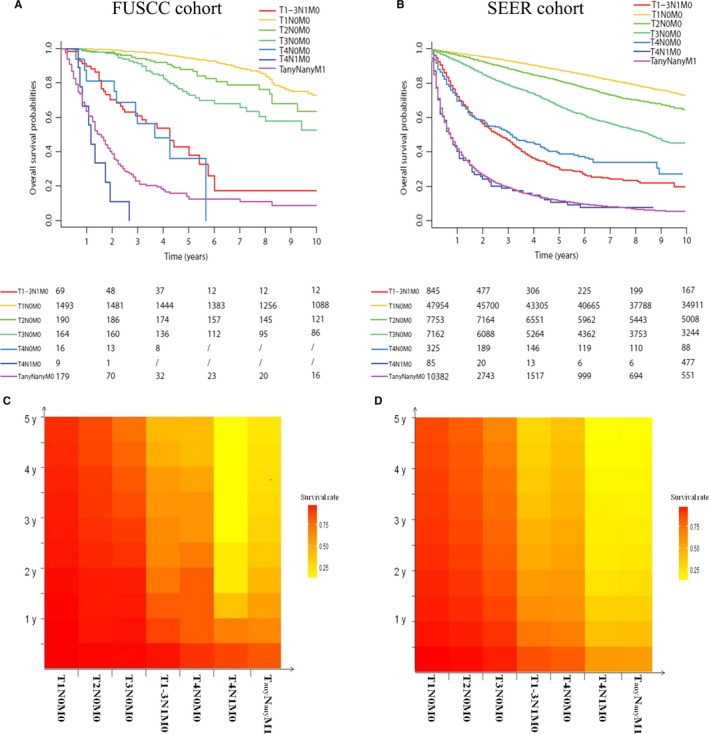
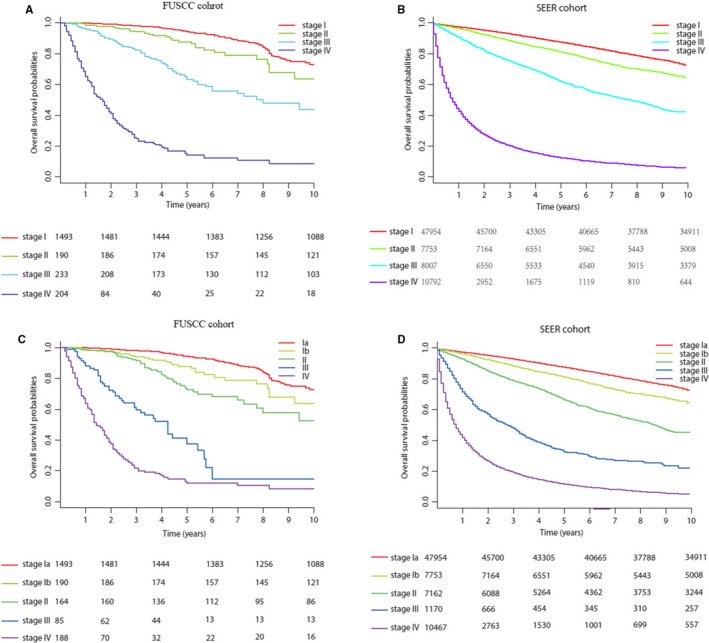
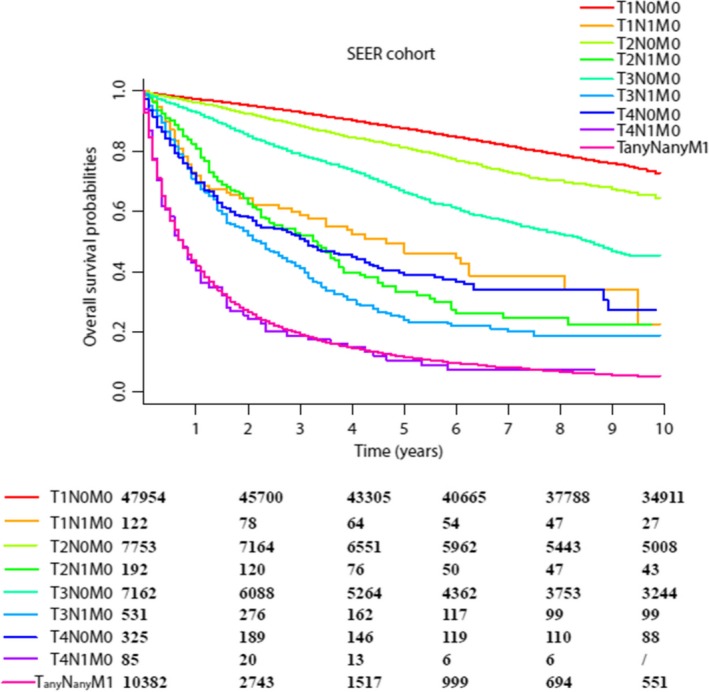
In FUSCC cohort, the 5-year-OS rate for T3N0M0 patients was higher than T1-3N1M0 (72.7% vs 38.1%). The 5-year-OS rate for T4N0M0 was 36.2%, which was close to T1-3N1M0 but not to T4N1M0 (0%) and TanyNanyM1 (12.6%). The elements of AJCC groups were regrouped according to the ranks of hazard ratios. The modified stages II (T3N0M0), III (T1-3N1M0, T4N0M0), and IV (T4N1M0, TanyNanyM1) exhibited greater survival stratification than AJCC groups. The modifications were validated in SEER cohort and yielded similar survival outcomes. The predictive accuracy of OS in modified prognostic groups was significantly higher than AJCC groups in stages II-IV subgroups in both FUSCC (C-index: 0.801 vs 0.779, P < 0.001) and SEER cohort (C-index: 0.770 vs 0.764, P < 0.001).
The modified AJCC prognostic groups for RCC provided significantly improved survival prediction compared with the 8th AJCC edition. A precise risk stratification of modified stages II-IV disease provides an important basis for risk-equivalent treatment recommendation.
本研究旨在比较当前 AJCC 分期系统与我们改良后的分期系统对肾细胞癌(RCC)的预测价值。
本研究共纳入来自复旦大学附属肿瘤医院(FUSCC)数据库的 2120 例 RCC 患者和 SEER 数据库的 74506 例对照患者。采用 Cox 回归计算预后组之间的相对影响。采用一致性指数(C-index)评估总生存(OS)的预测准确性,并通过似然比检验进行比较。
在 FUSCC 队列中,T3N0M0 患者的 5 年 OS 率高于 T1-3N1M0(72.7% vs 38.1%)。T4N0M0 患者的 5 年 OS 率为 36.2%,接近 T1-3N1M0,但与 T4N1M0(0%)和 TanyNanyM1(12.6%)不同。根据风险比的等级重新分组 AJCC 分期组。改良的 II 期(T3N0M0)、III 期(T1-3N1M0、T4N0M0)和 IV 期(T4N1M0、TanyNanyM1)比 AJCC 分期组具有更好的生存分层。改良后的分期在 SEER 队列中得到验证,产生了相似的生存结果。在 FUSCC(C-index:0.801 vs 0.779,P<0.001)和 SEER 队列(C-index:0.770 vs 0.764,P<0.001)中,改良后的 II-IV 期亚组的 OS 预测准确性明显高于 AJCC 组。
与第 8 版 AJCC 相比,改良后的 AJCC 预后组对 RCC 的生存预测有显著改善。改良的 II-IV 期疾病的精确风险分层为风险等效治疗建议提供了重要依据。