Department of Biomedical Engineering, School of Biomedical Engineering & Imaging Sciences, King's College London, London, UK.
Centre for Medical Image Computing and Department of Computer Science, University College London, London, UK.
Sci Rep. 2018 Oct 11;8(1):15138. doi: 10.1038/s41598-018-33463-2.
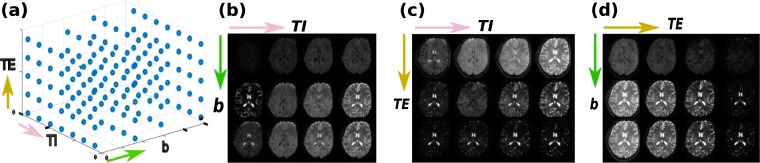
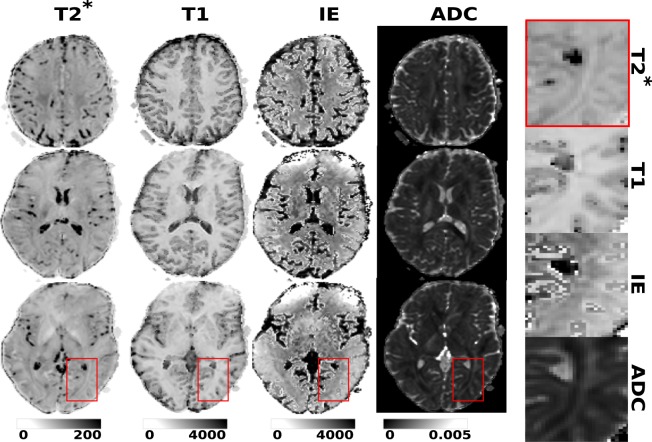
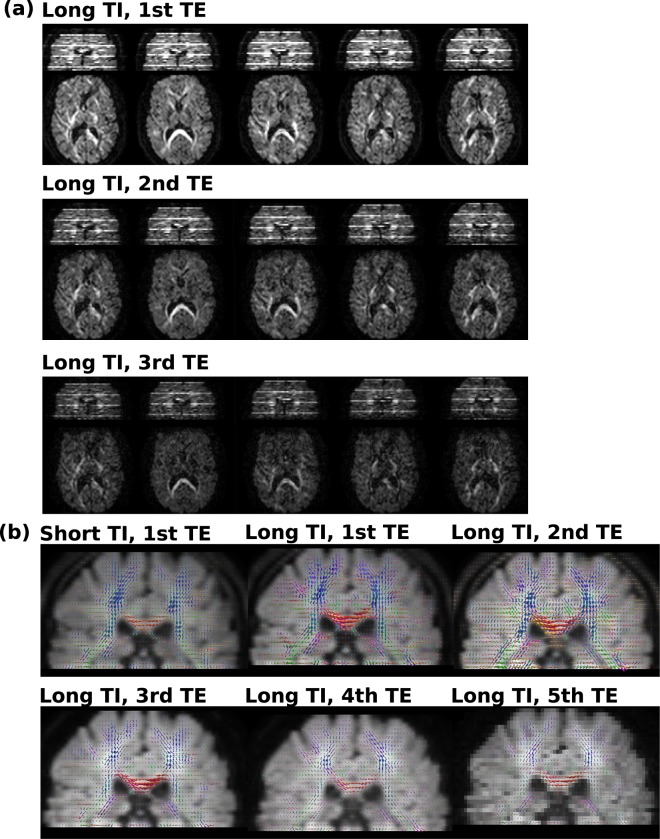
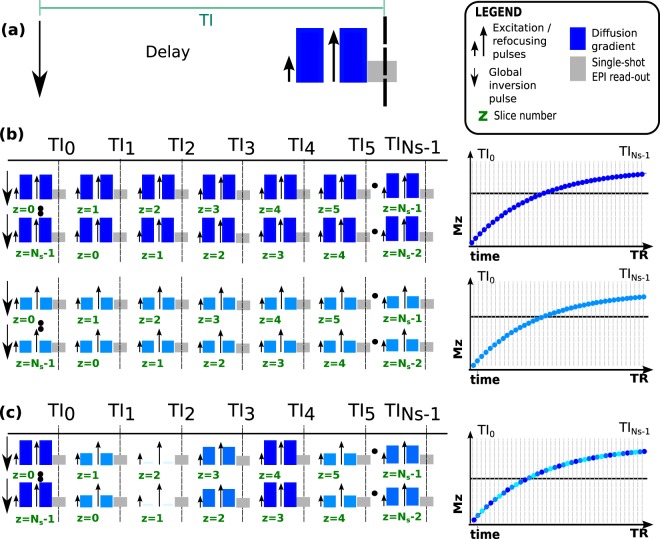
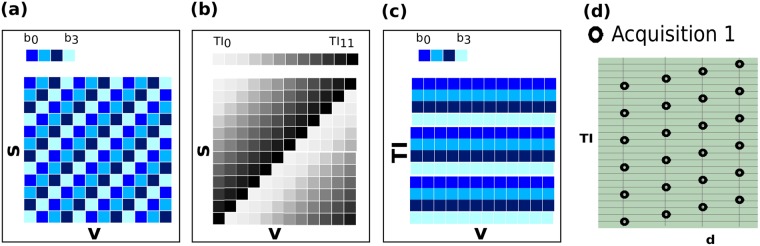
The emergence of multiparametric diffusion models combining diffusion and relaxometry measurements provides powerful new ways to explore tissue microstructure, with the potential to provide new insights into tissue structure and function. However, their ability to provide rich analyses and the potential for clinical translation critically depends on the availability of efficient, integrated, multi-dimensional acquisitions. We propose a fully integrated sequence simultaneously sampling the acquisition parameter spaces required for T1 and T2* relaxometry and diffusion MRI. Slice-level interleaved diffusion encoding, multiple spin/gradient echoes and slice-shuffling are combined for higher efficiency, sampling flexibility and enhanced internal consistency. In-vivo data was successfully acquired on healthy adult brains. Obtained parametric maps as well as clustering results demonstrate the potential of the technique to provide eloquent data with an acceleration of roughly 20 compared to conventionally used approaches. The proposed integrated acquisition, which we call ZEBRA, offers significant acceleration and flexibility compared to existing diffusion-relaxometry studies, and thus facilitates wider use of these techniques both for research-driven and clinical applications.
多参数扩散模型的出现结合了扩散和弛豫测量,为探索组织微观结构提供了强大的新方法,有可能为组织结构和功能提供新的见解。然而,它们提供丰富分析的能力和临床转化的潜力,严重依赖于高效、集成、多维采集的可用性。我们提出了一种完全集成的序列,同时对 T1 和 T2*弛豫和扩散 MRI 所需的采集参数空间进行采样。层内扩散编码、多个自旋/梯度回波和切片交换相结合,可提高效率、采样灵活性和增强内部一致性。在健康成人大脑上成功采集了体内数据。获得的参数图和聚类结果表明,该技术具有提供生动数据的潜力,与传统方法相比,加速约 20 倍。与现有的扩散-弛豫研究相比,所提出的集成采集(我们称之为 ZEBRA)提供了显著的加速和灵活性,从而促进了这些技术在研究驱动和临床应用中的更广泛应用。