Department of Chemistry, University of Bari Aldo Moro, Via E. Orabona 4, Bari, 70126, Italy.
School of Engineering, Newcastle University, Stephenson Building, Claremont Road, Newcastle upon Tyne, NE1 7RU, UK.
Sci Rep. 2018 Oct 11;8(1):15130. doi: 10.1038/s41598-018-33472-1.
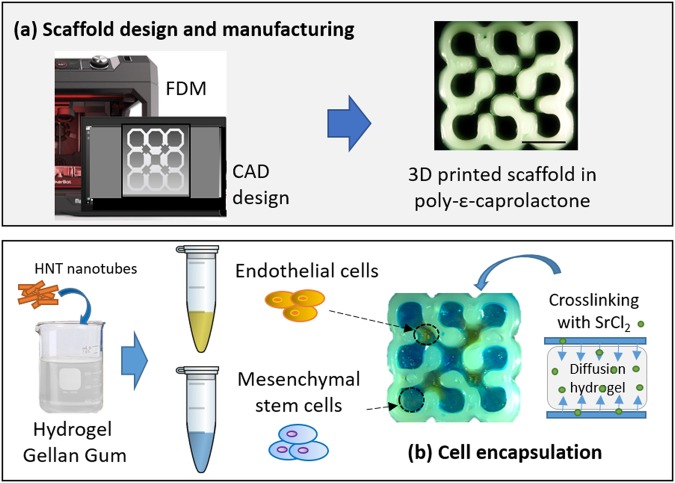
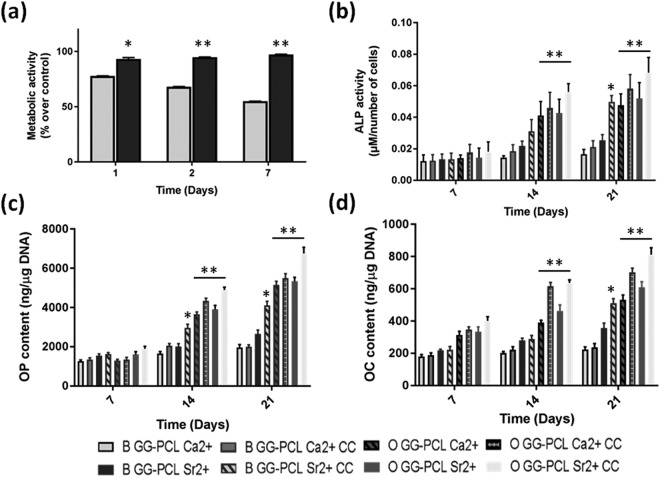
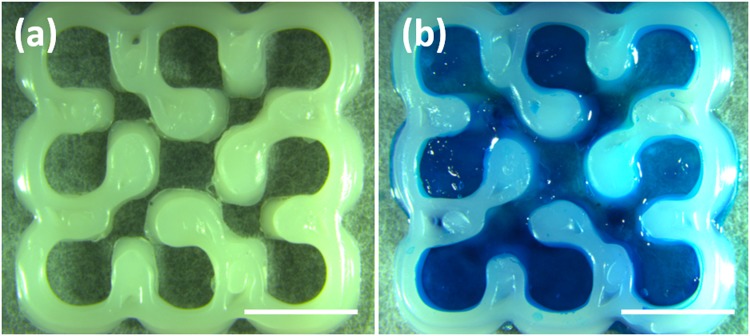
The development of in vitro 3D models to get insights into the mechanisms of bone regeneration could accelerate the translation of experimental findings to the clinic, reducing costs and duration of experiments. This work explores the design and manufacturing of multi-compartments structures in poly(ε-caprolactone) (PCL) 3D-printed by Fused Filament Fabrication technique. The construct was designed with interconnected stalls to host stem cells and endothelial cells. Cells were encapsulated within an optimised gellan gum (GG)-based hydrogel matrix, crosslinked using strontium (Sr) ions to exploit its bioactivity and finally, assembled within compartments with different sizes. Calcium (Ca)-crosslinked gels were also used as control for comparison of Sr osteogenic effect. The results obtained demonstrated that Sr ions were successfully diffused within the hydrogel matrix and increased the hydrogel matrix strength properties under compressive load. The in vitro co-culture of human-TERT mesenchymal stem cells (TERT- hMSCs) and human umbilical vein endothelial cells (HUVECs), encapsulated within Sr ions containing GG-hydrogels and inter-connected by compartmentalised scaffolds under osteogenic conditions, enhanced cell viability and supported osteogenesis, with a significant increase of alkaline phosphatase activity, osteopontin and osteocalcin respect with the Ca-crosslinked GG-PCL scaffolds. These outcomes demonstrate that the design and manufacturing of compartmentalised co-culture of TERT-hMSCs and HUVEC populations enables an effective system to study and promote osteogenesis.
体外 3D 模型的发展可以深入了解骨再生的机制,从而加速将实验发现转化为临床应用,降低实验成本和周期。本工作探索了通过熔融沉积制造技术设计和制造聚己内酯(PCL)多腔结构。该结构设计为带有互连隔室,以容纳干细胞和内皮细胞。细胞被封装在优化的结冷胶(GG)基水凝胶基质中,使用锶(Sr)离子交联以利用其生物活性,最后在具有不同尺寸的隔室中组装。还使用钙(Ca)交联凝胶作为 Sr 成骨效应比较的对照。结果表明,Sr 离子成功扩散到水凝胶基质中,并在压缩载荷下提高了水凝胶基质的强度特性。在体外共培养人端粒酶反转录酶(TERT)间充质干细胞(TERT-hMSCs)和人脐静脉内皮细胞(HUVECs),封装在含有 Sr 离子的 GG-水凝胶中,并在成骨条件下通过分腔支架相互连接,提高了细胞活力并支持成骨作用,碱性磷酸酶活性、骨桥蛋白和骨钙素的含量显著增加,与 Ca 交联的 GG-PCL 支架相比。这些结果表明,设计和制造 TERT-hMSCs 和 HUVEC 群体的分腔共培养能够提供一个有效的系统来研究和促进成骨作用。